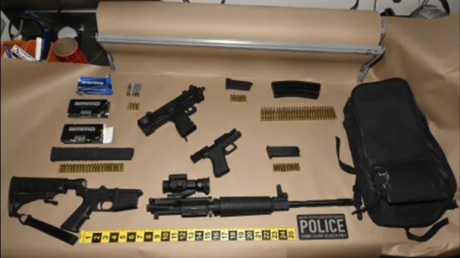
On the evening of Thursday, November 5, 2026, U.S. Secret Service officers approached a suspiciously parked car on the 1600 block of Constitution Avenue NW, just steps from the White House Ellipse. Inside sat 26-year-old Ronny Yordrix Guanipa Chrinos, a stolen vehicle, an AR-15-style rifle, a MAC-10 submachine gun, a Glock 43X handgun, and dozens of rounds of ammunition. When questioned, Chrinos told officers he had traveled to Washington because voices in his head ordered him to kill President Donald Trump.
Most news outlets treated the arrest as a two-minute wire blotter item. They repeated the Department of Homeland Security press release, noted the firearms, and moved on to the next midterm election post-mortem. That superficial coverage misses the real story. When you look past the sensational quote about auditory hallucinations, you find a convergence of three systemic failures that continue to leave the highest office in the country exposed to lone-actor attacks.
Anatomy of an Intercepted Attack
The facts of the November 5 stop are deceptively simple. Uniformed Secret Service officers patrolling the southern edge of the White House complex noticed a vehicle idling in a manner that broke the normal rhythm of late-evening D.C. traffic.
They approached. Chrinos did not flee, nor did he reach for the arsenal sitting within arm's length. Instead, he volunteered a confession that immediately shifted a routine suspicious-vehicle check into a federal threat investigation. A quick check of the plates revealed the car was stolen. A subsequent search turned up a loadout designed for sustained, close-quarters combat—not self-defense.
The weapons recovered tell a specific story about lethality and procurement:
- An AR-15-style rifle, built for intermediate-range accuracy and rapid follow-up shots.
- A MAC-10, an open-bolt, high-rate-of-fire firearm notorious in urban law enforcement circles for spray-and-pray suppression.
- A Glock 43X, a slim, easily concealed 9mm pistol typically used as a backup weapon.
Chrinos, a Venezuelan national who entered the United States illegally through Texas in March 2024 and was subsequently released by Border Patrol, had managed to acquire a stolen vehicle and three distinct classes of firearms before parking within line-of-sight of the South Lawn. He was placed in U.S. Marshals Service custody under an immigration detainer while federal prosecutors assembled charges.
The Myth of the Mastermind Assassin
Whenever a suspect claims to hear voices, public discourse immediately splits into two predictable camps. One side dismisses the threat as the harmless rambling of a severely ill man. The other treats it as proof of a calculated political conspiracy. Both interpretations misunderstand the history of American presidential assassinations.
In the protective intelligence community, severe untreated psychosis is not a mitigating factor. It is an accelerant.
Command hallucinations—voices that issue direct orders—strip away the self-preservation instincts that deter rational actors. A politically motivated operative worries about escape routes, surveillance cameras, and counter-sniper teams. A person acting under the compulsion of command hallucinations often views death or capture as irrelevant to the mission. That psychological profile makes them harder to deter with standard visible security measures.
Historical precedent backs this up. From Richard Lawrence misfiring two flintlock pistols at Andrew Jackson in 1835 to John Hinckley Jr. shooting Ronald Reagan in 1981, the vast majority of individuals who successfully breach presidential security are not disciplined ideological soldiers. They are isolated, deteriorating individuals whose internal delusions fixate on the ultimate symbol of authority.
Why Fixation Gravitates Toward the White House
Psychiatrists who study threat assessment call it target fixation. When an individual's grip on reality fractures, the brain searches for an external source to blame for internal chaos. Because the President of the United States dominates every television screen, news feed, and street-corner conversation, the office becomes a lightning rod for paranoid ideation.
The geography of Washington amplifies this magnetic pull. Unlike foreign heads of state who reside behind miles of restricted military buffers, the White House sits directly inside a dense, walkable downtown grid. Tourists, commuters, and protestors pass within a few hundred feet of the residence every minute. For someone experiencing a mental health crisis, the physical accessibility of Pennsylvania Avenue and Constitution Avenue creates the illusion that the target is within easy reach.
Where the Protective Net Actually Broke
Homeland Security Secretary Markwayne Mullin praised the arresting officers for stopping Chrinos before anyone was hurt. The praise is warranted. Street-level vigilance worked on November 5.
Yet relying on a patrol officer to notice a weirdly parked car on Constitution Avenue is the absolute last line of defense. By the time a suspect is sitting in a stolen car on the 1600 block with a MAC-10 on the seat, multiple upstream systems have already failed.
First, consider the firearms acquisition pipeline. Under federal law, an individual in the country without legal status is strictly prohibited from possessing firearms or ammunition. Chrinos bypassed every background check and waiting period in the book. Whether those guns were stolen alongside the vehicle, purchased through unvetted private transfers, or sourced through underground trafficking networks, the result is identical. Paper prohibitions do not stop determined or psychotic actors when secondary markets remain flooded with untraceable hardware.
Second, look at the immigration and vetting gap. DHS officials were quick to highlight that Chrinos was apprehended at the Texas border in March 2024 and released into the interior. When millions of migrants are processed under strained administrative capacity, initial screenings check for existing criminal records in accessible databases. They cannot screen for latent psychiatric deterioration that manifests two years later, nor does the federal government maintain an active monitoring apparatus for individuals awaiting court dates.
Third, examine the mental health vacuum. Individuals experiencing acute auditory hallucinations rarely go from stable to armed overnight. There is almost always a visible trail of erratic behavior, missed shelter check-ins, or emergency room visits. Because HIPAA privacy laws, underfunded municipal crisis teams, and fragmented state reporting systems rarely communicate with federal threat assessment units, a man spiraling into violent psychosis can cross state lines in a stolen car without triggering a single red flag.
The White House Security Paradox
The November 5 arrest did not happen in a vacuum. It occurred during one of the most volatile stretches for White House perimeter security in modern memory.
In October 2025, a driver rammed a vehicle into a security barricade near the complex. Another vehicle-ramming incident followed in March 2026. In April 2026, a gunman breached security during the White House Correspondents' Dinner at the Washington Hilton while the President and First Lady were inside, wounding a Secret Service officer. In May, another gunman opened fire near the complex. By September, Secret Service police were arresting drivers who had driven directly onto sidewalks adjacent to the grounds.
Every time an incident occurs, the immediate institutional reflex is to harden the physical perimeter. Tall anti-scaling fences go up. Concrete bollards multiply. A federal panel recently approved a massive redesign for a permanent, fortified White House security screening facility to replace the temporary trailers that have sat on the southeastern edge of the grounds for two decades.
You can build a thirty-foot wall around the Executive Mansion, and a man in a stolen car will still drive up to the outer curb with a rifle.
Hardening the building only pushes the confrontation outward into the public streets of the capital. Constitution Avenue cannot be closed to civilian traffic without paralyzing the federal district. That reality forces the Secret Service Uniformed Division to operate less like palace guards and more like hyper-alert beat cops working a high-stakes neighborhood.
The Exhaustion Factor Inside the Uniformed Division
Ask any veteran of the Secret Service about the hidden vulnerability of this posture, and they will point to manpower and fatigue. The agency has spent years battling chronic attrition, mandatory overtime, and grueling shift schedules.
Detecting a threat like Chrinos requires sharp pattern recognition. An officer has to distinguish between a lost tourist checking GPS directions on Constitution Avenue and a psychotic gunman waiting for the voices in his head to say go. When officers are working twelve-hour shifts back-to-back, cognitive fatigue sets in. The margin between catching a suspect before he exits the vehicle and responding to gunfire on the sidewalk narrows to seconds.
Political Weaponization Versus Operational Reality
Within hours of the arrest, the incident was absorbed into Washington's partisan machinery. The DHS press release explicitly framed Chrinos as a "criminal illegal alien, released into our country by the Biden Administration," turning a complex threat-assessment failure into ammunition for ongoing immigration battles. Meanwhile, critics of the administration downplayed the incident or focused solely on the gun-control angle.
This political tug-of-war actively harms protective security. When every near-miss is reduced to a talking point about border policy or Second Amendment politics, the operational lessons get buried.
Border enforcement alone would not have stopped the domestic citizens who breached White House security earlier in 2026. Gun laws alone do not stop a man willing to steal a car and buy black-market weapons. Psychiatric intervention alone cannot catch someone who actively hides his symptoms until he parks outside the Ellipse.
What Actual Prevention Demands
If federal authorities want to stop the next Ronny Yordrix Guanipa Chrinos before he reaches the 1600 block of Constitution Avenue, the response cannot stop at congratulating the arresting officers or pouring more concrete around the South Lawn.
It requires integrating behavioral threat assessment with local law enforcement data so stolen vehicles and erratic 911 calls near high-profile targets trigger automated alerts. It requires aggressive federal task forces dedicated to tracing and dismantling the illicit pipeline that puts military-style rifles and open-bolt submachine guns into the hands of prohibited buyers. And it demands restoring the Secret Service Uniformed Division to full staffing levels so the officers walking the perimeter are operating at peak alertness rather than surviving on overtime.
On November 5, a pair of alert officers walked up to a suspicious car and prevented a mass-casualty event on the doorstep of the presidency. Relying on that kind of street-level luck is not a security strategy.
For further reporting on the arrest and the weapons recovered from the vehicle, view the CNN report on the White House arrest, which details the Secret Service's initial response to the incident.



