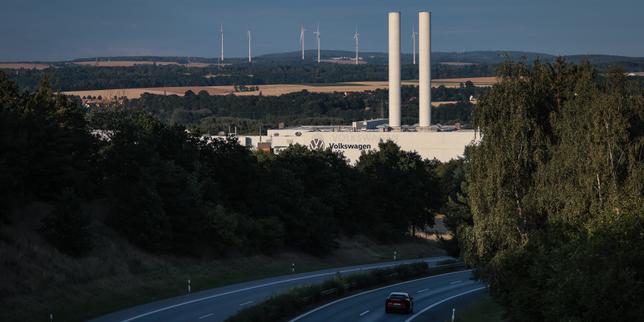
Volkswagen is staring down an existential abyss, and the people on the factory floor are paying for decades of corporate myopia. When CEO Oliver Blume stepped onto the stage at the Wolfsburg headquarters to face ten thousand hostile workers, he wasn't just addressing a routine corporate overhaul. He was fronting the most violent collision between traditional European manufacturing and modern economic reality in automotive history.
The numbers floating through Lower Saxony are staggering. Management argues that the automaker suffers from a thirty percent overhead cost disadvantage compared to global competitors, creating an untenable financial drain. To bridge that gap, executive leadership has outlined a restructuring framework that places tens of thousands of jobs in jeopardy, alongside intense scrutiny directed at key German manufacturing plants.
Yet, focusing strictly on the raw headcount misses the deeper institutional failure. This crisis is not merely a byproduct of sudden market shifts. It is the accumulated interest on years of strategic complacency, missed technological turns, and an over-reliance on a domestic model that no longer functions in a fractured global economy.
The Anatomy of a Structural Deficit
How does a titan of European industry find itself scrambling to preserve basic operational viability? The answer lies in a toxic mix of slow adaptation to battery-electric architectures and a devastating contraction in the Chinese market. For decades, Volkswagen treated China as an endless cash machine, funding domestic German labor pacts with massive margins generated overseas. When local Chinese manufacturers rapidly outpaced European legacy brands in software sophistication and affordable electric vehicle production, that cash machine stuttered, then stalled.
At home, the structural overhead became an anchor. Germany's rigid industrial model, characterized by powerful works councils, co-determination laws, and high legacy costs, makes pivoting nearly impossible without brutal friction. Management failed to anticipate that the transition away from internal combustion engines would require fewer assembly hours per vehicle, leaving legacy factories dramatically overstaffed relative to actual output demands.
Facilities in Emden, Zwickau, Hanover, and the Audi site in Neckarsulm now face grim projections regarding their capacity utilization into the next decade. Plants originally engineered to pump out millions of internal combustion units are struggling to find profitable equilibrium as production lines shift toward lower-volume electric platforms.
The Communication Breakdown and the Cost of Lost Trust
Beyond the balance sheets lies a secondary crisis of leadership credibility. Volkswagen's internal works council recently published survey data revealing that employees and their families feel deeply unsettled and frightened by what they characterized as disastrous external communication from the board.
When executives leak potential plant closures and massive downsizing figures to the press before hammering out details with labor representatives, they shatter the delicate psychological contract underpinning Germany's co-determination system. Works Council Chair Daniela Cavallo did not mince words, pointing out that trust in top leadership has taken a severe blow.
Trust is not a soft metric in industrial manufacturing. Without it, plant floors become breeding grounds for passive resistance, absenteeism, and plummeting productivity. When workers feel they are bearing the full weight of executive miscalculation, cooperation evaporates. Blume faces the unenviable task of convincing labor leaders to accept painful structural modifications while simultaneously repairing a fractured relationship that his own team's public posturing damaged.
The Geopolitical Trap
Compounding these internal wounds are external pressures that Volkswagen cannot control through cost-cutting alone. Rising trade barriers and impending United States tariffs threaten to upend export models that have traditionally protected German profit margins.
Consider a hypothetical example to understand this vulnerability. If an automaker designs a vehicle platform with specific margin assumptions tied to open global trade corridors, the sudden imposition of heavy regional tariffs instantly obliterates those calculations, turning a profitable export line into a cash-negative liability. Volkswagen finds itself caught between US trade walls and aggressive Chinese domestic discounting, squeezed from both sides of the industrial spectrum.
The company is attempting to navigate this maze by exploring sweeping organizational changes, including potential carve-outs of specific divisions and aggressive early-retirement programs. Yet every option carries severe risks. Carving out profitable segments to raise quick capital risks hollowing out the core enterprise, leaving the traditional mass-market manufacturing arm even more exposed to cyclical downturns.
The Road Through Wolfsburg
The path forward requires more than trimming fat from payrolls. Volkswagen must fundamentally redesign how it builds automobiles, shedding the bureaucratic bloat that accumulated during decades of undisputed market dominance.
If management proceeds by decree, bypassing the hard work of genuine negotiation, the resulting labor unrest will paralyze production lines precisely when the company needs operational agility the most. The meetings currently taking place across German manufacturing sites will determine whether Europe's largest carmaker manages a controlled descent into a leaner future or fractures under the weight of its own historical contradictions.
The era of subsidized complacency is over, and the reckoning on the factory floor has only just begun.