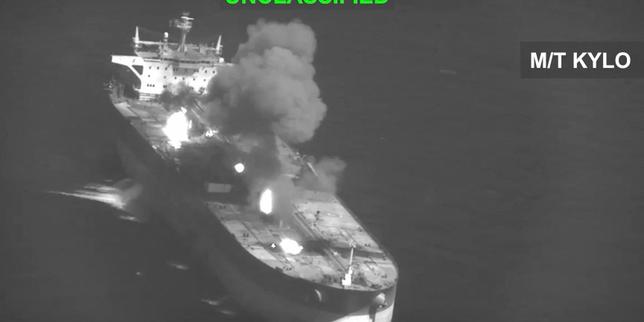
The United States military struck three Iranian crude oil tankers in a rapid retaliatory escalation after Islamic Revolutionary Guard Corps (IRGC) missiles targeted an American aircraft carrier and a guided-missile destroyer patrolling near the Strait of Hormuz. Central Command confirmed that while the warships successfully evaded the unprovoked strikes and suffered zero casualties, the subsequent American response codified an aggressive new doctrine. Washington is no longer merely defending shipping lanes from collateral damage; it has officially embraced a tit-for-tat economic targeting strategy designed to dismantle the financial infrastructure keeping Tehran afloat.
The Anatomy of an Escalation
For months, the naval confrontation in the Persian Gulf operated under a messy set of unwritten rules. American and allied warships intercepted incoming munitions, secured commercial merchant vessels, and enforced a tightening blockade on Iranian ports. Tehran pushed back through asymmetric means, relying on its shadow fleet of aging oil carriers to smuggle crude and fund regional proxies.
That fragile containment broke down completely when the IRGC shifted from harassing commercial traffic to directly engaging U.S. naval assets with ballistic missiles. The response from U.S. Central Command was immediate and arithmetic. As Admiral Brad Cooper bluntly outlined, if Tehran targets two American ships, the military will impose a higher economic price by taking out three of theirs.
Two of the targeted Iranian vessels were permanently disabled in their engine rooms, while a third unladen tanker in the Gulf of Oman was completely destroyed, forcing its crew to abandon ship. By moving the target profile from missile launchers and radar sites directly onto government-linked commercial tonnage, the White House crossed a strategic Rubicon.
Breaking the Shadow Network
To understand why hitting three tankers matters more than destroying a dozen coastal radar installations, look at the ledger. Iran has spent decades perfecting the art of sanctions evasion. A multi-billion-dollar shadow network of dark-transponder ships, shell companies, and clandestine ship-to-ship transfers allows Tehran to move oil past Western blockades and into international markets.
This fleet is the literal lifeblood of the IRGC. Traditional economic sanctions failed to cripple the regime because these floating workarounds generated just enough cash to keep the state solvent and finance proxy groups across the Middle East.
When Washington threatens to systematically erase this limited and exposed oil fleet, it targets the physical assets Iran cannot easily replace. Building a centrifuge or a missile launcher takes domestic engineering. Procuring, insuring, and operating ocean-going crude carriers under active combat conditions requires an international infrastructure that is rapidly shrinking.
The Illusion of Limited Conflict
This latest exchange shatters the political narrative that the ongoing conflict can be kept at a slow boil. Just days prior, high-level rhetoric out of Washington sought to minimize the operational friction as minor background noise, even as diplomatic channels collapsed and localized bombardments claimed civilian lives.
The friction between the elected administration of Iranian President Masoud Pezeshkian—which periodically signals a desire to reopen negotiations—and the unyielding posture of the IRGC creates a dangerous internal vacuum. Every time diplomatic avenues narrow, military commanders on both sides fill the void with ordnance.
Tehran’s military command has already promised harsher retaliation against American naval vessels if the blockade and interception campaigns persist. Yet, Iran's capacity to escalate horizontally is increasingly boxed in. Previous attempts to strike regional U.S. bases or disrupt neighboring airspace through allied air defenses yielded minimal tactical damage while inviting overwhelming counter-strikes.
The Fragile Energy Corridor
Global energy markets watch these developments with profound unease, knowing that the Strait of Hormuz remains a razor-thin bottleneck for international commerce. While a handful of merchant vessels continue to navigate the corridor daily under armed escort, the insurance risk premiums and military involvement required to keep oil flowing are structurally unsustainable over the long term.
The strategy now deployed by the Pentagon treats energy infrastructure and military deterrence as a single unified problem. By systematically squeezing the commercial vessels that fund Iran's military apparatus, the United States is betting that economic strangulation will succeed where years of diplomatic stagnation failed.
The tanker fleet burns in the Persian Gulf, and the margin for error vanishes entirely.