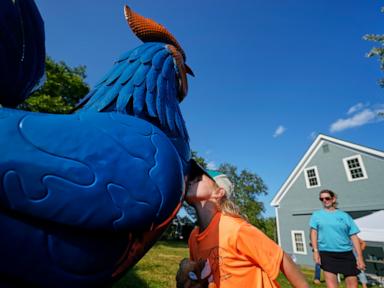
In the coastal resort enclave of Ogunquit, Maine, a bureaucratic dispute over local zoning codes has transformed a private sensory support tool into an international display of solidarity. When town officials issued fines against local restaurant owners David and Sara LeBlanc for displaying six-foot-tall metal rooster sculptures on their residential lawn, municipal code enforcement framed the issue as an straightforward violation of commercial signage rules. The family countered that the vibrant decorations served a critical non-commercial function: aiding their six-year-old autistic daughter, Pyper, with daily emotional regulation and environmental transitions. The escalating dispute highlights the rigid boundaries of municipal sign codes when confronting non-traditional sensory accommodations.
The controversy began when Ogunquit code enforcement officer Tyler McOsker cited the LeBlanc family for violating local sign ordinances, issuing $450 in initial fines. The property sits along Route 1, where the family operates The Omelette Factory, a popular local breakfast spot attached directly to their home. According to municipal inspectors, the collection of giant tin roosters on the front lawn functioned as unpermitted outdoor advertising for the restaurant. Read more on a connected topic: this related article.
Town officials pointed to circumstantial evidence to justify the enforcement action. The Omelette Factory features a stylized rooster on its official logo and branded merchandise. Additionally, municipal representatives cited a May 2025 article in a local weekly newspaper in which a reporter characterized the sculptures as a quirky way to announce the restaurant was open for business.
David LeBlanc disputed that characterization directly during public hearings. He clarified that the quote stemmed from a customer's joke rather than a commercial strategy. Additional analysis by NBC News explores similar perspectives on this issue.
"Roosters don't lay eggs," LeBlanc stated, emphasizing that the sculptures were never designed to drive sales or advertise egg dishes.
The Sensory Science Behind Decorative Sculptures
To understand why a family would incur thousands of dollars in legal fees and municipal fines over lawn decorations, one must look closely at how neurodivergent children process physical space. Pyper came to the LeBlanc family after spending nearly a year in state care before her adoption. When she arrived, her primary comfort item was a small plush rooster. Over time, her attachment to the animal grew into a distinct anchor for navigating environmental stress.
For autistic individuals, predictable visual anchors play a central role in sensory processing. Navigating daily routines—such as exiting the house to board a school bus—can trigger acute anxiety or sensory overload. The LeBlancs purchased their first six-foot metal rooster from a farm supply store after noticing Pyper's immediate positive response to the object. Over months, the collection expanded to include seasonal setups.
The routine became functional. Each morning before school, Pyper would stand or hide behind one of the giant metal birds while waiting for her bus. The predictable physical presence offered a grounding mechanism that helped her manage the transition between home and school environments.
Experts in developmental psychology notes that non-traditional comfort objects often serve as vital self-regulation mechanisms for autistic children. While neurotypical observers might see a lawn ornament, a child with sensory processing differences uses the object as a physical buffer against ambient environmental stress.
Bureaucratic Pushback and the Limits of Local Variances
When the LeBlancs appealed the municipal citations to the Ogunquit Zoning Board of Appeals in June, the proceedings quickly exposed the friction between rigid land-use codes and individual disability accommodations. Code enforcement reiterated that without strict control over commercial roadside displays, coastal tourist towns risk visual clutter that harms property values and violates historical aesthetics.
During the hearings, board members grappled with how to categorize the giant metal structures under existing laws. Board member Jay Smith expressed public frustration regarding the lack of formal clinical documentation initially provided, questioning where municipal authorities should draw the line on public displays.
"I'm inclined to think there may be some merit to a comfort animal on the front lawn," Smith remarked during the meeting, "but the point is, how many does it take?"
The board determined it lacked the legal mandate to retroactively cancel the $450 in code enforcement fines. Seeking a middle ground, the panel attempted to accommodate the family by approving a specific disability variance. The variance permitted the family to keep two metal roosters on the property, but attached strict conditions: the sculptures had to be physically integrated into the structural porch railing leading to the home's entrance, effectively defining them as architectural modifications rather than freestanding ground signs.
The compromise pleased few. Board members added cautionary conditions during the ruling. "I want to emphasize we're talking about two roosters," one member noted for the public record. "If they have babies or multiply in the night — no."
Implementation proved complicated. The LeBlancs secured two of the metal birds to their front steps with heavy-duty bolts rather than full structural railing integration. Because this installation failed to meet the precise architectural specifications required by the board's variance order, municipal officials levied an additional $500 fine for noncompliance, pushing the family's total municipal penalties past $950.
How a Local Zoning Dispute Sparked a Global Reaction
Faced with mandatory orders to reduce their front yard collection down to two birds, the LeBlanc family had to relocate more than twenty remaining tin sculptures. Rather than placing the metal birds into storage, David LeBlanc reached out to local business owners and neighbors along Route 1, offering to rehome the sculptures across the region.
The response was immediate and widespread. A neighbor down the street took the first sculpture. Within days, local shopkeepers, library staff, and motel operators across Southern Maine began requesting roosters to display on their own commercial and residential properties.
In neighboring Wells, Maine, Hetal Patel, owner of the Wells Moody Motel, sought to purchase a rooster after learning about Pyper's situation. Patel, who has a relative on the autism spectrum, found that local retail suppliers had completely sold out of the six-foot tin figures due to surging demand. She drove into neighboring New Hampshire to secure one of the last available units in the region, placing it prominently along the highway outside her motel.
The visual transformation along coastal Maine's main traffic artery became impossible to ignore. Dozens of metal roosters now stand outside libraries, hotels, private lawns, and storefronts along Route 1.
Digital communities amplified the momentum. A dedicated social media page tracking the sculptures led to messages and photos from supporters across the United States and internationally, including families in New Zealand who installed matching tin birds in their own yards as a sign of solidarity.
+-------------------------------------------------------------------+
|               CHRONOLOGY OF OGUNQUIT ZONING FEUD                  |
+-------------------------------------------------------------------+
| Date       | Event / Action                                       |
+------------+------------------------------------------------------+
| May 2025   | Local newspaper publishes feature referencing lawn   |
|            | sculptures near The Omelette Factory.              |
| April 2026 | Code Enforcement issues $450 in fines for unpermitted|
|            | signage.                                        |
| June 2026  | Zoning Board grants disability variance for two      |
|            | roosters attached to porch railings.           |
| July 2026  | Family fined additional $500 for noncompliant        |
|            | step installation; neighboring towns adopt sculptures|
|            | across Southern Maine and beyond.     |
+-------------------------------------------------------------------+
The Structural Gap Between Zoning Rules and Disability Rights
The Ogunquit case underscores an ongoing legal challenge facing small towns across the country: municipal zoning codes are rarely written to account for sensory or psychological support tools that exist in outdoor public view.
When federal regulations like the Americans with Disabilities Act or the Fair Housing Act mandate reasonable accommodations, they typically address physical ramps, service animals, or internal structural modifications. They rarely offer clear guidelines for large visual objects situated on residential properties that overlap with commercial zones.
When local enforcement officers approach properties using strict, literal interpretations of sign codes, intent is often ignored in favor of physical appearance. A six-foot bird in front of a restaurant looks like a sign to an inspector trained to evaluate commercial corridors. To a neurodivergent child, that same structure serves as a daily emotional anchor.
By attempting to force a functional sensory tool into a standard commercial sign category, municipal governance created an unintended public relations disaster. The town's rigid enforcement succeeded in reducing the number of sculptures on the LeBlanc lawn from twenty-four to two. However, it inadvertently prompted the installation of dozens of identical structures across three townships, turning a local ordinance conflict into a visible public campaign for neurodiversity acceptance.
Instead of fighting the remaining $500 fine or engaging in further zoning board appeals, the LeBlanc family has chosen to leave their two bolted step roosters in place while letting the surrounding community carry the rest. Municipalities seeking to avoid similar public backlashes will need to re-examine how their zoning boards evaluate non-traditional accommodation requests before code enforcement officers issue citations.