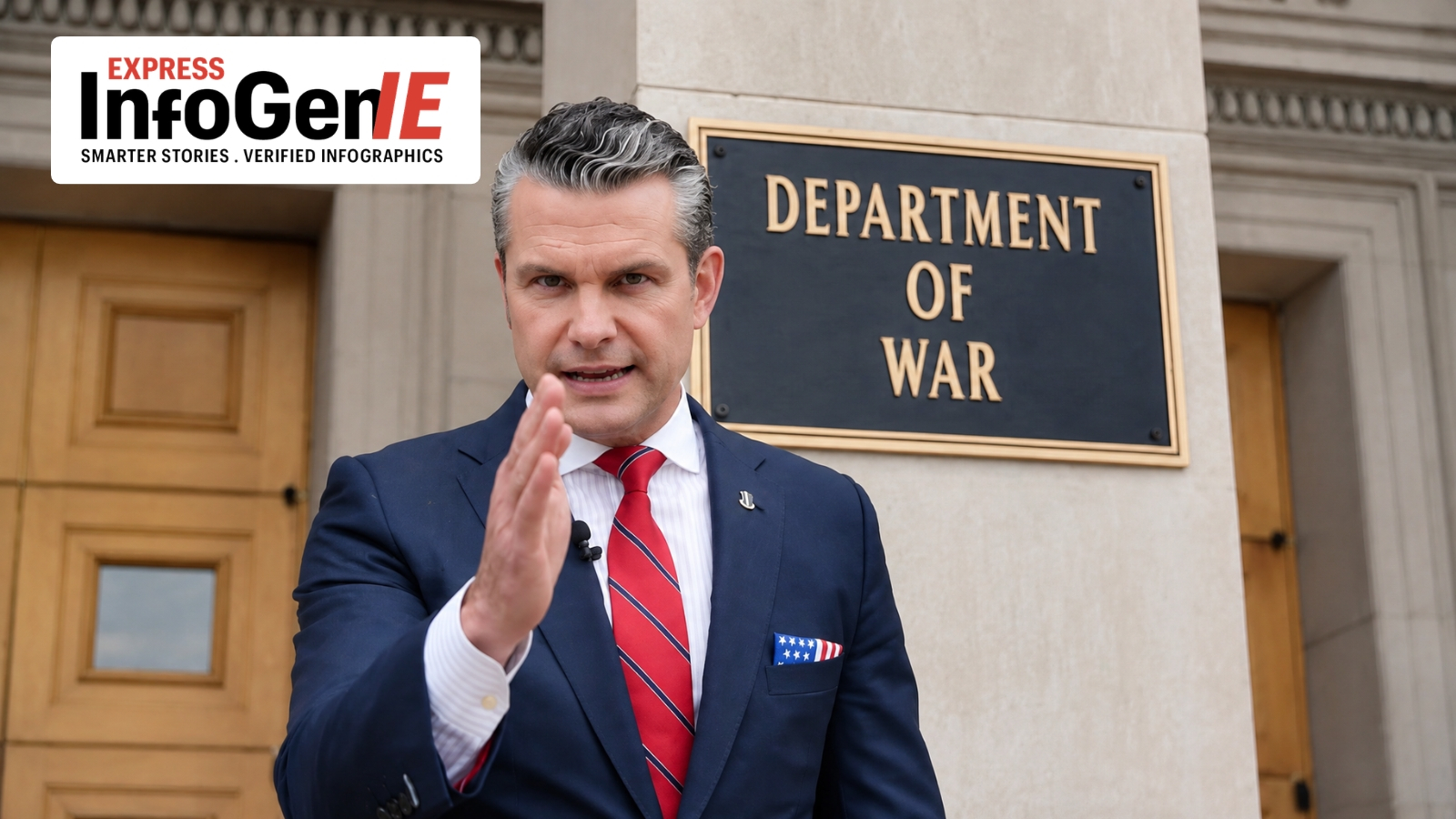
Defense Secretary Pete Hegseth is facing acute political jeopardy following the 2026 midterm elections because the loss of congressional leverage strips away the protective shield that previously insulated his controversial Pentagon overhaul from subpoena power and institutional pushback. With a shifted legislative balance on Capitol Hill, the former television host and military veteran must now defend aggressive personnel purges, stalled procurement timelines, and cultural restructuring before hostile oversight committees. For a cabinet official whose primary currency has always been ideological loyalty rather than bureaucratic consensus, the post-midterm environment transforms routine defense governance into an existential fight for survival.
The math in Washington changed overnight, and nowhere is that recalibration felt more acutely than in the E-Ring of the Pentagon. During the first two years of the second Trump administration, Hegseth operated with a rare degree of latitude. A compliant Congress largely deferred to his vision of remaking the American military, clearing the path for sweeping changes to officer promotion boards, diversity initiatives, and senior command assignments. That era of unilateral execution is over.
The Anatomy of a Post-Midterm Reckoning
Midterm elections historically serve as a referendum on the sitting president, yet the immediate casualties are frequently cabinet secretaries who drew the most partisan fire. Hegseth fits that profile with textbook precision. From the moment his nomination cleared the Senate by the narrowest of margins in early 2025, he positioned himself as a disruptor determined to dismantle what he routinely termed the "woke military establishment."
Disruption makes for compelling cable news segments. It makes for treacherous administrative governance when the opposing party gains the gavel.
Under the rules of congressional oversight, committee chairs possess the unilateral authority to issue subpoenas, compel testimony from career civil servants, and freeze specific reprogramming requests within the massive defense budget. For the past twenty-four months, the Department of Defense has largely bypassed granular scrutiny over how it justifies the removal of three- and four-star officers or how it redirects funds toward favored defense startups. Now, every memo, text message, and personnel file tied to those decisions is subject to formal discovery.
Career officials inside the building, many of whom spent the last two years keeping their heads down, suddenly hold immense institutional value to congressional investigators. Leaks from the Pentagon are rarely random; they are usually the opening salvos of bureaucratic self-preservation. When career brass sense that a political appointee has lost the backing of the legislature, the flow of internal documents to Capitol Hill accelerates rapidly.
Why Loyalty No Longer Buys Immunity
To understand why Hegseth is uniquely vulnerable, one has to look at the mechanics of White House survival after a midterm setback. Presidents rarely admit that their broader policy agenda was rejected by voters. Instead, they look for operational bottlenecks and public relations liabilities that can be jettisoned to reset the narrative ahead of the next presidential cycle.
Hegseth’s entire political brand was built on total alignment with Donald Trump’s populist instincts. While that alignment secured him the top job at the Pentagon, it leaves him with zero independent power base inside the defense establishment. Unlike traditional defense secretaries—figures like Robert Gates, Leon Panetta, or even James Mattis—Hegseth cannot rely on deep reservoirs of bipartisan goodwill among defense hawks, defense contractors, or retired flag officers to vouch for his competence when the political winds shift.
His allies are strictly ideological. When an administration suffers a midterm defeat, ideological allies in the White House begin calculating their own survival.
If the Pentagon becomes a daily source of damaging headlines—whether over readiness metrics, recruiting shortfalls, or drawn-out confirmation battles for subordinate posts—the calculus inside the West Wing changes quickly. A Defense Secretary is supposed to absorb political flak on behalf of the Commander-in-Chief, not generate new fronts of vulnerability. Once a cabinet official transitions from a political asset into a recurring distraction, their tenure is measured in weeks rather than years.
The Readiness Trap and the Recruiting Reality
Beyond the partisan warfare on Capitol Hill lies a far more stubborn adversary, which is the cold reality of military readiness and force generation. Hegseth entered office promising that an aggressive rollback of social policies and a renewed focus on traditional warfighter ethos would instantly solve the military’s chronic recruiting crisis.
The numbers tell a more complicated story.
While certain combat arms branches saw modest upticks in initial enlistments following the high-profile branding shifts of 2025, the broader structural deficits in specialized technical fields—cyber warfare, nuclear propulsion, aviation maintenance, and military medicine—have proven entirely resistant to culture-war messaging. You cannot slogan your way out of a shortage of qualified software engineers or submarine welders when the private sector offers triple the compensation without the deployment tempo.
Furthermore, the rapid removal of senior military leaders over perceived ideological misalignment has created a chilling effect across the officer corps. For a hypothetical example of how this plays out in practice, consider a mid-career brigade commander tasked with drafting a candid readiness assessment for an upcoming deployment. If that officer believes that reporting equipment shortages or training gaps will be interpreted by political appointees as a lack of enthusiasm for the administration’s leadership, the incentive shifts toward sugarcoating the data.
History shows that militaries fail when subordinates become afraid to tell superiors the truth about operational readiness. Congressional oversight committees, armed with reports from the Government Accountability Office and the Pentagon’s own Inspector General, are already preparing to audit whether the administration's personnel churn has degraded actual combat capability in key theaters like the Indo-Pacific and Eastern Europe.
Friction With the Defense Industrial Base
Another overlooked factor driving the heat on Hegseth is quiet but persistent frustration from the traditional defense industrial base. While the administration championed a push toward agile, Silicon Valley-backed defense tech firms—prioritizing autonomous drones, artificial intelligence software, and commercial space assets—that pivot frequently came at the expense of legacy procurement programs that employ hundreds of thousands of workers across key congressional districts.
Defense contracting is fundamentally a game of long-term capital allocation. Major aerospace and shipbuilding firms plan their supply chains on decade-long horizons. When the Pentagon abruptly alters acquisition priorities or holds up contract awards to conduct ideological reviews of corporate governance practices, it creates friction not just with CEOs, but with the senators and representatives whose local economies depend on those factories.
Even Republican lawmakers from defense-heavy states have grown privately irritated by the unpredictability emanating from the Secretary’s office. During a period of unified government, those lawmakers swallowed their frustration to maintain party unity. In the wake of a midterm loss, party discipline inevitably frays. Lawmakers facing tough re-election battles in two years will not hesitate to throw a cabinet secretary under the bus to protect a shipyard or an aerospace plant in their home state.
The Subpoena Gauntlet Ahead
The immediate operational threat to Hegseth is the sheer bandwidth required to survive a hostile Congress. Running the Department of Defense—an enterprise with over three million employees and an annual budget pushing toward a trillion dollars—is an all-consuming administrative task under normal circumstances.
When you layer aggressive congressional investigations on top of daily global crisis management, the administrative machinery grinds to a halt.
Personnel Purges and Command Climate
Investigators are expected to demand full transparency regarding the criteria used to dismiss senior officers and civil servants over the past two years. If internal communications reveal that career officials were sidelined based on partisan litmus tests rather than performance metrics, it will trigger prolonged legal battles over civil service protections and military promotion statutes.
Budget Reprogramming Battles
The Pentagon relies on routine congressional sign-off to move money between accounts as global threats evolve. Hostile committee chairs can freeze these requests indefinitely, forcing the Defense Department to operate under rigid spending constraints that hamper everything from munitions production to base maintenance.
Overseas Posture and Alliance Strain
Questions surrounding American commitment to NATO allies, troop deployments in Europe, and burden-sharing arrangements in the Pacific will dominate upcoming posture hearings. Hegseth’s past rhetoric, which frequently questioned the utility of traditional alliances, will be dissected line by line against current intelligence assessments of Russian and Chinese military modernization.
The Bureaucracy Knows How to Wait
There is an old axiom in Washington that political appointees are merely temporary guests in a house owned by the permanent bureaucracy. Seasoned defense secretaries understand this dynamic and spend their first year building alliances within the Joint Staff and the civil service to ensure their orders are actually executed rather than slow-rolled into oblivion.
Hegseth took the opposite approach, treating the Pentagon bureaucracy as hostile territory to be conquered rather than a complex machine to be steered. That strategy works only so long as the conqueror holds overwhelming political force.
The 2026 midterms demonstrated that the political force behind the administration has limits. Inside the Pentagon, the career officials who survived the initial purges recognize that the clock is now ticking in their favor. Directives that once sparked immediate compliance are now met with requests for legal reviews, environmental impact studies, and interagency consultations—the classic bureaucratic tools used to stall a weakened executive until the next personnel shuffle occurs.
What Survival Actually Requires
Can Hegseth weather the storm? In Washington, survival is never impossible if a cabinet official is willing to adapt, yet adaptation requires abandoning the very traits that brought him to power.
To survive the next two years, Hegseth would need to pivot abruptly from culture warrior to traditional institutionalist. That means empowering seasoned deputies to handle the gritty details of acquisition reform, mending fences with defense hawks on both sides of the aisle, and refraining from the kind of provocative public commentary that hands opposition lawmakers easy soundbites for evening news broadcasts.
There is little evidence in his public career or his management style over the last twenty-four months to suggest he has either the temperament or the inclination for that kind of strategic retreat. More importantly, pivoting toward the center risks alienating the populist media ecosystem that remains his sole base of support. If he moderates, he loses his usefulness to the base; if he doubles down, he hands congressional investigators the exact ammunition they need to paralyze his department.
For a Defense Secretary trapped between an emboldened opposition in Congress, a restless bureaucracy inside the Pentagon, and a White House looking for someone to blame for a bruised political brand, the exits are rapidly closing.


