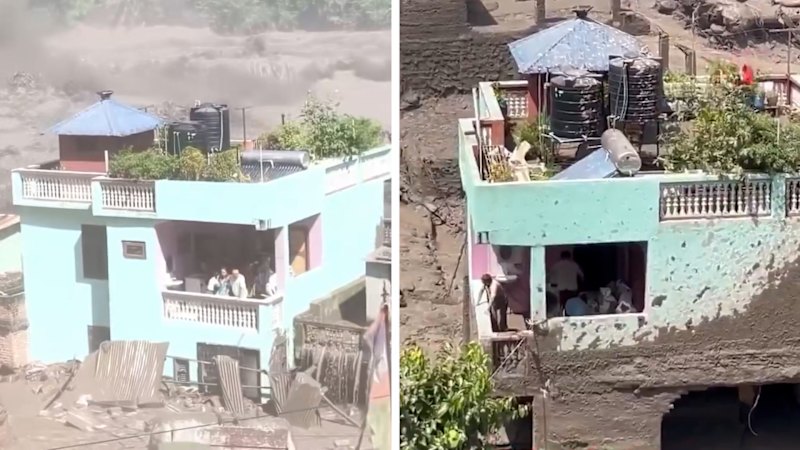
When a catastrophic glacier-and-rock collapse near the Nepal-Tibet border triggered a massive flash flood down the Trishuli and Bhotekoshi river systems, it unleashed a wall of heavy debris, mud, and water that leveled entire neighborhoods. Amid the absolute devastation in the Nuwakot district's Dunge Bazaar, a single 40-year-old, mint-green reinforced concrete house remained standing while neighboring structures were completely swept away. Viral video footage capturing family members stranded on the upper balconies while raging brown torrents tore through the ground floor instantly captivated global attention. Mainstream coverage dubbed it a miracle, focusing heavily on the cinematic rescue and the sheer improbability of survival. Viral algorithms love a clean narrative of divine intervention against impossible odds. Real structural engineering, local building adaptation, and environmental placement, however, explain why this specific building survived the doomsday mudflow while others vanished.
Anatomy of a Structural Survivor
Internet commentators marveled at the luck of the draw, yet structural analysts point to specific material choices made decades ago. The house belongs to a resident named Prakash, who noted that the building was constructed approximately 40 years ago with a heavy focus on reinforcement due to its proximity to the Trishuli River. Unlike unreinforced masonry or traditional stacked-stone homes that disintegrate instantly under lateral hydraulic loads, this building utilized a rigid structural skeleton.
The primary mechanics behind the survival of Nepal's viral green house involve a combination of three major factors:
- Foundation Reinforcement: The owner explicitly noted that multiple layers of road material and aggregate were packed underneath the base during initial construction to anchor it against shifting riverbanks.
- Tied Concrete Skeleton: A reinforced concrete frame absorbs and distributes kinetic energy downward into the earth rather than letting shear forces peel the walls apart.
- Hydraulic Fluid Dynamics: The compact, rectangular footprint of the three-story structure allowed the dense slurry of rocks and water to split and flow around its flanks rather than striking a wide, flat surface dead-on.
Even with superior construction, the building did not escape unscathed. The ground floor, which served as a commercial storage warehouse, was thoroughly hollowed out. Vehicles, inventory, and doors were completely obliterated by the relentless pressure of the mudflow.
The Brutal Reality Behind the Viral Fame
Viral clips freeze a single moment in time, stripping away the broader humanitarian tragedy. While millions shared the inspiring footage of the family waving from the upper floors before their eventual rescue via a improvised rope-and-pipe bridge, the wider catastrophe claimed hundreds of lives and displaced thousands across the region. The house stood firm, but the local infrastructure, roads, and surrounding community were erased.
Property owners in Himalayan valleys face an escalating crisis as climate shifts destabilize high-altitude ice and rock walls. Traditional ecological knowledge often dictates building styles, but intensifying weather anomalies mean structures built forty years ago are now tested by unprecedented hydraulic loads. The green house survived because its builders anticipated lateral river stress, yet relying on historical building tolerances in an era of massive glacial outbursts is a dangerous gamble.
The family survived through a combination of structural integrity, vertical evacuation to the highest floor, and local community members who risked their lives to bridge the gap with ropes. They now face the grim reality of clearing meters of heavy silt from a gutted ground floor and rebuilding an entire livelihood from scratch. The structure remains standing as an extraordinary exception, serving as both a testament to sound historical masonry and a stark warning about the unyielding power of Himalayan flash floods.