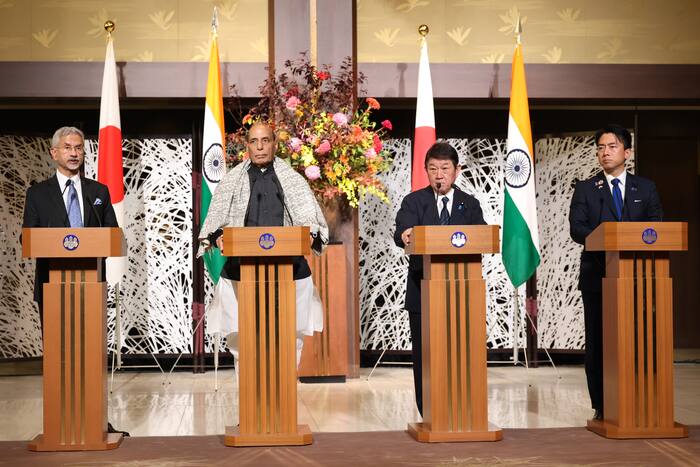
Japan and India agreed to expand military and defense industry cooperation during their November 2026 Tokyo 2+2 ministerial talks, pairing live-fire missile range access in India with co-development of naval hardware such as the UNICORN integrated communications mast. Diplomatic press releases frame the push as a triumph of shared Indo-Pacific security. Look closer at the factory floors and procurement files, and a harsher reality emerges: two slow-moving bureaucracies are trying to weld high-precision Japanese engineering onto India's sprawling industrial base before regional deterrence breaks down.
Both capitals have good reasons to sign thicker memoranda. Tokyo needs test space and supply chain depth as it builds stand-off strike capabilities. New Delhi wants high-end technology transfer and domestic manufacturing scale without surrendering strategic autonomy. Yet goodwill at ministerial tables does not build ships, integrate radar masts, or clear customs bottlenecks on time.
Why Tokyo Needs Indian Ranges and Factories
Japan has geography problems that summits alone cannot fix. Crowded skies, tight coastal waters, and dense population centers leave the Japan Self-Defense Forces with scarce room to test long-range missiles at realistic distances. Following Tokyo's 2022 shift toward counterstrike capabilities and the entry of systems like the Type-25 missile into service in March 2026, live-fire training requirements have outgrown domestic ranges. Securing access to Indian firing ranges gives Tokyo space that simply does not exist at home.
Industrial fragility matters just as much. Supply shocks from the war in Ukraine, heightened friction around Taiwan, and maritime shipping disruptions exposed how brittle concentrated defense supply chains can become. Japanese firms excel at precision components, metallurgy, and naval architecture, yet their domestic production footprint sits inside a high-cost, export-cautious ecosystem.
- Range bottlenecks: Domestic test areas restrict flight profiles and safety corridors for longer-range systems, making distant partner ranges attractive for operational validation.
- Supply chain spread: Distributed manufacturing across trusted partners reduces single-point failure when specialized parts or shipping lanes face pressure.
- Export competition: After Australia selected an upgraded version of Japan's Mogami-class frigate in 2025, Tokyo's defense firms have options—and they watch schedule risk closely.
What New Delhi Actually Gains and Risks
For India, deepening military and defense industry cooperation with Japan promises access to technology that Western partners often ration or price out of reach. The flagship early test case is the UNICORN mast (also known as NORA-50), which bundles exposed shipboard antennas into a single stealthier structure fitted on Japan Maritime Self-Defense Force Mogami-class frigates. Under the planned division of labor, NEC Corporation brings core design expertise while Bharat Electronics Limited handles manufacturing and integration in India.
That model carries real industrial upside. India moves from buying finished gear to co-developing subsystems, gaining production know-how while Tokyo guards its most sensitive intellectual property. In September 2026, Japan also deployed F-2A fighter jets to Jodhpur for Veer Guardian 2026, marking the first fighter jet deployment to India for a bilateral air drill.
Still, New Delhi faces a familiar trap: mistaking memoranda for hardware. Years of talks around Japan's US-2 amphibious aircraft dragged on without a contract, a reminder that strategic alignment does not automatically clear commercial and regulatory hurdles. Even with UNICORN, a memorandum of implementation in 2024 and a formal summit announcement in July 2026 still left officials aiming for an Acceptance of Necessity approval around February 2027—nearly three years from initial agreement to the first formal procurement milestone for a single mast.
Where the Partnership Stumbles in Practice
Anyone who has tracked defense joint ventures across Asia knows the friction points before the ink dries. Tokyo and New Delhi operate under different legal reflexes and military doctrines.
Japan sits tightly inside the U.S. alliance system and applies strict controls on dual-use and defense transfers, even after relaxing its export rules in 2014 and amending its transfer principles in December 2022. India guards its non-aligned habits and strategic autonomy, running an acquisition bureaucracy built for caution and multi-layered oversight rather than rapid co-development.
Consider a hypothetical example on a shipyard floor. Suppose a Japanese supplier designs a specialized composite mast housing and an Indian state-run integrator builds the assembly for a new frigate hull. If an export-control review stalls a sub-assembly in Tokyo while a tender clarification stalls in New Delhi, a three-month delay in one place can push a shipyard dry-dock slot back by a year.
| Friction Factor | Japan's Side | India's Side | Practical Impact on Programs |
|---|---|---|---|
| Approval Speed | Strict export and transfer screening protects sensitive designs. | Multi-stage procurement reviews prioritize auditability and rules. | Long lead times between concept, approval, and delivery. |
| Industrial Base | High precision and naval maturity, limited overseas defense scale. | Large manufacturing ambition and growing private engineering depth. | Split workshare where core tech stays guarded. |
| Strategic Posture | Deeply tied to U.S. alliance frameworks and counterstrike planning. | Insists on strategic autonomy and diverse partnerships. | Practical cooperation favors maritime and logistics over formal treaties. |
Counterarguments and Overlooked Realities
Not every analyst buys the narrative that defense co-production is a silver bullet. One counterargument holds that India's massive domestic defense push already crowds out foreign partners unless they accept steep localization mandates and thin margins. Japanese boardrooms, historically risk-averse when it comes to overseas defense ventures, rarely chase low-margin volume at the expense of reputation or compliance.
Another overlooked factor is cost versus complexity. Cutting-edge naval sensors, unmanned systems, and underwater technologies demand tight tolerances and sustained maintenance pipelines. If unit costs climb too high or spare-part supply chains stay complicated, budgets in both capitals will force hard trade-offs against faster, off-the-shelf alternatives.
There is also a quieter advantage in the November 2026 agenda that gets less headlines than missiles: maritime logistics, reciprocal ship repair, semiconductors, and undersea cables. Keeping ships afloat, repairing hulls in friendly ports, and protecting data cables do not make flashy television, yet they keep fleets moving when crises hit.
What Will Prove the Pact Real
Flags, joint statements, and ministerial handshakes are cheap. Real defense industrial integration shows up in signed contracts, cleared export licenses, and working hardware delivered on schedule.
Watch whether the UNICORN mast clears its formal procurement hurdles cleanly and moves into repeatable naval integration rather than stalling in paperwork. Watch how DRDO and ATLA translate talks on missiles, underwater systems, and shipbuilding into concrete joint milestones. Until steel is cut, antennas are mounted, and live-fire safety protocols move from paper to range, military and defense industry cooperation between Japan and India remains a promise waiting to be tested by its own clock.