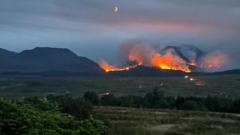
When catastrophic wildfires break out, ground crews rely heavily on aerial support to drop retardant, douse hot spots, and buy precious time. Yet emergency activations increasingly reveal a dangerous reality on the tarmac. Helicopters sit grounded, contracts go unfilled, and municipal authorities find themselves forced into reactive crisis management modes rather than executing proactive containment. The absence of rotary-wing aircraft during peak wildfire outbreaks stems not from sudden, unpredictable acts of nature, but from years of structural procurement flaws, crippling maintenance delays, and an overreliance on short-term seasonal leasing models.
Understanding how aerial firefighting infrastructure broke down requires tracing the chain of decisions that transformed a routine seasonal operational need into an urgent public safety vulnerability. If you enjoyed this piece, you might want to look at: this related article.
The Operational Bottleneck Behind Grounded Fleets
The failure to deploy rotary-wing aircraft during an active wildfire rarely happens overnight. It is the end result of a long, quiet decay in logistical readiness.
Air utility operators face a crushing convergence of regulatory compliance, soaring insurance premiums, and severe technician shortages. Maintaining heavy-lift helicopters like the Sikorsky S-64 Skycrane or CH-47 Chinook requires specialized mechanical talent and a constant supply of FAA-certified parts. Over the past five years, supply chain disruptions have stretched lead times for critical components from weeks to months. A single delayed rotor bearing or turbine seal can keep a multi-million-dollar asset tied to a hangar floor while fires burn through thousands of acres. For another look on this story, check out the recent coverage from BBC News.
Government procurement contracts compound these physical delays. State and federal forestry agencies often rely on Call-When-Needed (CWN) contracts rather than Exclusive Use (EU) agreements.
CWN contracts sound efficient on paper. Agencies pay only when the aircraft flies, avoiding the high fixed cost of holding a fleet on standby. But in practice, CWN creates massive uncertainty for private aviation companies. Without guaranteed revenue, operators cannot justify keeping expensive specialized crews on payroll or stocking costly replacement parts in advance. When fires erupt simultaneously across multiple regions, every municipality competes for the same small pool of available private aircraft. The highest bidder or the agency with an existing Exclusive Use agreement wins. Everyone else gets left with empty skies and a press release explaining that crisis management protocols have been triggered.
The Fallacy of Reactive Emergency Activations
Emergency activation protocols are meant to act as a safety net. In reality, they often serve as political cover for systemic planning failures.
When an agency announces it has activated its emergency response framework because aerial assets are unavailable, it is shifting the narrative from a logistics failure to an act of force majeure. Ground forces are deployed into increasingly hazardous conditions without the cooling drops necessary to blunt a fire's leading edge.
Consider a hypothetical scenario where a mid-sized county facing an unexpected late-summer blaze calls upon its regional mutual-aid agreement for air support. Under standard procedures, neighboring districts share available air tankers and helicopters. But if those neighboring jurisdictions are already battling their own local blazes, the mutual-aid request fails. The county must then scramble to secure commercial operators on the open market at exorbitant spot rates, only to discover that every certified crew in a five-hundred-mile radius is already committed elsewhere.
This dynamic forces incident commanders to alter their strategy entirely. Instead of aggressive direct attack strategies supported by water drops, crews must retreat to secondary containment lines, giving up vast swaths of territory and risking broader residential exposure.
The financial cost of this delay is staggering. Fire suppression expenses scale exponentially as containment time increases. Spending extra upfront to secure guaranteed air power is significantly cheaper than paying for weeks of extended ground operations, structure defense, and post-fire ecological remediation.
Structural Supply Constraints and the Pilot Deficit
Even if an agency has the budget to lease a fleet of heavy-lift helicopters outright, they run directly into a secondary bottleneck. There are simply not enough qualified pilots to fly them.
Aerial firefighting is among the most demanding disciplines in aviation. It requires flying at ultra-low altitudes through heavy smoke, extreme turbulence, and intense thermal updrafts, often while carrying a variable ten-ton water payload suspended on a longline. The barrier to entry is exceptionally high. Flight hours in standard civil or military aviation do not directly translate to low-level wildland operations.
Historically, the industry relied on a steady pipeline of military aviators transitioning out of active service. That pipeline has narrowed considerably. Commercial airlines, facing their own widespread pilot shortages, offer higher pay, predictable schedules, and far safer working environments. The wildland aviation sector, characterized by intense seasonal work, long stretches away from home, and high physical risk, struggles to compete for that talent.
The Aging Aircraft Problem
The physical fleet itself is aging out. A significant portion of the global rotary-wing firefighting fleet consists of refurbished military surplus aircraft built decades ago.
- High Maintenance Hours: Older airframes require substantially more maintenance hours per flight hour, increasing operational downtime during high-demand months.
- Capital Intensity: Modernizing the fleet with modern, purpose-built civilian aircraft requires capital investments running into tens of millions of dollars per unit.
- Regulatory Hurdles: Modifying legacy airframes to meet modern safety and environmental standards involves lengthy certification processes that stall deployment.
Private operators, constrained by short-term government contract structures, rarely have access to the long-term capital necessary to finance fleet modernization. They are stuck maintaining vintage equipment, hoping that part wear doesn't coincide with peak fire season.
Rebuilding the Aerial Defense Infrastructure
Fixing the chronic shortage of aerial firefighting assets requires a complete overhaul of how state and federal bodies approach procurement and resource management. Patching the problem with annual emergency declarations is no longer a viable strategy in an era of prolonged, intense fire seasons.
First, government entities must move away from the heavy reliance on Call-When-Needed contracting. Transitioning to multi-year Exclusive Use contracts gives private aviation operators the financial stability needed to invest in modern airframes, maintain robust spare-parts inventories, and offer competitive year-round salaries to elite pilots.
Second, regional pooling mechanisms need to be modernized through centralized, multi-state scheduling authorities. Instead of dozens of individual counties and agencies bidding against one another in a chaotic spot market during a crisis, consolidated regional fleets can be strategically prepositioned based on predictive fire-weather modeling.
Third, public-private partnerships must address the training pipeline directly. Establishing dedicated rotary-wing firefighting academies, backed by federal grants and industry partnerships, can create a structured pathway for civilian pilots to gain the specialized flight hours required for wildland operations.
Until funding models align with the operational realities on the tarmac, emergency activation declarations will remain a recurring feature of wildfire season. Relying on crisis management after the fleet is already grounded is not a strategy. It is a predictable failure.


