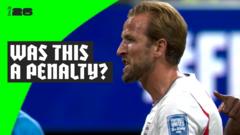
The modern penalty kick is no longer a punishment for a denied goal-scoring opportunity. It has mutated into a clinical, video-assisted trap where the micro-analysis of slow-motion contact overrides the fundamental mechanics of human movement.
When referee Felix Zwayer was directed to the pitchside monitor during the Euro 2024 semi-final between England and the Netherlands, a collective shudder ran through the traditionalist core of international football. Denzel Dumfries had thrown his body on the line to block a Harry Kane shot. The ball flew over the crossbar, a legitimate defensive effort completed. Yet, because Kane’s follow-through carried his boot into the bottom of Dumfries’ raised studs, Video Assistant Referee Bastian Dankert intervened. The subsequent penalty changed the momentum of a European Championship semi-final, highlighting a deep and systemic rot in how the game is governed. If you found value in this post, you should look at: this related article.
This was not an isolated incident of poor officiating. It was the logical conclusion of a regulatory shift that prioritizes hyper-literal rule enforcement over the actual spirit of sport.
The Myth of the Clear and Obvious Error
The original mandate of VAR was simple. It was designed to eliminate the scandalous, glaring mistakes that altered the course of tournaments, the missed handballs or blatant offside goals that the human eye simply couldn't catch in real-time. It was never intended to re-referee subjective physical contact. For another look on this development, see the recent coverage from CBS Sports.
By turning the Dumfries block into a punishable offense, the officiating crew crossed a dangerous line.
Zwayer initially waved play on. He saw the contact in real-time and deemed it a natural consequence of two elite athletes moving at high speeds toward the same space. In the broadcast booth, former England defenders like Jamie Carragher and Gary Neville immediately labeled the eventual overturn a disgrace. When even the beneficiaries of a decision admit it is a gift, the system is fundamentally broken.
The intervention relied on a hyper-technical reading of UEFA’s guidelines regarding reckless play. The argument put forward by refereeing defenders was that Dumfries showed a reckless disregard for safety by leading with his studs.
But this interpretation ignores physics. A defender trying to block a powerful shot must extend their leg to create a barrier. Dumfries did not lung at Kane. He lunged at the ball. Kane kicked the ball, and his natural physical momentum carried his foot forward into Dumfries. By punishing the defender for a collision initiated by the attacker's shooting motion, football has effectively made blocking a shot a high-risk gamble.
The Erasure of Natural Movement
Defenders are being asked to do the impossible. They must sprint, pivot, block, and slide, all while maintaining perfect, unnatural control over where their limbs land after the primary action is completed.
The Hazard of Follow Through Contact
If a striker takes a shot and a defender subsequently makes contact with them, historical precedent always dictated that the play was dead once the ball left the foot, provided the challenge wasn't a malicious or violent act. The Euro 2024 ruling turned that logic on its head. It established a precedent where an attacker can get a shot off, miss completely, and still win a penalty if the defender’s block attempt results in any high-margin contact.
This shifts the entire balance of power in the penalty box to an absurd degree. Attackers already possess every natural advantage. They know where they are going, they are protected by strict anti-tackle laws, and they are handed spot-kicks for the slightest clip of a heel. Now, even a successful block that results in post-shot contact can be scrutinized framed frame-by-frame until a legal defensive act looks like an assault.
A Systemic Crisis of Authority
The controversy surrounding the decision was compounded by the baggage brought into the stadium. Officiating high-stakes international matches requires absolute, unquestioned institutional trust.
UEFA damaged that trust long before kickoff by appointing Zwayer, a referee with a historical six-month ban from 2006 tied to a German match-fixing investigation. While Jude Bellingham had previously been fined for publicly bringing up that history after a club match, the selection of an official with such high-profile friction with key players was a failure of management. It created an environment of skepticism before a single ball was kicked.
When the penalty was given, it didn't just infuriate Dutch manager Ronald Koeman or captain Virgil van Dijk. It alienated the viewing public. Fans do not want to see tournaments decided by referees spending three minutes staring at a frozen television screen trying to determine the exact millimeter where leather met plastic.
The sport is losing its flow. The constant interruptions to analyze contact that no one on the pitch actually believed was a foul at the moment of impact is draining the emotion from the game.
The rulemakers must decide what football is supposed to be. If it is a non-contact sport where any collision inside the eighteen-yard box results in a ninety-percent chance of a goal, then the current trajectory is perfect. If it remains a physical, dynamic game where defending is viewed as an art form rather than a liability, the current implementation of VAR must be stripped back. Football cannot survive a future where the natural physics of a goal-mouth scramble are treated as a crime scene.