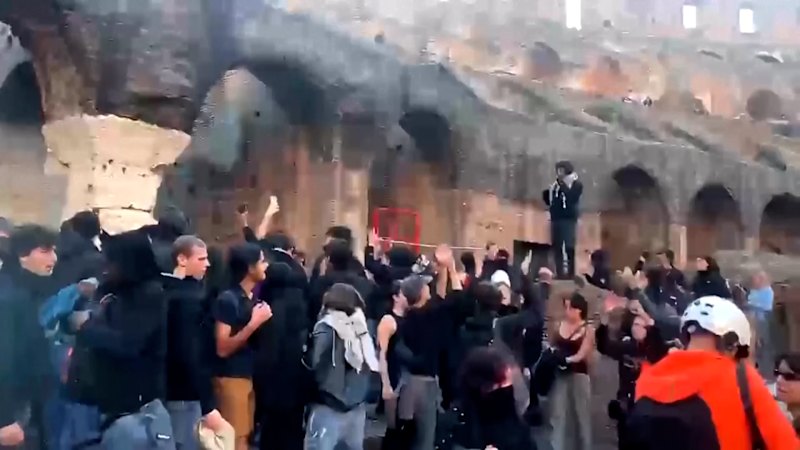
When protestors breach the Colosseum in Rome, the initial headlines always focus on the spectacle. Cameras flash, banners unfurl against two-thousand-year-old travertine stone, and local officials express predictable outrage over the disrespect shown to a global treasure. Yet treating these incidents as isolated stunts misses the real story entirely. The repeated penetration of Italy’s most famous monument exposes a structural vulnerability at the heart of global heritage management, where the competing demands of mass tourism, open-air preservation, and modern protest tactics have created an impossible security equation.
The mechanics of a breach are surprisingly simple. Every day, tens of thousands of visitors funnel through the Flavian Amphitheatre, creating a human sea that overwhelms standard crowd-control measures. Security personnel are trained and positioned primarily to manage ticket queues, prevent petty theft, and stop the occasional tourist from carving initials into the brickwork. They are not configured as a tactical perimeter defense force. When a coordinated group of activists buys standard entry tickets, conceals banners or biodegradable dyes beneath ordinary street clothes, and waits for a scheduled shift change, the monument is effectively defenseless.
The Architecture of Vulnerability
To understand why the Colosseum remains so exposed, you have to look at the physical reality of the site. Unlike a modern museum with controlled climate zones, reinforced glass, and compartmentalized galleries, the Colosseum is a massive, porous ruin sitting directly in the center of a bustling metropolis.
It was built to move fifty thousand Romans in and out within minutes. That ancient engineering brilliance is a modern security nightmare. Multiple arched entrances, vast open concourses, and tiered seating areas offer dozens of vantage points and escape routes. Installing airport-style screening at every conceivable choke point would grind Rome’s tourism economy to a halt, creating multi-hour queues that stretch toward the Roman Forum and turn the surrounding piazza into a soft target of its own.
Security contractors at the site face an unenviable mandate. They must keep the human conveyor belt moving at maximum capacity while simultaneously screening for threats that do not look like weapons. A metal detector will catch a knife or a firearm. It will not flag a rolled-up piece of nylon fabric or a plastic bottle filled with charcoal liquid.
The Shift in Activist Tactics
Over the past several years, environmental and political protest groups across Europe have fundamentally altered their playbook. Rather than staging marches outside government buildings—events that are easily contained by riot police and largely ignored by international news cycles—activists have turned historic landmarks into high-visibility stages.
The logic is ruthless and effective. Targeting a priceless cultural artifact guarantees immediate global media coverage without requiring a massive crowd. Three people with a banner inside the Colosseum generate more international press than three thousand people marching down Via dei Fori Imperiali.
This shift catches heritage administrators off guard because their risk models are built around traditional vandalism and terrorism. Traditional vandals operate covertly, trying to avoid capture. Modern protest groups operate overtly, actively seeking arrest because the footage of police dragging them away from an ancient monument completes their narrative arc. You cannot deter someone with the threat of detention when detention is part of their communications strategy.
The Economics of Open Doors
Money dictates policy at major archaeological sites, even when officials claim preservation comes first. The Colosseum Archaeological Park is one of the most lucrative cultural institutions in the world, generating tens of millions of euros annually that subsidize less profitable museums and excavations across Italy.
Restricting access to improve security directly threatens that revenue stream. Every additional minute spent screening a visitor reduces daily capacity. Capping ticket sales to allow for higher guard-to-visitor ratios means leaving millions of euros on the table.
There is also the aesthetic factor. Tourists travel from across the globe to experience the raw, unmediated majesty of ancient Rome. Surrounding the amphitheater with high steel fencing, concrete bollards, and heavily armed tactical units destroys the very atmosphere people pay to see. Heritage managers are trapped in a bind where the cure for vulnerability looks almost as damaging to the visitor experience as the breaches themselves.
The Legal Counter-Offensive
Unable to seal the physical perimeter without ruining the monument, Italian authorities have leaned heavily on legislative deterrence. Recent laws championed by the Ministry of Culture introduced severe financial penalties for anyone who damages or defaces cultural heritage sites, with fines reaching up to sixty thousand euros alongside potential prison sentences.
The strategy is clear. If you cannot stop activists at the gate, you make the aftermath financially ruinous.
Yet the effectiveness of strict liability laws against ideologically driven protestors remains questionable. Many activists operate through decentralized networks that crowdfund legal fees and fines. Others simply accept bankruptcy as a badge of honor. Furthermore, prosecutors often struggle to prove permanent damage when protestors use washable substances or merely hang banners without altering the physical stone, leading to prolonged legal battles that dilute the intended deterrent effect.
What Other Landmarks Have Learned
Rome is hardly alone in facing this dilemma. Across Europe, iconic institutions have been forced to rethink how they balance public access with physical security.
- The Louvre in Paris has quietly integrated plainclothes behavioral detection officers into its densest galleries, focusing on identifying suspicious group dynamics rather than relying solely on bag checks.
- The British Museum in London has tightened bag size restrictions and implemented secondary screening zones during periods of heightened political tension, accepting slower entry times as a necessary cost.
- The Prado in Madrid responded to high-profile frame-gluing incidents by adding physical distance barriers and increasing staff density in rooms housing marquee works, even at the expense of visitor flow.
In each case, the lesson has been the same. Passive security measures—cameras, signs, and stationary guards—do not stop determined actors. Only active, unpredictable human intervention disrupts a planned breach before it reaches its target.
The Gray Area of Public Space
A deeper philosophical tension underlies the physical security debate. Monuments like the Colosseum are not private corporate headquarters; they are shared human heritage situated in public spaces.
For centuries, the great piazzas and ruins of Rome have served as forums for public expression, celebration, and dissent. Militarizing these spaces carries a civic cost. When a democratic society treats every unapproved gathering near a monument as a high-level security threat, it alters the relationship between citizens and their own history.
Critics of the government’s hardline approach argue that equating non-destructive political protest with cultural vandalism sets a dangerous precedent. They point out that ancient monuments have survived wars, earthquakes, and centuries of stone-robbing, and that temporary banners pose zero existential threat to the structure itself. On the other side, conservators warn that normalization breeds escalation. If peaceful breaches go unchecked, it is only a matter of time before a stunt goes wrong, resulting in irreversible chemical staining or structural collapse on fragile, two-millennia-old masonry.
The Reality of the Next Breach
Until heritage authorities fundamentally change how they manage crowd density and intelligence gathering, the Colosseum will remain vulnerable. Bag scanners and higher fines are reactive measures designed to appease public anger after the cameras have already captured the stunt.
True security at an open-air ruin requires invisible layers: monitoring activist chatter before tickets are ever purchased, staggering entry flows to eliminate dense crowd cover, and deploying mobile, plainclothes teams trained to spot coordinated movement rather than contraband. Even then, no system is airtight. A monument built to welcome the world will always carry the risk of what the world brings through its arches.