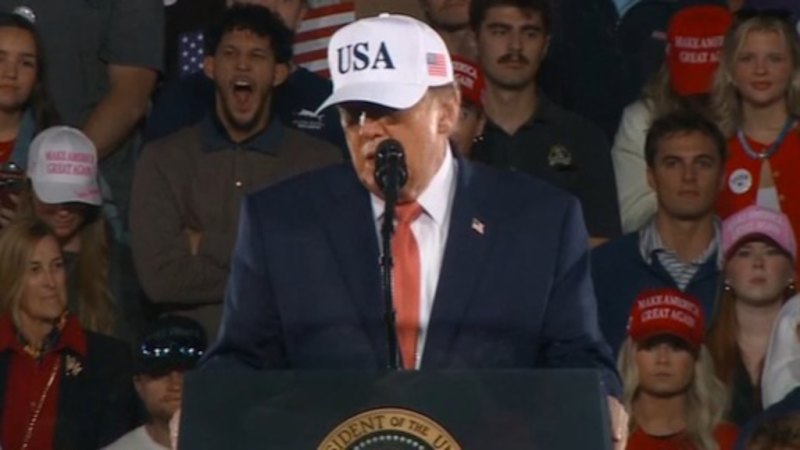
Donald Trump has never operated by conventional political playbooks. When he took the stage at recent campaign rallies, he didn't just stick to the standard stump speech about inflation or border policy. Instead, he went on extended, graphic monologues evaluating the physical builds of various male political figures, most notably Ohio Senator Jon Husted.
It is a strange quirk of modern political discourse that leaves voters, pundits, and late-night hosts scratching their heads. Why is a sitting American president publicly critiquing a senator's muscle mass, hand size, and posture on a live microphone? Let's unpack the mechanics behind this phenomenon, the specific targets of Trump's unsolicited physical reviews, and what it signals about modern political communication.
The Jon Husted Episode and the Anatomy of a Rally Rant
The most prominent example centers on Senator Jon Husted. While campaigning across multiple states, Trump repeatedly deviated from his prepared notes to offer vivid descriptions of Husted's physique. He told crowds that he had studied the senator's body, declared his rear end to be "a pile of muscle," and noted that tapping his shoulder hurt his own hand because Husted was "like a piece of steel".
For political analysts, these remarks represent a deliberate tactical shift away from policy minutiae into pure, unfiltered entertainment. Trump treats rallies less like policy seminars and more like unscripted variety shows. By focusing on hyper-masculine tropes—comparing jawlines, hand sizes, and athletic builds—he taps into a specific type of locker-room bravado that resonates deeply with a segment of his base. He often frames these physical compliments as markers of strength, authenticity, and toughness, contrasting his favored candidates against opponents he frames as weak.
A Growing Pattern of Physical Appraisals
Husted isn't the only one who has received this treatment. Trump's penchant for rating the physical forms of other men spans multiple public figures and settings.
Take his extensive commentary on late golf legend Arnold Palmer, where Trump delivered a lengthy monologue detailing locker room stories about Palmer's physical stature. Similarly, when discussing Health and Human Services Secretary Robert F. Kennedy Jr., Trump publicly marveled at his workout routine and physique, comparing him favorably to a man decades younger. During other campaign stops, figures like Georgia's Mike Collins earned praise for being "all man," while political opponents were frequently dismissed based on superficial physical contrasts.
This pattern reveals a consistent rhetorical framework. Physical strength, traditional masculinity, and visible fitness are treated by Trump as proxy metrics for political capability and leadership endurance.
Why This Strategy Persists Despite the Noise
Mainstream media outlets and political opponents frequently mock these moments, running montages of Trump's anatomical assessments to highlight how far modern political discourse has drifted from traditional norms. Cable news networks dissect the absurdity of a politician evaluating a senator's muscle tone on the national stage.
Yet, dismissing these remarks as mere gaffes misses the point entirely. Trump operates under the assumption that all attention is strategic attention. These viral soundbites dominate media cycles, overshadowing opponent talking points and keeping the news narrative anchored entirely to his personality. Whether the commentary helps or hurts individual candidates at the ballot box—as seen when Husted ultimately lost his tight Senate race to Democrat Sherrod Brown despite the high-profile endorsements—the comments guarantee maximum saturation across social media algorithms.
Political communication has shifted permanently toward spectacle. As long as voters reward the unexpected, unscripted, and bizarre with endless engagement, the boundaries of what is acceptable speech in American politics will continue to stretch.
This YouTube video provides original broadcast footage and context regarding the political commentary surrounding the physical appraisals made during campaign events.