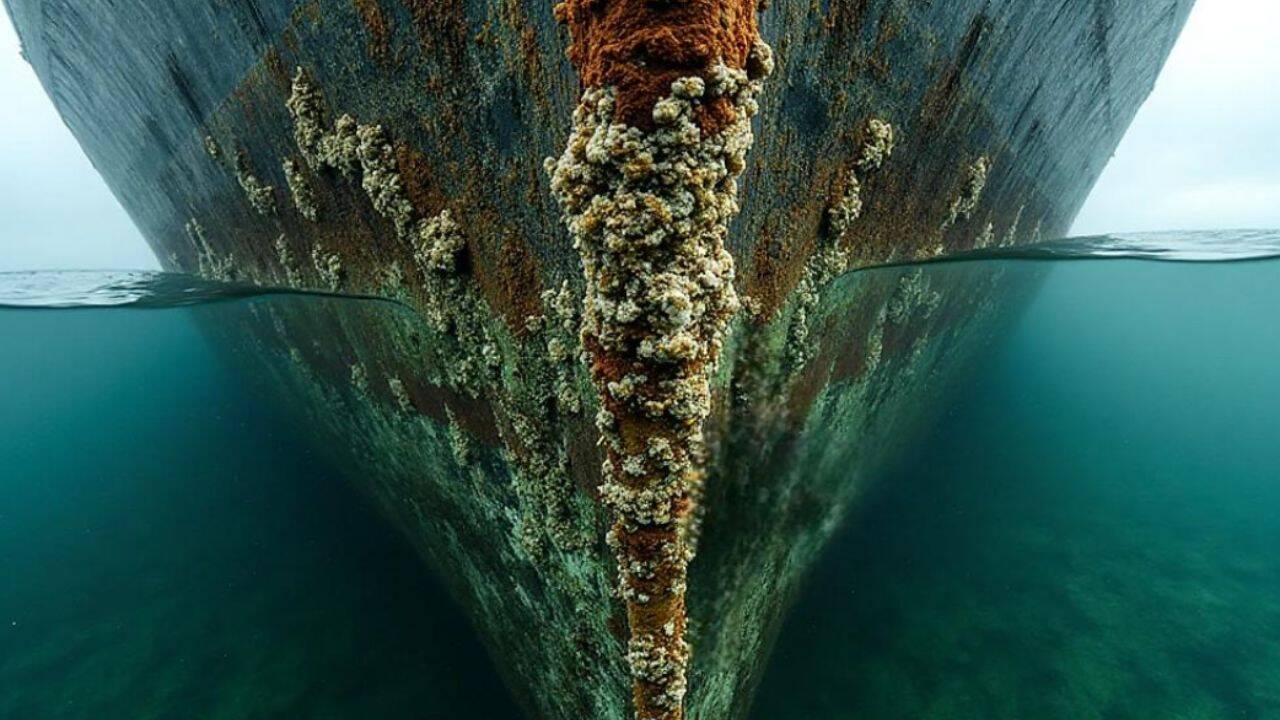
Between 2012 and 2022, nearly 30,000 commercial vessels sailed into Alaskan ports, dragging an invisible, expanding ecosystem across the North Pacific. That massive fleet delivered a cumulative 430 square kilometers of submerged wetted surface area directly into fragile northern waters.
This is not a minor footnote in shipping logs. It represents a 50 percent expansion in biofouling habitat over a single decade, transforming every cruise liner, oil tanker, and container ship into an unintended mobile nursery for marine non-indigenous species (NIS). While public attention remains fixed on melting glaciers and carbon footprints, commercial hulls are quietly rewriting the biological baseline of the Last Frontier.
The Mathematics of Marine Hitchhikers
To understand how a foreign organism crosses an ocean, you have to look at the geometry of a ship underwater. A floating hull is essentially an artificial reef moving at twenty knots. Mussels, tunicates, barnacles, and algae cling to flat plates, recessed sea chests, and pipe niches, surviving transits that should theoretically kill them.
The sheer scale defies casual oversight. During the studied eleven-year timeline, commercial arrivals grew by 23 percent, but the total wetted surface area expanded at a much faster clip. It jumped from 39.9 square kilometers in 2012 to 59.7 square kilometers by 2022.
Passenger vessels drove this surge. Accounting for 15,984 arrivals, these massive floating hotels dwarf other commercial traffic in both physical dimensions and frequency. A single modern cruise ship presents an average wetted surface area approaching 18,000 square meters. Multiply that by hundreds of seasonal sailings through the Inside Passage, and you realize that southeast Alaska functions as a high-volume biological highway.
Regional Fault Lines in the North Pacific
Not all Alaskan waters face the same degree of vulnerability. The crisis fractures unevenly across distinct geographic corridors, each dominated by specific commercial sectors.
The North American Pacific Fjordland region absorbed the brunt of the traffic, recording nearly 15,000 arrivals over the decade, overwhelmingly driven by passenger fleets. The intricate maze of fjords and sheltered bays creates a compounding hazard. Protected waters mean less turbulent sloughing of hull communities, allowing hitchhiking organisms a higher survival rate upon arrival.
Further west, the Gulf of Alaska belongs to the tankers. Pushing crude and refined products from southern refineries or international ports, these heavy vessels introduce distinct biofouling profiles. Meanwhile, container ships concentrate heavily on Aleutian hubs like Dutch Harbor, creating isolated entry points from Asian Pacific trade routes.
Crucially, over half of all arrivals originated from within Alaska itself, while another third traced back to the broader North American Pacific coastline. Localized shipping does not eliminate biological threat; instead, it acts as a regional distributor, turbocharging the spread of aggressive species from one local ecosystem to untouched neighboring bays.
The Warming Catalyst
Biology obeys temperature. For decades, Alaska's frigid coastal waters served as a natural thermal barrier, keeping temperate or tropical marine invaders from establishing permanent breeding populations.
That barrier is failing. Climate change is rewriting marine isotherms across the sub-Arctic. As water temperatures tick upward, environments that once rejected foreign organisms are turning hospitable. A tunicate or crab larva dropped off a ship's hull in 2012 might have frozen before finding a foothold. That same organism arriving today finds a welcoming habitat.
Consider the European green crab. Documented expanding its northern range, this aggressive invader wreaks havoc on local shellfish populations, uprooting eelgrass beds and decimating juvenile commercial fish stocks. When paired with the relentless influx of fresh hull surfaces, warming waters convert minor transport events into full-scale biological invasions.
Where Traditional Oversight Falls Short
Current regulatory frameworks remain heavily focused on ballast water management, treating internal water tanks as the primary vector for marine introductions. Ballast treatment systems have indeed grown more sophisticated, filtering out sediments and micro-organisms before coastal discharge.
Yet hulls remain the regulatory blind spot. Anti-fouling coatings degrade over time, lose efficacy during extended port stays, or suffer physical damage against ice and docks. Ships frequently operate on tight turnaround schedules where underwater cleaning is restricted or neglected to maintain commercial momentum.
Enforcement options in remote Alaskan ports are sparse. Federal and state agencies lack the diving infrastructure, manpower, and budgetary resources to routinely inspect the submerged portions of incoming commercial fleets. Captains operate largely on the honor system regarding hull maintenance intervals and anti-fouling paint lifespans.
Managing the Invisible Tide
Mitigating this risk requires moving past reactive crisis management. Researchers emphasize that establishing granular risk baselines is the mandatory first step. By mapping which vessel classes and specific routes carry the highest environmental similarity to Alaska's coastal zones, regulators can better target scarce inspection resources.
Ports with high environmental matching scores require mandatory pre-arrival reporting on hull cleaning history and dry-dock schedules. Incentivizing shipping lines to adopt advanced, non-toxic silicone foul-release coatings can dramatically cut the physical attachment rates of marine NIS.
The biological integrity of Prince William Sound and the entire Alaskan coastline hangs in the balance. Every square kilometer of submerged hull entering these waters represents an active gamble with the future of native marine habitats, commercial fisheries, and subsistence food sources. The ships will keep coming, but the tolerance for unmonitored biological transit has run out.


