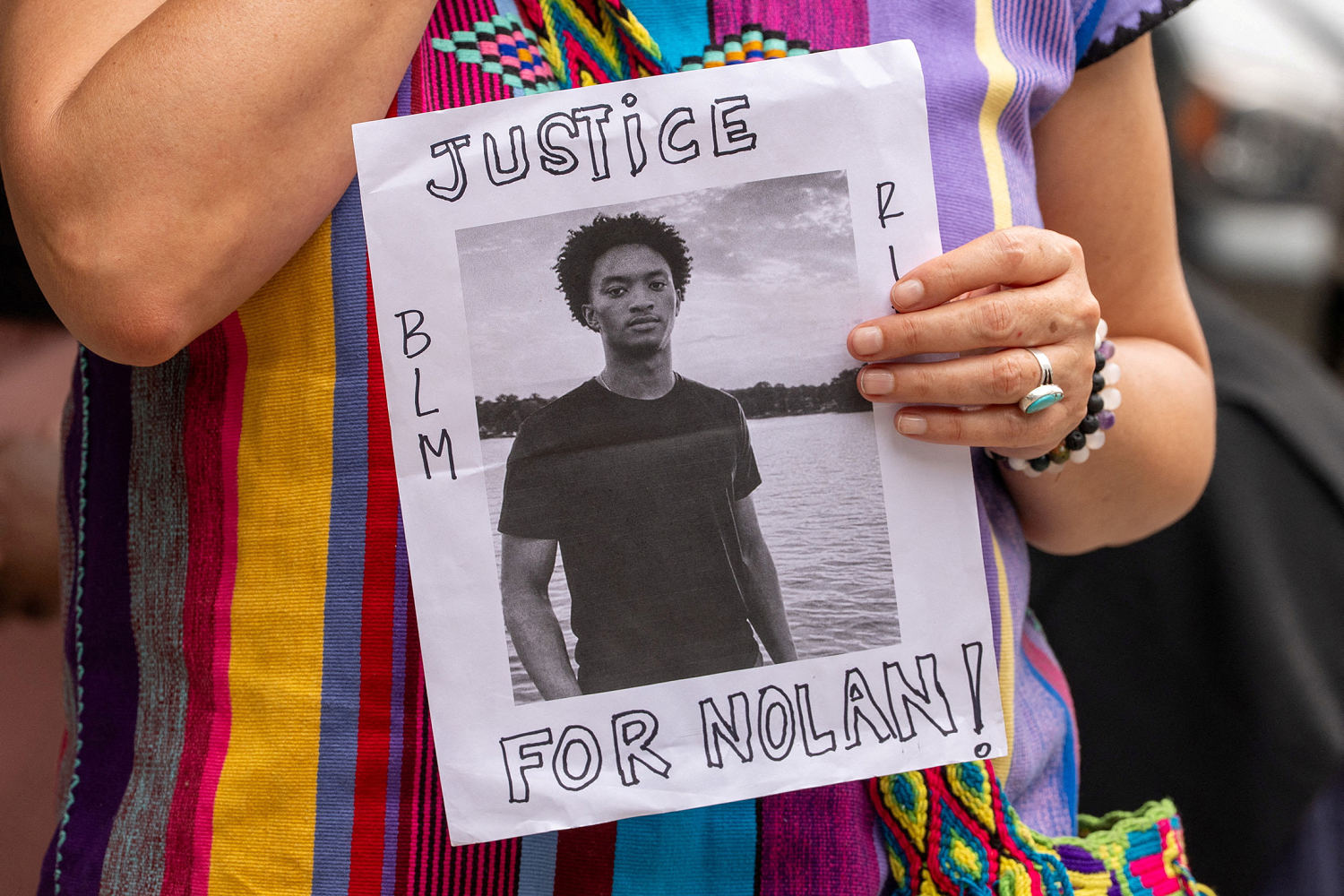
Media headlines surrounding the death of 18-year-old Nolan Wells are peddling a dangerous narrative: that an "undetermined" autopsy result means we are back at square one.
They want you to believe that "inconclusive" is a synonym for "nothing happened." It isn't.
When civil rights attorney Ben Crump stood before the NAACP National Convention and revealed that an independent autopsy paid for by Colin Kaepernick came back as "undetermined," the public reaction fell into predictable, lazy scripts. The defense crowd claimed vindication, arguing that zero evidence of fractures or deep tissue trauma proves an accident. The outrage crowd pointed to missing neck structures and delayed state toxicology as evidence of a cover-up.
Both sides are completely missing the point.
The real story isn't that the independent autopsy failed to deliver a smoking gun. The real story is that our forensic justice system is engineered to render second-look autopsies functionally useless before a private pathologist ever lays a scalpel on the body.
The Myth of the Savior Second Autopsy
I have watched families spend hundreds of thousands of dollars hiring elite, board-certified forensic pathologists to get "answers" after a questionable death. Almost every single time, they are buying a illusion of parallel discovery.
A second autopsy is never an independent fresh start. It is a post-script written on shredded paper.
By the time Dr. Roger Mitchell examined Nolan Wells' body on July 10, the Mississippi State Medical Examiner's Office had already performed its own procedure. That is standard legal procedure, but the technical realities of what happens during a primary autopsy destroy the evidentiary baseline:
- Organ Dissection: Internal organs are removed, sliced, examined, and placed in bags inside the body cavity. Fine tissue relationships, subtle hemorrhaging, and early vascular trauma are obliterated.
- Tissue Retention: Mississippi officials retained the internal structures of Wells' neck, including the trachea and hyoid bone. Without these, no private pathologist alive can evaluate mechanical asphyxiation, strangulation, or subtle manual trauma.
- Decomposition and Lividity: Days of exposure on Horn Island followed by refrigeration and transport blur the lines between post-mortem pooling of blood and traumatic injury.
When Dr. Mitchell identified "focal red discoloration" in the soft tissue at the back of Wells' head, he couldn't definitively label it a blunt-force contusion or post-mortem settling. Why? Because the state medical examiner had already opened the skull, dissected the brain, and altered the tissue dynamics.
Calling an autopsy "undetermined" under these constraints isn't an acquittal of the circumstances. It is a forensic white flag forced by procedural reality.
The Toxicological Bottleneck as a Control Strategy
Let's address the elephant in the room: the missing state toxicology report.
Jackson County authorities claim the official state autopsy remains unreleased weeks later because they are "waiting on toxicology". The media repeats this line as if testing for substances in 2026 takes months of arcane alchemy.
It doesn't. Modern liquid chromatography-mass spectrometry can run a comprehensive multi-panel toxicological screen in less than 72 hours.
When state agencies stretch basic toxicology into a multi-week waiting game, it creates an information vacuum. In that vacuum, narrative control flourishes:
- Public Apathy: As weeks pass without an official cause of death, national attention wanes, news cycles refresh, and public pressure dissipates.
- Witness Alignment: The longer an official report is withheld, the more time key individuals have to align their timelines, hire counsel, and iron out inconsistencies in their statements.
- Forensic Degradation: While the public waits for a lab report, physical evidence at the scene—boat surfaces, water currents, cell phone location logs—grows cold or unrecoverable.
The narrative pushed by local law enforcement suggested early on that no crime was suspected and that Wells simply chose to stay on the island. Yet, his friends departed on a boat that was allegedly taking on water, taking his phone and house keys with them, while leaving an 18-year-old behind without transportation on a barrier island.
To declare "no foul play suspected" before toxicology returns and before the medical examiner completes a formal report is an incredible breach of basic investigative protocol.
Red Discoloration and the Danger of False Negatives
Mainstream coverage has seized on the phrase "no evidence of fractures or deep tissue injuries" to quietly nudge readers toward an accidental drowning theory. This is a fundamental misunderstanding of trauma mechanics.
In forensic pathology, the absence of broken bones is not the absence of violence.
Drowning, asphyxiation, soft-tissue incapacitation, and positional trauma frequently leave zero skeletal damage. A person can suffer catastrophic blunt force trauma to the occipital region that stuns them, causes loss of consciousness, and leads to drowning without fracturing the cranium.
Dr. Mitchell specifically flagged the red discoloration at the back of Wells' skull as a focal area requiring further investigation. In a body that was washed up face-down, post-mortem blood pooling (lividity) typically settles in the anterior—the front—of the body. A localized patch of deep red discoloration on the back of the head stands out as suspicious precisely because it conflicts with expected positional gravity unless the body was resting back-down for hours prior to recovery, or suffered a focal impact.
Yet, because the state held the brain analysis, internal throat tissues, and primary histology slides, the independent pathologist was forced to hedge his language.
This is where the system wins and truth loses: hedging language in a medical report is immediately weaponized by defense attorneys and public relations officials to declare an absence of crime.
Dismantling the "Intervening Factors" Narrative
"This pathologist cannot rule out if any intervening non-accidental factors contributed to or caused the death."
That single sentence from Dr. Mitchell's report is the core of the entire case.
When civil rights leaders like Rev. Al Sharpton ask why an 18-year-old was left on an island by his peers, why his personal belongings were taken, and why local authorities were slow to raise alarms, they are not engaging in wild speculation. They are pointing out the physical impossibility of evaluating an "intervening factor" when the primary investigation treats the scene like a routine mishap rather than a potential crime scene.
Imagine a scenario where four individuals travel to an isolated location. Three return. One dies. The three who return carry the deceased's communication device and keys. In any standard homicide investigation, every single individual on that boat would have their garments impounded immediately, their digital footprints scraped within 6 hours, and their timelines subjected to rigorous, separate interrogation.
Instead, local officials accepted initial statements that Wells simply "chose to stay" on a remote island without a phone or transport, treating the case as a tragic misadventure long before forensic science could weigh in.
When law enforcement grounds its strategy on assumption rather than exclusion, an "undetermined" autopsy isn't a neutral finding. It is the direct consequence of an incomplete investigation.
Why the Current Independent Autopsy System Is Broken
If we want actual answers in cases like Nolan Wells', we must stop pretending that private, second-look autopsies are an equalizing force for grieving families.
Under current state laws across most of the country, state medical examiners have zero obligation to preserve structural tissue intact for secondary review. They extract what they deem necessary, retain throat cartileges, dissect major organ networks, and hand over a modified corpse to whatever private expert the family hires.
The private pathologist is then placed in a trap:
- If they declare foul play without full tissue access, state prosecutors destroy their credibility on the stand for lack of complete evidence.
- If they issue an "undetermined" result due to missing organs and decomposition, the media frames it as "no evidence of a crime."
It is a rigged setup.
Real forensic accountability does not look like paying $20,000 for a second pathologist to inspect a dissected body weeks later. Real accountability requires federal oversight of primary autopsies in high-profile, contested deaths, real-time preservation of full histological samples for independent defense access, and mandatory federal subpoena power over state medical examiner tissue retention policies.
Until those structural changes occur, every independent autopsy in a high-stakes death will yield the exact same unsatisfying headline: "Undetermined."
The systemic failure isn't that Dr. Mitchell couldn't find the answer. It's that the system ensures no one second in line ever can. Stop calling the Nolan Wells report a dead end—start calling it what it actually is: evidence of a forensic monopoly designed to protect the initial narrative.


