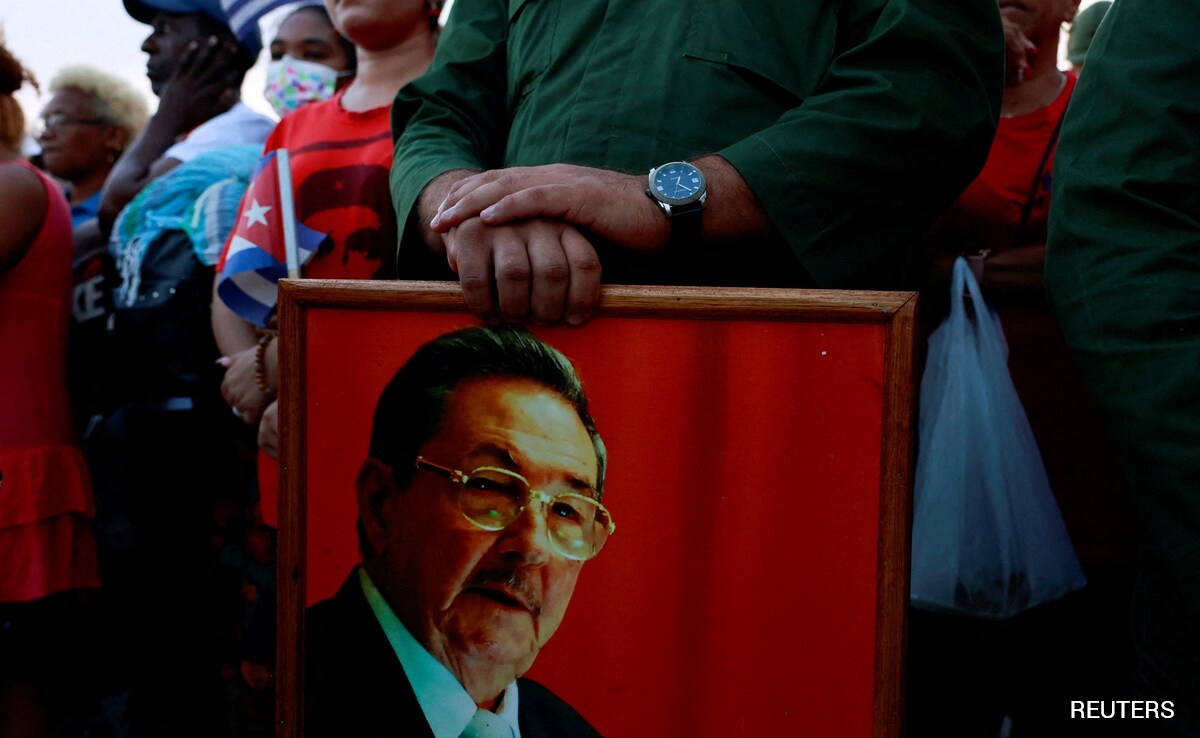
The White House believes it has found a winning formula for regime change in the Caribbean, but the arithmetic is dangerously flawed. Following the dramatic January military operation that extracted Venezuelan President Nicolás Maduro from power, the Trump administration has turned its full attention toward Havana. An oil blockade is tightening, U.S. naval assets are patrolling the Caribbean, and the Justice Department recently unsealed a criminal indictment against 94-year-old Raúl Castro. President Trump summarized the strategy bluntly, declaring Cuba a "failed country" and claiming that he would be the one to finally push it over the edge.
Yet the assumption that Cuba will fall precisely like Venezuela misreads the structural realities of the island. Washington is attempting to execute an identical playbook on a completely different adversary. While Venezuela collapsed because its state machinery was fragile and its political opposition was highly organized, Cuba possesses a monolithic security apparatus and no viable successor waiting in the wings.
Maximum pressure can destroy an economy, but it cannot automatically manufacture a transition of power. By treating Cuba as a mirror image of Venezuela, American foreign policy is courting a massive migration disaster rather than a diplomatic victory.
The Mirage of the Internal Successor
The most glaring flaw in Washington’s current strategy is the total absence of an institutional alternative in Havana. The January operation in Caracas succeeded because there was a clear, pre-arranged political transition. When American special forces removed Maduro, his vice president, Delcy Rodríguez, stepped into the vacuum with explicit U.S. approval, keeping the state intact and preventing total anarchy.
There is no Delcy Rodríguez in Cuba.
The Cuban political landscape has been intentionally scrubbed of independent power centers. Decades of institutional design have ensured that the Communist Party and the Revolutionary Armed Forces operate as a single, indivisible entity. In Venezuela, the political opposition was fractious but highly organized, uniting behind a single electoral banner to challenge the regime. In Cuba, the domestic opposition has been systematically dismantled. Its most prominent leaders are either serving long prison sentences or living in exile.
If the American government were to successfully decapitate the Cuban leadership tomorrow, it would not find a waiting democratic coalition. It would find a vacuum. The administration’s own intelligence assessments suggest that even if the top tier of the Cuban state were removed, the military would not split; it would close ranks to protect its corporate survival.
Starvation is Not a Strategy
The current economic offensive centers on a strict oil blockade designed to cut off Cuba's remaining energy supplies. With Venezuela's oil now largely diverted to U.S. refineries and Mexico halting its shipments under pressure, Cuba’s domestic energy grid has collapsed into near-permanent darkness. The island currently produces only about 40 percent of its own crude requirements.
http://googleusercontent.com/image_content/214
But historical precedent shows that economic deprivation does not translate into political rebellion. During the Special Period of the 1990s, the island lost 80 percent of its trade overnight following the collapse of the Soviet Union. The gross domestic product contracted by a third, and widespread malnutrition followed. The regime did not fall. Instead, it weaponized the scarcity, tightening social control through ration books and localized surveillance networks.
The current blockade is producing immense human suffering, leaving hospitals without power and kitchens without fuel. However, the political fallout of this misery behaves counterintuitively. When a population is consumed by the daily mechanics of basic survival, the energy required to organize a systemic rebellion disappears. Rather than building barricades, the young and capable build rafts.
The Blowback Florida Cannot Afford
The true danger of the administration's maximum pressure campaign is not that it will fail to destabilize Cuba, but that it will succeed too well. By forcing a complete economic shutdown without an institutional off-ramp, Washington is building a pressure cooker with only one release valve: the Florida Straits.
During previous moments of intense domestic pressure, the Cuban government has historically used mass migration as a geopolitical shield. By simply withdrawing its border guards, Havana can transform its internal crisis into an American domestic crisis. The migration surges of 1980 and 1994 proved that the U.S. Coast Guard cannot effectively stop thousands of improvised vessels simultaneously heading north.
For an administration that has staked its domestic reputation on border security and halting migration, the destabilization of an island of 11 million people just 90 miles from Key West is an extraordinary gamble. A sudden, chaotic collapse of the Cuban state would trigger a maritime refugee crisis that would overwhelm southern Florida's infrastructure within weeks.
A Solitary Fortress
Washington’s rhetoric frequently frames Cuba as a forward operating base for extra-regional powers like Russia and China. Intelligence reports warn of signals intelligence gathering and Chinese-backed security installations on the island. Yet this overstates the willingness of Moscow or Beijing to risk a direct military confrontation over Havana’s survival.
Cuba is geopolitically isolated in a way Venezuela never was. Venezuela possessed the largest proven oil reserves on earth, giving global empires a tangible financial stake in its preservation. Cuba possesses no such strategic commodities. While Russia can occasionally send naval escorts to accompany fuel tankers, its ongoing military commitments elsewhere limit its ability to underwrite the Cuban economy indefinitely. China views Cuba as a stable political ally, but it operates primarily as a commercial actor. Beijing will not write blank checks to subvert an American naval blockade in the Caribbean.
Havana understands its solitude. This realization has not made the regime compliant; it has made it paranoid and deeply defensive. The unsealing of indictments and the threats of military action have merely validated the ruling elite's oldest narrative: that the survival of the nation depends on total ideological uniformity.
The Limits of Absolute Resolve
The victory in Caracas has created a dangerous overconfidence within the National Security Council. The assumption that military posture and legal indictments can break a system that survived the Cold War ignores the fundamental differences in state architecture between the two nations.
Venezuela’s chavismo was a chaotic, oil-funded populist movement built on patronage and fragile alliances. Cuba’s revolutionary state is an institutional fortress built on discipline, counter-intelligence, and five decades of siege mentality.
Pressing harder on the economic gears will certainly break the remaining infrastructure of the island. It will turn off the remaining lights in Havana and empty the remaining shelves in Santiago. But it will not produce a compliant, pro-Western democracy. Washington is playing a dangerous game of leverage, ignoring the fact that when a state with no successor finally breaks, it shatters outward.
Why Cuba won't be the next Venezuela
This video analysis provides crucial expert commentary on the organizational weakness of the Cuban opposition compared to Venezuela, explaining why a political transition cannot be easily replicated on the island.