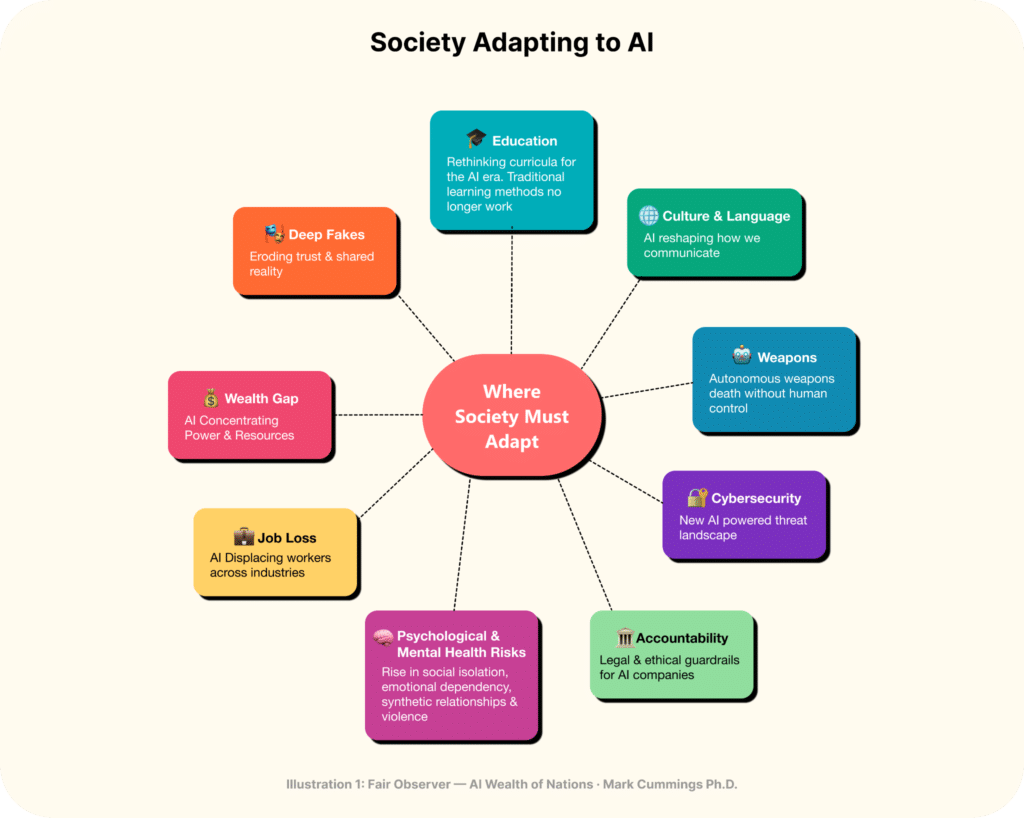
The global race to adapt to artificial intelligence is built on a fundamental lie. Silicon Valley executives and economic forums present a clean narrative where any nation can climb the ladder of progress by adopting algorithmic infrastructure. They promise that early adoption will create a tide that lifts all economies. This is mathematically impossible under current economic models. Instead of distributing wealth, automated systems are hyper-concentrating capital into a handful of corporate entities clustered in a single geographic region, leaving the rest of the world to foot the bill for data extraction and power consumption.
The true trajectory of this shift resembles nineteenth-century resource extraction far more than a digital democratization.
Governments worldwide are rushing to draft national strategies, spending billions on infrastructure they do not own and cannot maintain. They treat generative models as public utilities. They are commercial products managed by closed networks. When a developing economy integrates these systems into its civil service, banking, or education, it does not build domestic wealth. It creates a permanent subscription liability paid to a foreign technology monopoly.
The Compute Monopoly and New Resource Extraction
Economic development traditionally relied on manufacturing or services to build domestic capital. Automation upends this progression. The capital requirements for training and running large-scale computational models are so massive that only a few corporations possess the balance sheets to compete.
Consider how data center expansion operates on the ground. A multinational technology firm establishes a server facility in a developing country, citing local investment. The host country provides land, tax exemptions, and massive amounts of electricity and water to cool the servers. The local economy receives a few dozen specialized maintenance jobs. The high-value intellectual property, the processed data, and the actual profits flow directly back to the corporate headquarters in California or Seattle.
This is a classic extractive economic relationship masked by modern vocabulary.
The raw material being extracted is no longer copper or rubber; it is domestic behavioral data and public administrative records. This data train refines proprietary models, which are then sold back to the host nation’s businesses and citizens via API access fees. The domestic economy pays twice. First, they subsidize the infrastructure with their resources. Second, they buy back the refined product to keep their local industries compatible with global standards.
The Sovereign Debt Trap of National Infrastructure
Many finance ministries believe the solution is to build sovereign cloud systems and domestic models. They are walking into a financial trap. The hardware required to run these operations changes rapidly. A state-of-the-art computational facility built today will face obsolescence within three to five years as model architectures evolve.
The Capital Expenditure Cycle
To maintain a sovereign system, a government must enter a continuous cycle of capital expenditure. They must purchase specialized microprocessors from a microscopic supply chain.
- Hardware dependency: A single company controls the manufacturing designs for the most advanced chips, while a single machinery firm in Europe builds the lithography tools required to make them.
- Energy burdens: Running these facilities strains national grids, often requiring governments to burn more fossil fuels or divert renewable energy away from domestic manufacturing.
- Licensing fees: Even sovereign models rely on open-source frameworks maintained by foreign corporate entities, requiring specialized tools that carry hidden costs.
When a middle-income country borrows money to fund a national computational center, it takes on hard currency debt to buy depreciating assets. The hardware loses value faster than the economic growth it generates. If the project fails to yield immediate tax revenues, the nation is left with a massive debt load and an outdated server farm that costs millions per month just to keep cool.
The Domestic Disinvestment
This misallocation of capital starves other vital sectors. Money spent on cloud infrastructure cannot be spent on primary education, physical transport networks, or basic healthcare.
Hypothetical scenarios help clarify this trade-off. Imagine a government allocating five hundred million dollars to build a national language model to improve administrative efficiency. That money leaves the country immediately to pay for hardware imports. The efficiency gains in the civil service are marginal, saving a few minutes per file transfer. Meanwhile, the country’s agricultural sector suffers from underfunded irrigation networks, leading to a drop in crop yields that costs the economy twice what the model was supposed to save.
The Labor Fallacy and the Evaporation of the Service Desk
For thirty years, the standard playbook for emerging economies involved building a service sector. Call centers, software testing firms, and back-office processing hubs allowed countries in South Asia, Eastern Europe, and Latin America to leverage their educated, lower-cost workforces to capture global capital.
That ladder is being dismantled.
Basic code generation, technical support, and document review are the easiest tasks for automated systems to absorb. The impact is not a sudden wave of mass unemployment, but a quiet evaporation of new entry-level roles.
Companies in wealthy nations no longer need to outsource these tasks to firms abroad. They run them internally through enterprise software. The economic transmission mechanism that moved money from Western corporate treasuries into the middle classes of developing cities is shutting down.
The counter-argument from tech optimists is that these workers will transition to higher-value roles, such as prompt engineering or AI oversight. This claim ignores the scale of the labor market. A back-office processing facility that once employed four thousand people can be replaced by an enterprise software suite managed by a team of forty specialists based entirely in the United States or Western Europe. The remaining workers are pushed into the low-wage informal service economy, driving down domestic wages and shrinking the tax base.
The Geopolitical Chokepoints of Silicon and Power
The distribution of wealth in an automated world depends entirely on physical choke points. The software may feel ethereal, but the physical supply chain is incredibly concentrated.
[Advanced Lithography in Europe]
       │
       ▼
[Foundry Fabrication in East Asia]
       │
       ▼
[Cloud Data Centers in North America]
       │
       ▼
[Global Consumer Monetization]
A disruption at any point in this chain halts the global digital economy. Because these choke points are controlled by a tiny handful of nation-states and single-source suppliers, true economic sovereignty becomes impossible for the rest of the world.
If a nation relies on foreign cloud architecture to run its domestic logistics, banking, and energy distribution, it surrenders its political autonomy. The provider can alter pricing structures, change terms of service, or cut off access entirely due to regulatory shifts or geopolitical disputes. This is not a theoretical threat. Recent trade restrictions and export controls demonstrate that access to computational power is now used as an instrument of national power.
The Real Cost of Corporate Subsidies
To attract technology investments, local governments often engage in a race to the bottom, offering massive concessions that strip their own tax bases.
| Concession Type | Real Cost to Host Nation | Primary Corporate Beneficiary |
|---|---|---|
| Tax Holidays | Starves local municipal budgets of funds needed for public roads and schools. | Multinational technology providers seeking to minimize global tax liability. |
| Guaranteed Energy Pricing | Forces domestic consumers to pay higher electricity rates during peak usage. | High-consumption data center operators requiring constant power. |
| Water Rights Access | Depletes local aquifers used for agriculture and community drinking water. | Server cooling operations that run millions of gallons through heat exchangers. |
These agreements are negotiated by officials who rarely understand the technical realities of the systems they are courting. They believe they are investing in a knowledge economy. They are actually subsidizing a highly automated utility that extracts value while leaving a minimal physical footprint of prosperity behind.
The Failure of Regulatory Adaptation
Faced with these imbalances, some regions attempt to regulate their way to equity. The European Union’s approach focuses heavily on compliance, privacy frameworks, and risk management.
This strategy misunderstands the nature of economic power in this sector.
Compliance frameworks do not create wealth; they increase the cost of doing business. While a massive technology firm can easily deploy a small army of lawyers and engineers to meet complex regulatory standards, domestic startups and smaller local enterprises are crushed by the administrative overhead. The regulation inadvertently protects the foreign monopoly from local competition, solidifying the exact dependence it was meant to mitigate.
A nation cannot regulate its way into technological self-sufficiency if it does not possess the capital, the hardware, or the energy infrastructure required to build alternatives. Compliance without capability is simply an expensive way to manage dependency.
The Inevitable Wealth Stratification
The narrative of global adaptation assumes that every country can find a niche in the new economy. This view ignores the compounding returns of data accumulation. The more users a system has, the more data it collects, the better it performs, and the more capital it attracts. This feedback loop creates a winner-take-all dynamic that leaves no room for secondary players.
The gap between the countries that own the infrastructure and those that merely rent it will widen into an unbridgeable gulf. The nations renting the infrastructure will see their productivity gains eaten away by licensing fees, while their internal tax bases shrink due to the displacement of high-value service jobs. The wealth of nations in this era is not determined by how effectively a society adapts to using these tools, but by who owns the capital assets that generate them. Everything else is just a costly subscription to a future someone else designed.