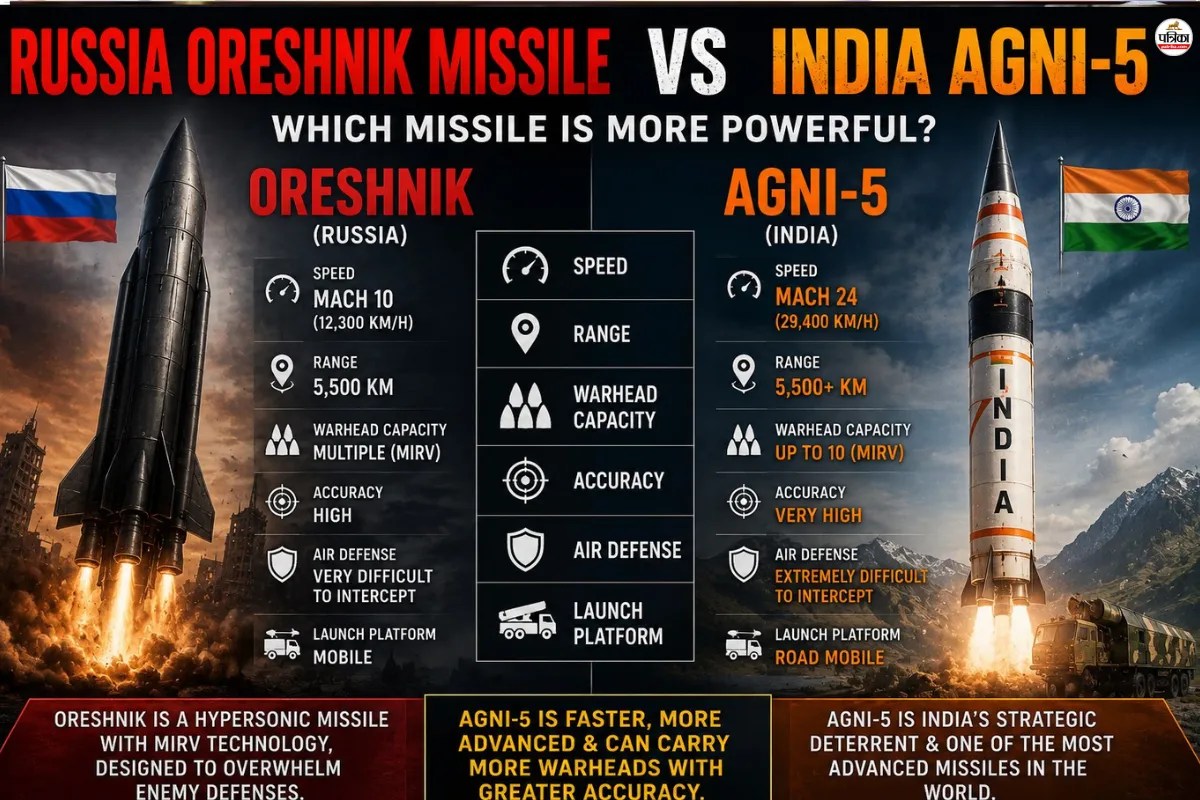
Nationalist defense commentary loves a numbers game. When Russia deployed its Oreshnik intermediate-range ballistic missile, the internet flooded with comparisons. Sensationalist headlines quickly claimed that India possesses a missile ten times more dangerous, capable of traveling eight kilometers in a single second. This translates to Mach 23. Such claims look spectacular on a smartphone screen. They spark pride. They also collapse under the slightest weight of engineering reality.
India does not have an operational Mach 23 hypersonic cruise missile. The country is making significant strides in hypersonic technology, but inflating experimental data points into operational superiority misleads the public and obscures the actual, hard-won progress of Indian defense science.
To understand where India actually stands, one must look past the hyperbole of social media commentators and examine the actual hardware currently under development by the Defence Research and Development Organisation.
The Confusion Between Ballistic Speed and Hypersonic Flight
Misinformation usually starts with a grain of misinterpretation. Ballistic missiles have always been fast. When an Intercontinental Ballistic Missile re-enters the atmosphere from space, it routinely reaches speeds between Mach 20 and Mach 25. India’s Agni-V, a proven and formidable pillar of the country's nuclear deterrent, achieves these extreme velocities during its terminal phase.
But speed alone does not make a weapon a modern hypersonic missile.
Traditional ballistic missiles follow a predictable, parabolic arc. Think of a thrown baseball. Once launched, tracking radar can calculate exactly where it will land. Modern air defense systems use these calculations to intercept incoming warheads.
The global rush for hypersonic weapons focuses on something entirely different. True hypersonic weapons fall into two categories: Hypersonic Glide Vehicles and Hypersonic Cruise Missiles. These weapons travel at speeds above Mach 5 while remaining inside the atmosphere, maneuvering unpredictably to evade radar detection.
India's Agni-V is a highly successful strategic asset. It is not, however, an atmospheric maneuvering weapon that outclasses Russia's latest missile technology by a factor of ten. Labeling it as such conflates raw re-entry speed with low-altitude maneuvering capability.
What India is Actually Testing
The real story of Indian hypersonic development takes place at the Dr. APJ Abdul Kalam Island launch complex. Here, scientists are working on the Hypersonic Technology Demonstrator Vehicle.
This project does not rely on standard rocket fuel alone. It uses a scramjet engine.
A conventional jet engine uses spinning blades to compress incoming air before mixing it with fuel. At speeds above Mach 5, those blades would melt or shatter. A scramjet has no moving parts. It relies on the forward speed of the vehicle to compress the incoming air at supersonic velocities.
Maintaining combustion in a scramjet stream is incredibly difficult. Engineers often compare it to lighting a match in a hurricane and keeping it lit.
During testing, India's demonstrator vehicle achieved scramjet-powered flight for around twenty seconds, reaching a speed of Mach 6. This was a massive achievement for domestic engineering. It proved that the country could manufacture materials capable of withstanding friction-induced temperatures exceeding 1000 degrees Celsius.
Yet, twenty seconds of flight at Mach 6 is a long way from an operational weapon system traveling at Mach 23. A weapon system requires guidance computers that can function through a thick shroud of superheated plasma, steering fins that can withstand immense aerodynamic stress, and a payload delivery mechanism that operates reliably under extreme g-forces.
The Global Context and the Supply Chain Bottleneck
India is not developing this technology in a vacuum. Russia, China, and the United States have spent decades and billions of dollars trying to master atmospheric hypersonic flight. Even with their massive budgets, failures are frequent.
The Western defense establishment frequently struggles with prototype testing failures, while Russian deployments like the Kinzhal have faced mixed results against modern air defense systems in active conflict zones.
For India, the primary obstacle to deploying these advanced systems isn't a lack of scientific intellect. It is the domestic industrial base.
Developing a prototype is an academic exercise. Mass-producing weapons requires specialized infrastructure.
- Advanced carbon-carbon composites to prevent the missile from burning up.
- High-end semiconductor foundries to create chips that survive high-radiation and high-temperature environments.
- Specialized wind tunnels capable of simulating sustained Mach 6+ airflow for minutes rather than milliseconds.
India currently relies heavily on foreign imports for specialized raw materials and precision manufacturing equipment. Until the domestic supply chain catches up to the designs coming out of government laboratories, weapon systems based on scramjet technology will remain experimental.
The Operational Reality of the BrahMos Connection
While the scramjet demonstrator represents the long-term future, India's immediate hypersonic ambitions rest on a more practical foundation: the BrahMos-II.
This project is a joint venture with Russia. It aims to replace the current supersonic BrahMos missile with a hypersonic variant capable of speeds around Mach 7 or Mach 8. By leveraging Russian experience with the Zircon hypersonic missile, India aims to bypass years of trial-and-error development.
The BrahMos-II will likely be a regional factor, intended for deployment on naval destroyers and modified aircraft. It will not travel at Mach 23. It will not render every other global superpower's arsenal obsolete overnight.
What it will do is provide a reliable, high-speed strike option that reduces an adversary's reaction time from minutes to seconds. That is the actual strategic value of these weapons. It is not about achieving absurd, fictional speed records; it is about creating a window of vulnerability that an enemy's command structure cannot close in time.
Why Sensationalism Hurts National Defense
When media outlets publish exaggerated claims about domestic weapons, they create a false sense of security among the public. It fosters the illusion that military modernization is complete and that India already possesses uncontested technological dominance.
The reality inside the defense ministry is much more sober. Policymakers know that India faces a multi-front challenge, particularly from neighbors investing heavily in military infrastructure and domestic research.
Accurate reporting highlights the real victories of Indian scientists without inventing fairy tales. Building a working scramjet engine is an elite feat shared by only a handful of nations. That achievement stands on its own merit. It does not need to be amplified by internet rumors or compared to foreign missile systems via flawed mathematical equations.
The true metric of a nation's defense capability is found in verified deployment, industrial scalability, and operational reliability under combat conditions. Everything else is just noise.