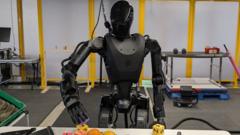
You’ve seen the videos of sleek metal bipedal machines doing backflips in laboratory conditions. You’ve probably dismissed them as expensive public relations stunts or tech-bro fever dreams. It’s easy to think that putting a two-legged robot on a messy, mud-soaked, chaotic battlefield is decades away.
You’re wrong.
The military deployment of humanoid robots isn't a distant sci-fi scenario. It's happening right now in testing grounds, training exercises, and active conflict zones. While the public debates the ethics of algorithm-driven warfare, defense startups and global superpowers are already pouring millions into hardware meant to walk, climb, and shoot exactly like a human infantryman.
The question isn't whether humanoid robots are heading for the battlefield. The real question is how commanders intend to use them, and what happens when these machines are handed the authority to pull the trigger.
The Real Reason the Military Wants the Human Form Factor
Military analysts often get caught up in a logical trap. They argue that tracks, wheels, and rotors are far more efficient than two legs. A tracked vehicle doesn't trip over a rock. A quadcopter drone can fly over a wall instead of opening a door.
That misses the point entirely.
Our world was built by humans, for humans. Every trench dug in eastern Europe, every concrete staircase in a dense urban combat zone, and every door handle in a government building was designed around the constraints of human anatomy. If you want a robotic system that can seamlessly clear a building, climb a ladder into a sniper position, or jump into the driver's seat of an ordinary unarmored transport truck without modifying the vehicle, it needs to be shaped like a human.
Take the Phantom MK-1, a bipedal machine built by the defense startup Foundation. The firm has pulled in $24 million in research contracts from the U.S. Army, Navy, and Air Force. This isn't a lab pet. It walks at four miles per hour, carries a 44-pound payload, and is built explicitly to navigate the rubble, doorways, and staircases of urban warfare.
More importantly, a humanoid form factor solves a massive logistics headache. A bipedal robot can use standard-issue military equipment. It can pick up an M4 rifle, throw a standard fragmentation grenade, or put on standard ballistic body armor. You don't need to build a bespoke supply chain for custom robotic parts when the machine can just grab whatever is lying around the motor pool.
The Secret Front Line Trials of 2026
If you think these machines are only operating in safe domestic testing facilities, look closely at the modern conflict zones. In February 2026, two Phantom units were quietly sent to Ukraine for initial frontline reconnaissance support. They aren't engaged in sci-fi movie firefights yet, but they're doing something nearly as dangerous: mapping out enemy positions and testing how well bipedal mechanics hold up in real, unfiltered combat muck.
Meanwhile, during the joint African Lion 2026 military exercises in Morocco, the U.S. Army heavily tested how to shorten the "kill chain" using autonomous systems. While wheeled vehicles like Overland AI's ULTRA handled heavy desert transit, the software governing these operations showed exactly where the tech is going.
The Pentagon is pairing these rugged frames with incredibly sophisticated artificial intelligence. For example, Figure AI's recent integration of vision-language-action models allows robots to understand conversational commands, analyze a physical room, and adapt to chaotic changes without a remote operator babysitting every step. When you give a machine a broad objective—like "clear this bunker"—and its software can figure out how to navigate the terrain and handle obstacles on the fly, the nature of infantry combat changes completely.
The Fine Motor Skills Nightmare
Despite the rapid progress, military contractors face a massive engineering wall that has nothing to do with weapons or armor.
Hands.
Human hands are an evolutionary miracle. We instinctively know exactly how hard to grip a fragile glass bulb versus a heavy steel crowbar. Humanoid robots still struggle immensely with tactile feel. During industrial trials, even advanced humanoids frequently drop tools or crush objects because they lack real-time haptic feedback.
Imagine a robot trying to clear a jammed machine gun or reload a magazine in a freezing downpour while its metal fingers slide off the wet steel components. If a robot can't handle fine motor tasks under stress, it becomes an incredibly expensive paperweight on the front line.
There's also the issue of power. These machines are incredibly power-hungry. While industrial humanoids like Apptronik’s Apollo use hot-swappable batteries to achieve long runtime cycles in structured factory environments, a muddy trench doesn't have a charging dock. A humanoid soldier that runs out of juice after a few hours of intense physical exertion is just a hunk of scrap metal waiting to be captured by the enemy.
The Ethical Fiction of the Human in the Loop
Every major military power insists that autonomous weapons will always keep a "human in the loop." They promise that an AI will never make the final decision to end a human life; a flesh-and-blood operator will always have to authorize the shot.
Honestly, that's a comforting lie we tell ourselves to feel better about the technology.
Modern warfare moves too fast for human reaction times. When a swarm of FPV drones or a squad of robotic systems breaches a defensive line, waiting for a remote operator three hundred miles away to click "confirm" on a laptop screen means death. The pressure to compress the decision-making cycle means autonomous firing modes are already technically possible and highly sought after.
When defense executives pitch these machines, they use a predictable script. They claim robot soldiers will save lives. They point out that a machine doesn't get tired, doesn't suffer from PTSD, and won't commit war crimes out of panic or revenge. But critics are rightfully terrified. Handing over lethal targeting to neural networks that still hallucinate basic facts or misidentify objects under weird lighting conditions is an invitation for catastrophic errors.
Surviving the Transition to Robotic Warfare
The push toward autonomous, bipedal combat units is moving too fast to stop. If you're a defense contractor, military strategist, or tech observer, you need to look past the hype and focus on the immediate operational realities.
First, stop looking at humanoids as standalone super-soldiers. They are going to be deployed as force multipliers. The immediate next step is the integration of mixed squads, where one or two humanoids handle the highest-risk tasks—like opening doors in an uncleared building or walking through a suspected minefield—while a human squad leader directs them from a protected armored vehicle nearby.
Second, watch the supply chain rather than the tech keynotes. The nation that wins the robotic warfare race isn't the one with the flashiest prototype. It's the nation that can mass-produce ruggedized, weather-insulated bipedal frames by the tens of thousands. Companies are already targeting production facilities capable of churning out over 12,000 units a year. When those numbers scale up, the traditional infantry numbers game changes forever.
Keep your eyes on the upcoming field evaluations later this year. The gap between science fiction and actual defense procurement has officially closed.
The 5 Most TERRIFYING And SHOCKING Humanoids to Enter War in 2026…
This video provides an excellent breakdown of the top humanoid robots currently being positioned for military adaptation, highlighting how AI integration is changing autonomy on the ground.

:max_bytes(150000):strip_icc():focal(665x0:667x2)/gettyimages-50733149-2000-8b129a2475974982a915418ce92a73d8.jpg)

