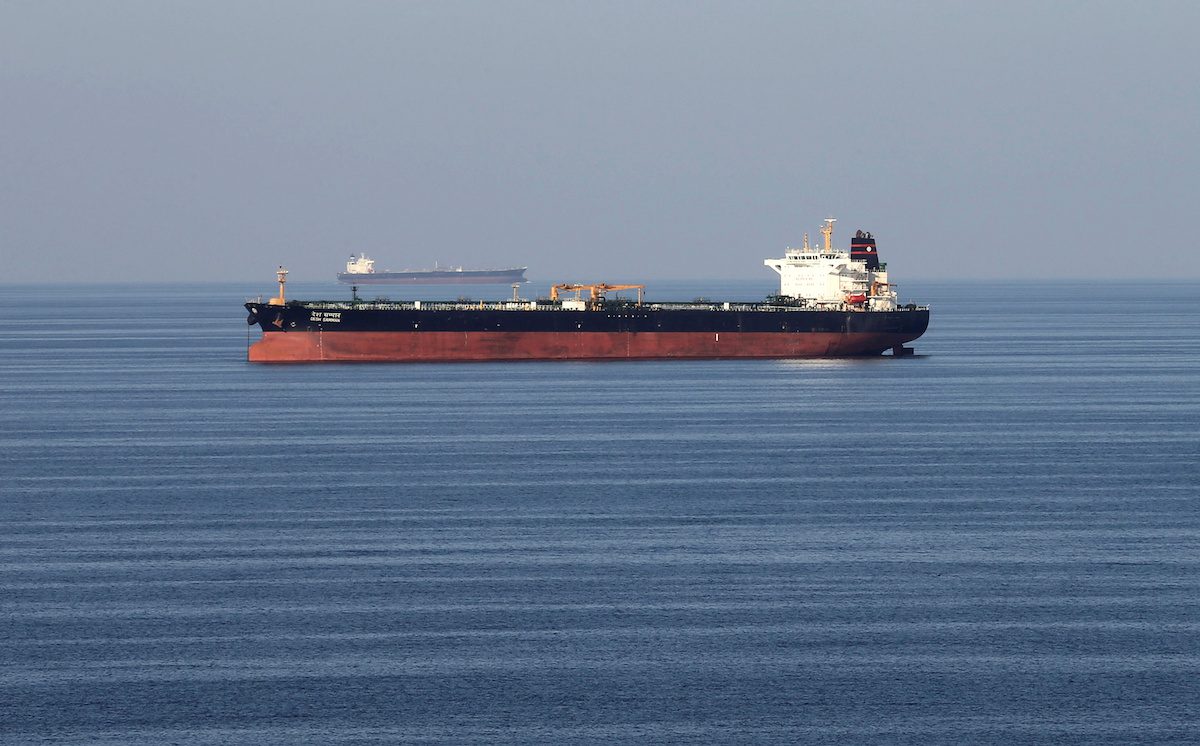
The footage is cinematic perfection. Black-clad commandos fast-roping from a Mi-17 helicopter onto the deck of the MSC Aries. It looks like a high-stakes thriller, a desperate act of aggression, or a "provocation" depending on which mainstream news ticker you’re reading.
The media wants you to see a security failure. They want you to see "piracy." They are wrong.
What happened in the Strait of Hormuz wasn't a lapse in maritime security. It was a masterclass in low-cost, high-leverage geopolitical signaling that the West—and India—is currently failing to decode. While analysts scramble to talk about "shipping lane vulnerability," they are missing the reality: the physical ship is irrelevant. The helicopter is a prop. The entire event is a data packet sent through the only protocol the global North still pays attention to: the supply chain.
The Myth of the "Vulnerable" Tanker
The prevailing narrative suggests that these vessels are sitting ducks, victims of a lawless regime. This is the first lie. Every major shipping conglomerate and sovereign navy knows exactly where the Iranian Revolutionary Guard Corps (IRGC) operates. If the MSC Aries—a Portuguese-flagged vessel associated with Israeli billionaire Eyal Ofer—was seized, it wasn't because it was "caught." It was because its presence served as the perfect sacrificial lamb for a specific diplomatic message.
We call it "piracy" because that word invokes a sense of chaotic criminality. It makes us feel superior. But real piracy is messy. It’s Somalis in skiffs looking for a payday. This? This is state-sponsored maritime foreclosure.
When the IRGC seizes a ship, they aren't looking for ransom. They are stress-testing the global insurance market. They are proving that they can raise the "war risk" premiums on every vessel entering the Persian Gulf with a single rope and a 40-year-old Soviet helicopter.
The Calculus of the Choke Point
The Strait of Hormuz is roughly 21 miles wide at its narrowest point. About a third of the world’s liquefied natural gas and 25% of total global oil consumption passes through this needle's eye.
Standard defense logic says: Send more destroyers. Escort the tankers.
That is a 20th-century solution to a 21st-century psychological war. You cannot "defend" a choke point against a neighbor who lives there. It’s like trying to guard your front door while your roommate holds the keys and a flamethrower.
The IRGC doesn't need to win a naval battle. They don't need a blue-water navy. They just need to maintain the possibility of a shutdown. By seizing a ship bound for India, they aren't attacking India; they are reminding the BRICS nations that Western security guarantees—like those provided by the U.S. 5th Fleet—are essentially decorative when the boots hit the deck.
The Cost-Asymmetry Equation
Let’s look at the math, because the math is where the "experts" get embarrassed.
- The Cost of Capture: One Mi-17 flight, twenty commandos, and a few gallons of fuel. Total: Less than $50,000.
- The Cost of Response: Deploying a Carrier Strike Group (CSG) to the region costs roughly $6.5 million per day just in operational expenses.
- The Economic Fallout: A 1% rise in global oil prices due to "regional instability" translates to billions of dollars in shifted market cap within hours.
Iran is trading pennies for dollars. They are using kinetic theater to achieve macroeconomic results. If you think this is about a cargo of containers, you’re still playing checkers.
Why India is the Target (And Why It Isn't)
The MSC Aries was India-bound, with 17 Indian crew members on board. The headlines in Delhi screamed about the "threat to Indian interests."
This is where the nuance is buried. Iran and India have historically maintained a functional, even friendly, relationship centered around the Chabahar Port and the International North-South Transport Corridor (INSTC). Why would Tehran poke the lion?
They aren't poking the lion. They are showing the lion that its friends are unreliable.
By seizing a ship with an Israeli connection that is servicing the Indian market, Iran is forcing India to choose between its burgeoning strategic partnership with Israel and its energy/security reliance on the Persian Gulf. It’s a wedge maneuver. It’s designed to prove that the "India-Middle East-Europe Economic Corridor" (IMEC) is a fantasy if it doesn't have Tehran's blessing.
The Failure of "Maritime Security" Tech
I have watched companies spend tens of millions on "cutting-edge" AI-driven maritime domain awareness. They have satellites tracking every AIS (Automatic Identification System) signal. They have drones. They have "smart" hulls.
None of it mattered.
The IRGC commandos simply turned off the ship’s AIS. In an instant, a 150,000-ton vessel became a ghost. The "transparent ocean" promised by tech startups is a myth. The sea is big, it is dark, and it is incredibly easy to hide a ship if you have the keys to the neighborhood.
We are over-reliant on digital solutions for a physical problem. You cannot "hack" a commando sliding down a rope. You cannot "disrupt" a seizure with a software update. The obsession with technological solutions to geopolitical friction is a tax on the naive.
The Insurance Market is the Real Battlefield
If you want to know who is actually winning this conflict, don't look at the Pentagon’s briefings. Look at Lloyd’s of London.
The shipping industry operates on razor-thin margins. When the "War Risk" premium jumps from 0.01% to 0.7% of a vessel's value, the entire trade route becomes toxic. Iran knows this. They are attacking the accounting of global trade.
Every time a video of a masked commando goes viral, a risk assessor in a London office hits a key that makes it more expensive for you to buy gasoline, electronics, and grain. This isn't "interdicting trade"; it’s "taxing existence." Iran has figured out how to levy a global tax without owning a single central bank.
Stop Asking "How Do We Stop It?"
The question itself is flawed. You don't "stop" a country from exercising its geography.
The Western obsession with "securing the lanes" assumes that the status quo of the last 40 years is a natural right. It isn't. It was an anomaly supported by a unipolar power that no longer has the stomach—or the checkbook—for a permanent blockade of the Iranian coast.
Instead of asking how to stop the seizures, the real industry insiders are asking: What is the price of the bypass?
We are seeing a permanent shift toward land-based trade routes and "friend-shoring." But even those are pipe dreams. You can't pipe the volume of the Strait of Hormuz through a train line in Kazakhstan.
The Brutal Reality of the New Era
The seizure of the MSC Aries is the funeral for the "Global Commons." The idea that the oceans belong to everyone and are governed by the "rule of law" is being replaced by a much older, more honest rule: The sea belongs to whoever can board the ship.
We are entering an era of "Geopolitical Subscription Models." If you want your cargo to pass through a specific region, you don't pay for "security"—you pay for relevance. You ensure that the local power has a vested interest in your ship arriving.
India’s mistake wasn't a lack of naval escort. Its mistake was thinking it could remain "neutral" while its supply chain was tethered to a billionaire in Tel Aviv and a port in Dubai, all while skirting the literal territorial waters of a sanctioned power with nothing to lose.
The "De-escalation" Trap
Whenever these seizures happen, the diplomatic corps immediately calls for "de-escalation."
De-escalation is a euphemism for "returning to the status quo that favored us." Iran has no interest in de-escalating. Why would they? They have found a way to paralyze global shipping, embarrass the U.S. Navy, and force India to the negotiating table, all for the price of a few hours of flight time.
The "masked commandos" aren't the story. They are the ink on a contract that the rest of the world hasn't realized it’s already signed.
If you’re waiting for the "resolution" to this crisis, you’re going to be waiting forever. This isn't a crisis. It’s the new operating system for global trade.
Accept the fact that the Strait of Hormuz is no longer a highway. It’s a toll road. And the toll isn't paid in money—it’s paid in sovereignty.
The helicopter is staying. The masks aren't coming off. Adjust your margins accordingly.