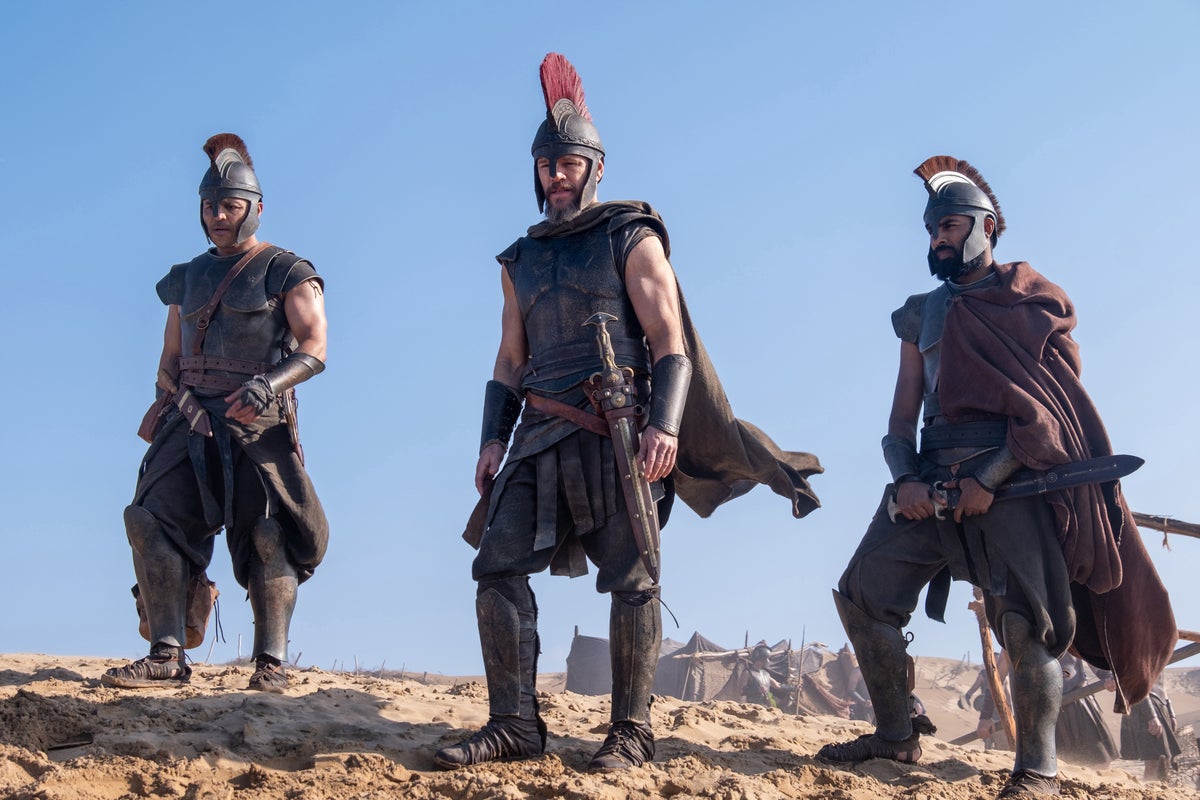
Christopher Nolan’s The Odyssey is officially playing in theaters, bringing Homer's 3,000-year-old epic to life on massive IMAX 70mm film. With a staggering $250 million budget, an all-star cast featuring Matt Damon and Anne Hathaway, and glowing reviews calling it a masterpiece, the film is a box office juggernaut. Yet, underneath the cinematic triumph lies a glaring, uncomfortable truth that has modern Greece asking a very simple question.
Why did Christopher Nolan make a Greek epic without any Greek people?
Apart from a minor supporting role played by Michael Vlamis, the cast is entirely devoid of Greek actors. In their place, we get an Anglo-American ensemble putting on standard Hollywood performances. For years, global audiences have accepted this as "just how Hollywood works," but in Greece, the sentiment is shifting from quiet resignation to active frustration.
The Philhellenic Lie and the Erasure of the Mediterranean
This isn’t just a simple casting oversight. It’s the latest chapter in a long history of Western cultural appropriation that classicists call the "Philhellenic" bias.
During the 19th century, Western European thinkers—most famously British romantic poets like Lord Byron—developed a deeply romanticized, highly distorted view of ancient Greece. They wanted to claim the birthplace of democracy and philosophy as the direct ancestor of Northern European civilization. To do this, they had to divorce ancient Greek culture from its actual geographical context.
Ancient Greece wasn’t a precursor to Victorian Britain or modern-day New England. It was an Eastern Mediterranean culture, deeply connected to and influenced by its neighbors in Anatolia, Egypt, and the Levant. Homer’s The Odyssey is structurally and thematically far closer to the Mesopotamian Epic of Gilgamesh than anything written in Western Europe.
By casting Hollywood stars and ignoring Greek actors, Nolan’s film perpetuates the myth that Greek heritage belongs to the global West rather than the people who actually live there. It suggests that Greece was a great playground for ancient legends, but its modern descendants aren't necessary to tell those stories.
What Modern Greece Really Thinks of the Film
Public reaction inside Greece is far more nuanced than the loudest voices on social media suggest. The debate isn't a monolith, but rather splits into three distinct viewpoints.
1. The Intellectual and Educational View
For many Greek educators and academics, the film is seen as a net positive simply because it keeps Homer relevant. In Greece, The Odyssey is taught to seventh graders, who debate the morality of Odysseus’s actions, his PTSD, and his hubris.
"I think it's wonderful that something that is created at a specific point in time by a given people is shared by so many people across the globe," says Christos Tsagalis, a professor of ancient Greek literature at the Aristotle University of Thessaloniki.
For educators, a new cinematic version—even a deeply flawed, highly westernized one—sparks classroom debates and gets kids excited about mythology. The narrative has survived for three millennia precisely because it is constantly reinvented.
2. The Cultural and Casting Frustration
On the streets of Athens and across Greek social media, the primary emotion is exclusion. While Hollywood champions "representation" and global diversity—with cast members pointing out that the movie represents the whole world—Greeks are left wondering why that diverse vision somehow excludes them.
It feels incredibly hypocritical to modern Greeks when Hollywood claims to care about authentic representation, yet repeatedly uses Greece as a aesthetic backdrop while refusing to hire Greek talent.
3. The Political Culture War
The film has also been dragged into local Greek politics. The Greek government provided roughly 6 million euros in subsidies to support local production for the film. This sparked a fierce backlash from the nationalist Niki party, who accused the government of using taxpayer money to fund a "woke-type" foreign interpretation of their history.
When "Creative Liberty" Ignores History
Nolan has defended his creative choices, arguing that he wanted to make the film accessible and avoid past Hollywood tropes of the ancient world. He opted for incredibly modern, casual English dialogue, with Telemachus calling Odysseus "dad", and Penelope telling her suitors "I've listened to you party".
While classicist Mary Beard defended this choice as a great way to introduce Homer to new audiences, many viewers find the combination of epic scale and modern slang incredibly jarring. Add to that the bizarre inclusion of a medieval Viking longship in the trailer, and it becomes clear that Nolan's version prioritizes fantasy aesthetics over historical and cultural authenticity.
If a director made a film about Native American or West African mythology without casting actors from those cultures, the backlash would be immense. Yet, because of the long-standing Western claim over ancient Greece, the erasure of Greek voices is treated as normal.
Where Do We Go From Here?
The next time you watch a historical epic, pay attention to who is actually on screen. If you want to support authentic Greek storytelling and understand the true depth of Homer's work, here is what you can do next:
- Read Emily Wilson's translation: If you want to experience the actual text without Hollywood's filter, pick up Emily Wilson's translation of The Odyssey. It captures the complexity of Odysseus—the veteran, the liar, the survivor—far better than any screenplay.
- Seek out Greek creators: Look for local Greek theatrical productions, indie films, and literature that reclaim these myths from a modern Mediterranean perspective.
- Challenge the "Western" narrative: Remember that ancient Greece belonged to the Mediterranean world, not the modern Western empires that co-opted its legacy.
Nolan's The Odyssey is undeniably a technical marvel. But a movie can be visually stunning while still being culturally bankrupt.
To better understand the cultural dialogue surrounding this release and how classicists view modern adaptations, watch Mary Beard on Greek Mythology and Modern Cinema. This discussion explores how ancient stories continue to morph to fit the anxieties and biases of the era in which they are retold.