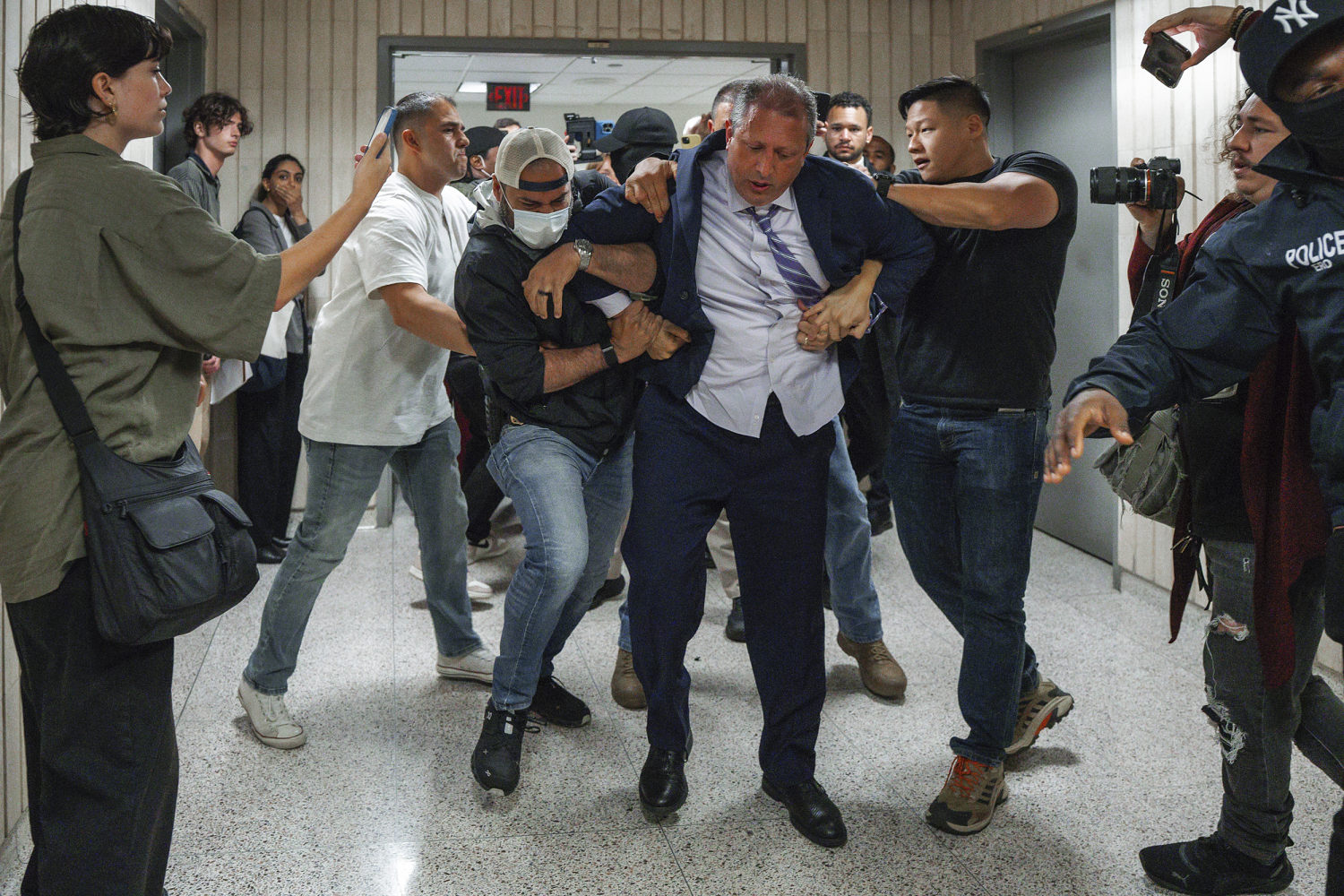
The fluorescent humming of the tenth floor at 26 Federal Plaza does not sound like a battlefield. It sounds like bureaucracy. It smells of stale floor wax and industrial air conditioning. But on September 18, 2025, that narrow hallway outside the elevator bank became the front line of a furious debate over human dignity, municipal power, and the lengths an elected official will go to look a federal agency in the eye.
Brad Lander stood in that corridor. He was not there as an abstraction or a talking head on a cable news loop. He was the New York City Comptroller, a man whose job usually involved analyzing spreadsheets, auditing municipal agencies, and managing billions in pension funds. Yet, he found himself staring at heavy double doors that cordoned off a makeshift detention area.
Behind those doors, the data had turned into human collateral.
A federal judge had recently ruled that the conditions inside those specific holding rooms were cruel, inhumane, and a blatant violation of federal law. Under a sweeping federal crackdown on immigrants, the traditional rules of engagement had dissolved. For decades, federal agents largely refrained from conducting sweeping arrests inside immigration courthouses. It was an unspoken truce. That truce evaporated. Arrestees flooded the building, completely overwhelming the standard processing facilities.
A holding cell designed for a swift, twelve-hour transition suddenly became a multi-day purgatory. Federal data revealed that average detention times in the building ballooned from a mere six hours to a staggering 103 hours. Imagine spending four days trapped in a crowded, windowless room, waiting for a bureaucratic machine to process your existence.
Lander and ten other local elected officials decided they needed to see it for themselves. They used their credentials to pass through building security, stepped into the elevator, and rode it up to the tenth floor. Their goal was simple: an inspection to ensure a federal court order was being followed.
They never made it past the lobby.
An officer stationed outside the double doors immediately blocked their path. The officials sat down. They tried to explain their mandate, invoking the federal judge's ruling on the squalid conditions just a few yards away. The response from law enforcement was swift and unyielding.
"If you refuse to leave under federal regulation, you're going to be arrested," an officer warned. "You are violating the law right now. You are protesting illegally."
Then came the count. Thirty-three seconds.
That is all the time that elapsed between the final warning and the moment Federal Protective Services officers began handcuffing the seated officials. Thirty-three seconds to transform a municipal leader into a criminal defendant.
Now, the scene shifts to a Manhattan federal courtroom where Lander’s bench trial has officially commenced. The federal government is spending time, money, and institutional resources to prosecute a highly specific, microscopic question: Did Bradford Lander unreasonably obstruct the usual use of the elevators and the elevator lobby?
The prosecution argues a simple narrative of law and order. They claim Lander ignored multiple warnings, blocked the corridor, and began chanting. They see a politician causing a deliberate disturbance on federal property.
Lander’s defense team offers a starkly different reality. They maintain he never blocked a single elevator door or obstructed the bank. More importantly, they argue that his presence was an act of official oversight, driven by a legitimate concern for the safety and constitutional rights of his constituents.
The government offered a way out. They promised to drop the violation in exchange for a simple condition: Lander had to agree not to protest inside any federal building for six months. The other ten officials accepted the deal.
Lander refused.
Instead, he pleaded not guilty. He chose the trial. He chose to stand before a magistrate judge, risking a misdemeanor conviction, for a singular, deliberate purpose: to force U.S. Immigration and Customs Enforcement agents to answer questions under oath about what exactly happens behind those tenth-floor doors.
This legal battle unfolds against a backdrop of immense political consequence. Lander is currently locked in a fierce primary race to unseat an incumbent congressman in New York’s 10th Congressional District, a sprawling territory that encompasses Lower Manhattan and northwestern Brooklyn. The primary is just weeks away. In the calculus of modern politics, a federal trial could be a catastrophic distraction or a powerful testament to one's convictions.
But as the attorneys trade barbs over elevator mechanics and hallway dimensions, the true gravity of the situation slips away from the legal jargon. This trial is not truly about thirty-three seconds of hallway obstruction. It is about the invisible walls built around institutions that demand absolute secrecy, and the immense friction that occurs when local leaders try to peer behind the curtain.
The trial will conclude, a verdict will be rendered, and the political primary will decide a career. But tomorrow morning, the elevators at 26 Federal Plaza will continue to slide open on the tenth floor, carrying people into a system that operates entirely in the dark, just inches away from the public eye.