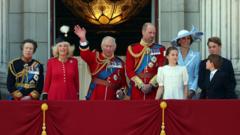
The wool is the first thing that breaks you. It is entirely too thick for June. Under the unrelenting glare of a midday sun, London is sweating, but the men standing in perfect, unblinking rows on Horse Guards Parade cannot acknowledge the heat. They cannot wipe the salt from their eyes. To the thousands of spectators cheering behind the barriers, the scene is a postcard brought to life. It is the annual pageantry of Trooping the Colour, a flawless sea of scarlet jackets, black bearskin caps, and gleaming silver.
But if you look closely at the third row, just past the shadow of the regimental flags, you can see the slight tremor in a young guardsman’s knuckles.
For him, and for the family watching from the balcony above, this day is not a celebration of summer. It is a grueling test of endurance, a high-stakes performance where the cost of failure is public humiliation broadcast to millions of screens around the globe. We watch these events from a distance, treating the British Royal Family and their military escort as figures in a living museum. We dissect their outfits, analyze their waves, and count the minutes of their appearances. Yet we rarely stop to consider the sheer physical and emotional gravity holding that balcony together.
The Anatomy of a Six-Inch Lean
To understand the hidden tension of the King’s birthday parade, you have to understand the physics of standing still.
Medical teams stationed behind the scenes know the enemy well: syncope. When a human being stands at attention for hours without moving their legs, blood pools in the lower extremities. The brain, suddenly starved of oxygen, triggers a swift shutdown. Troops are trained extensively to avoid this. They are taught to subtly clench their toes, to flex their calves inside their boots, and to never, under any circumstances, lock their knees.
Locking your knees is an invitation to gravity.
Every year, despite the rigorous preparation, at least one guard usually succumbs. The fall is always the same. It is not a stumble or a slump; it is a rigid, face-first dive directly into the gravel, the heavy bearskin cap tumbling forward like a fallen boulder. While medics rush out with stretchers, the remaining soldiers must stand frozen. To break formation to help a falling comrade is to break the illusion of perfect, mechanical unity.
The crowd gasps, the cameras click, and the parade moves on. This is the contract signed by everyone who participates in the spectacle. The individual disappears so that the institution can shine.
Consider a hypothetical spectator named Sarah, who traveled from Nottingham and stood by the Mall since 5:00 AM just to catch a glimpse of the carriage procession. She represents the thousands who line the streets, packed shoulder-to-shoulder, holding flags that flutter in the breeze. To Sarah, the event is a joyful tradition, a sensory overload of thundering hooves, the sharp scent of horse manure and polished leather, and the deafening roar of the Royal Air Force flypast.
But the view from the ground is entirely different from the view from the palace windows.
The Balcony as a Fortress
When the King and Queen, accompanied by the working members of the family, step onto the stone balcony of Buckingham Palace, the collective roar of the crowd is loud enough to vibrate in your chest. From a distance, it looks like a moment of pure triumph.
Up close, the reality is far more fragile.
In recent years, that famous balcony has shrunk. The sprawling extended family of the past has been replaced by a streamlined, core group of working royals. This is not just a stylistic choice; it is a survival strategy. The institution has realized that in a modern world hyper-focused on accountability, visibility is a double-edged sword. Every person standing on that red-draped ledge must earn their place in the eyes of a skeptical public.
For a family dealing with profound personal health battles behind closed doors, stepping into that blinding light requires a specific kind of courage. The makeup hides the fatigue. The tailored tailoring masks the weight loss. The smiles are fixed, practiced, and unwavering, even when the noise of the crowd is overwhelming.
Imagine the sensory bombardment. The brass bands are playing at a deafening volume below. The sky is being torn apart by the screaming engines of fighter jets overhead, painting the clouds in streaks of red, white, and blue. Millions of eyes are watching through high-powered telephoto lenses, waiting for a micro-expression, a turned back, or a whispered word that can be translated by lip-readers into tomorrow’s scandalous headline.
It is a psychological pressure cooker. Yet, they must remain as still as the guardsmen on the parade ground.
The Hidden Cost of the Script
We live in an era that values raw authenticity above all else. We want our public figures to be vulnerable, to be real, to show us their flaws.
Trooping the Colour is the exact antithesis of that desire.
It is a rigid, centuries-old script where deviation is forbidden. The horses must walk at an exact pace of 112 paces per minute. The flags must be lowered at a precise angle. The salutes must be held until the last note of the national anthem fades into the London air.
There is a comforting certainty in this rigidity. In a world that feels increasingly chaotic, volatile, and unpredictable, the sight of an ancient ritual executed with flawless precision acts as an anchor for many. It suggests that some things endure. It whispers that despite political upheavals, economic hardships, and social shifts, the foundational fabric of the culture remains intact.
But anchors are heavy.
The real story of the day is found in the quiet moments that the official television cameras often miss. It is the brief, reassuring touch of a hand on a spouse’s back before stepping through the French doors. It is the quiet sigh of relief from a young prince or princess when the flypast ends and they are finally allowed to step back into the cool, private interior of the palace. It is the agonizing ache in the arches of a soldier's feet as he finally receives the order to dismiss and stumbles into the barracks, drenched in sweat.
The thousands of people who gathered in London left with sunburnt shoulders and digital camera rolls filled with blurry images of passing carriages. They will remember the music, the flags, and the collective cheer that echoed down the Mall.
The people inside the uniforms and behind the stone balustrade will remember something else. They will remember the immense, invisible effort it took to keep the illusion alive for one more year, standing perfectly still while the world spun furiously around them.