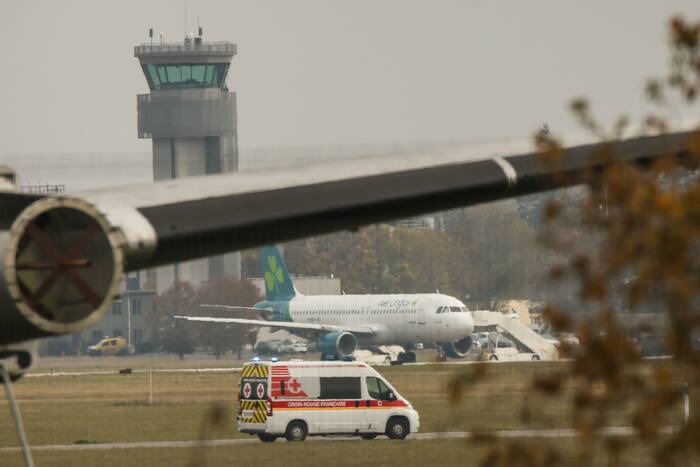
Your plane banks hard over the Alps, and the pilot comes on the intercom sounding way too calm. Suddenly, a three-hour hop from London to Rome turns into an unscheduled landing in Zurich surrounded by flashing blue lights. When flights are diverted in Europe over bomb threats, the public usually sees a three-paragraph wire story and a blurry photo of a jet parked far away from the terminal. That surface-level coverage misses almost everything that actually happens behind the scenes.
European airspace is one of the busiest and most tightly coordinated aviation networks on Earth. A single anonymous email or phone call doesn't just inconvenience one flight. It triggers a chain reaction across national borders, military radar stations, and airline operations centers.
Why European Aviation Sees Waves of Security Alerts
Most bomb threats targeting European commercial flights turn out to be hoaxes. That's a fact. Yet aviation authorities treat every single one as a live, credible emergency until proven otherwise.
Why? Because the cost of being wrong once is unthinkable.
Under regulations enforced by the European Union Aviation Safety Agency (EASA) and the International Civil Aviation Organization (ICAO), airlines and air navigation service providers have zero wiggle room. When a threat comes in—whether through an airport switchboard, an airline social media account, or an air traffic control frequency—protocols lock into place immediately.
In recent years, European airports and carriers have dealt with coordinated waves of emailed threats. These messages often hit multiple regional airports or several flights belonging to the same carrier within minutes of each other. Security researchers and law enforcement agencies, including Europol, have noted that many of these mass-emailed threats rely on encrypted email providers and spoofed routing to obscure their origin.
Even when intelligence analysts suspect a copycat hoax, operational crews can't gamble on a hunch. You don't guess when 200 people are sitting at 35,000 feet.
What Actually Happens in the Cockpit and on the Ground
When a threat is flagged, the decision to divert isn't made by the pilot alone. It's a rapid three-way coordination between the flight crew, the airline's dispatch and security center, and Eurocontrol alongside national air traffic controllers.
Here's what unfolds during a standard European security diversion:
- Immediate re-routing to a designated airfield. Controllers don't just pick the closest runway. They look for an airport equipped with an isolated aircraft parking position—often called a "remote stand" or "Zulu stand"—far away from main terminals and fuel depots.
- Military interception. In many European countries, including France, Germany, Italy, and the UK, Quick Reaction Alert (QRA) fighter jets scramble to visually inspect the airliner. If you look out the window and see a Eurofighter Typhoon or Dassault Rafale off your wingtip, it isn't for show. Fighter pilots verify that the cockpit crew is in control and escort the jet to a safe corridor away from densely populated cities.
- Emergency evacuation or controlled deplaning. Depending on the specificity of the threat, passengers either leave via emergency slides or walk down mobile airstairs straight onto waiting buses. Either way, you leave your carry-on bags behind. Every single one.
Once the plane stops on that remote pad, local tactical police and bomb disposal units take over. Bomb-sniffing dogs sweep the cabin and cargo hold. Every suitcase gets pulled from the belly, lined up on the tarmac, and manually matched to a passenger or re-screened through mobile X-ray units.
That process alone takes hours. Sometimes it takes all night.
The Ripple Effect Across European Airspace
A wire report mentioning that "flights were diverted" rarely captures the operational mess left behind. European air travel runs on razor-thin turnaround schedules. Aircraft flying short-haul routes across the continent often operate four to six legs a day.
When one Airbus A320 gets quarantined on a remote stand in Frankfurt or Milan, the schedule unravels fast.
First, the aircraft is taken out of service until police formally clear it and sign off on security paperwork. Second, the flight crew almost certainly hits their legal duty-time limits while waiting on the tarmac. Under strict EU flight time limitation rules, pilots and cabin crew can't legally fly once their shift clock runs out, even if the plane is finally declared safe.
The airline then has to scramble a replacement aircraft and a fresh crew from a hub—if they even have spares available. Meanwhile, hundreds of connecting passengers miss onward flights, creating a backlog at airport transfer desks that lasts for days.
Passenger Rights During Security Diversions in Europe
If you ever find yourself stuck in a terminal after a bomb threat diversion, you need to know how European law treats your situation. Many travelers assume EU261—the famous European passenger rights regulation—automatically hands out up to €600 in cash compensation for any major delay.
It doesn't.
Under Regulation (EC) No 261/2004, security threats, terrorism alerts, and airspace closures count as extraordinary circumstances. Because the airline didn't cause the bomb threat and couldn't prevent it, carriers are legally exempt from paying out financial compensation for the delay.
However, the airline's "duty of care" still applies without exception. Regardless of why your flight diverted, the carrier must provide:
- Meals and refreshments proportional to your waiting time.
- Hotel accommodation if the security sweep and crew replacement force an overnight stay.
- Transport between the airport and the hotel.
- Re-routing to your final destination at the earliest opportunity, or a full refund if you decide to abandon the trip.
Don't expect airline gate agents to volunteer hotel vouchers proactively when 600 displaced passengers are crowding the desk. Keep every receipt for food, water, and transit, and submit them directly through the airline's official claim portal once you get home.
Why Media Coverage Gets the Tone Wrong
Breaking news alerts thrive on panic. When outlets run headlines about flights diverting over bomb threats, the framing often implies imminent disaster or massive intelligence failures.
In reality, a diversion is proof that the system worked.
Aviation security operates on layered defense. Screening passengers at the gate is just the first layer. Intelligence sharing, real-time threat assessment, rapid ATC re-routing, and isolated airport infrastructure form the backstop. When an airliner lands safely on a remote stand and unloads passengers without injury, that's a textbook execution of emergency protocols—even if it ruins your weekend plans.
What You Should Do If Your Flight Diverts
If you're ever on a flight that diverts for a security reason, your behavior inside the cabin directly affects how fast everyone gets off the plane.
Follow crew instructions immediately and don't reach for the overhead bins. Trying to grab a backpack during an evacuation slows down the aisle and risks puncturing an emergency slide. Keep your passport, phone, and essential medication in your pockets or a small crossbody bag on your person during takeoff and landing—that way, if you have to leave your carry-on behind, you aren't stranded in a foreign country without ID.
Once you're inside the terminal, skip the physical customer service line and open the airline's app or call their international support number right away. Rebooking inventory disappears in minutes during a multi-flight disruption, and the passengers who act first get the remaining seats out.