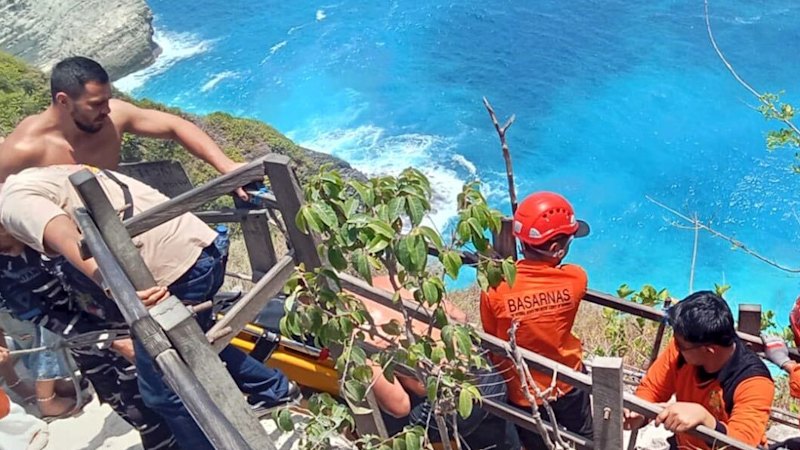
Another headline. Another tragic drop down the jagged limestone ribs of Kelingking Beach. Another wave of collective hand-wringing across global news outlets, screaming for more fences, more guards, and more government intervention to save tourists from their own gravity.
The media wants you to believe Nusa Penida is an unchecked death trap. They want you to blame social media algorithms, pushy influencers, and a lack of bureaucratic oversight. It is a lazy, predictable script written by people who have never stepped foot off a paved resort walkway in Seminyak, let alone scrambled down a vertical cliff face with a camera bag swinging from one shoulder.
The conventional narrative is completely backward.
More bureaucracy will not save lives. More handrails will not stop fatalities. In fact, if local authorities cave to the hysterical chorus demanding every cliffside trail be sanitized into a Disney queue, the death toll will actually rise.
Here is the unvarnished truth about adventure tourism, risk compensation, and why your vacation mindset is actively trying to kill you.
The Peltzman Effect on the Edge of a Cliff
Let us talk about economic reality and human psychology. In 1975, economist Sam Peltzman published a paper showing that when automobile safety regulations like mandatory seatbelts were introduced, drivers simply drove faster and more recklessly because they felt protected. The net result on pedestrian fatalities was flat or worse.
Apply that exact principle to a sheer vertical drop in Indonesia.
When you put up a flimsy bamboo railing or a rusted wire fence along the rim of Kelingking Beach, you trigger a profound psychological shift in the average traveler. The human brain is wired to conserve energy. It uses environmental cues to assess danger. The moment someone sees a constructed barrier—no matter how structurally suspect it is—their internal alarm system shuts down.
They stop looking at the footing. They stop calculating the vertical drop. They step backward to frame a wide-angle video for TikTok because subconscious trust has been outsourced to a stick of local timber hammered into volcanic dirt.
I have spent the last decade tracking adventure tourism markets across Southeast Asia. I have watched thousands of tourists wander into high-consequence environments wearing slippery white sneakers, holding iced coffees in one hand and smartphones in the other, completely detached from physical reality. They treat a thousand-foot cliff like an exhibit at a metropolitan zoo.
When you sanitize the wild, you breed complacency. And complacency on limestone is lethal.
The Instagram Boogeyman
The daily consensus from editorial desks in Sydney and London is that social media is turning otherwise rational human beings into lemmings throwing themselves off precipices for digital validation.
It is a convenient scapegoat. It shifts blame away from personal responsibility and onto an abstract digital villain.
People have been falling off cliffs since the dawn of recorded history. Long before smartphones existed, tourists tumbled into canyons, slipped off mountain ridges, and drowned in undertows because they misjudged conditions, overestimated their physical stamina, or simply failed to respect the environment. The camera does not push you over the edge. It simply records the exact microsecond your arrogance overrode your survival instinct.
Blaming Instagram is a cop-out. It treats adults like children who lack agency. If a traveler is willing to risk a fatal drop for a photo, banning the photo spot or stringing up warning signs written in English won't change their internal calculus. They are suffering from an acute deficit of situational awareness, not a severe case of social media addiction.
The Illusion of the Controlled Experience
Modern tourism is built on a dangerous lie: that the entire planet has been converted into a safe, managed theme park where the worst thing that can happen to you is a delayed flight or a bad room service order.
Travelers fly thousands of miles to exotic destinations expecting the same safety margins they enjoy in an air-conditioned suburban shopping mall. They expect padded corners, clear warning labels, and a professional rescue team stationed five minutes away with a stretcher and a defibrillator.
When reality violently intrudes—when a wave slams a swimmer against sharp coral in Uluwatu, or when a foot slips on the crumbling stairs of Nusa Penida—they act surprised. They look for someone to sue, someone to blame, or a government agency to regulate.
This is where the true failure lies. We have systematically erased risk literacy from modern life. We coddle people until they reach adulthood, and then we drop them into raw, untamed landscapes without the foundational skills required to stay alive.
What Real Travel Safety Looks Like
If we want to stop people from dying on cliff edges, we need to completely invert our approach. We need to stop pretending we can bubble-wrap the earth.
- Embrace Radical Friction: Dangerous places should look and feel dangerous. When a trail is steep, unstable, and unforgiving, it should remain steep, unstable, and unforgiving. Do not pave it. Do not mask the peril with cosmetic handrails that offer a false sense of security. Let the physical environment broadcast its own hazards.
- Shift Liability to Personal Agency: Stop expecting local communities to police the stupidity of foreign visitors. Balinese villagers operating small warungs at the top of these cliffs are not expedition guides or park rangers. Expecting them to stop determined tourists from climbing past warning signs is absurd.
- Redefine Competence: True safety is an internal state, not an external barrier. Before you step onto any trail with a vertical drop, you should ask yourself three fundamental questions: Do I have the footwear? Do I have the physical stamina for the climb back up in thirty-degree heat? Am I willing to accept the consequences if my foot slips?
If the answer to any of those questions is no, you turn around. You do not blame the cliff. You do not demand a fence. You accept your own limits.
The Cost of Sanitizing Adventure
There is a dark irony playing out across the globe right now. The same travelers who complain that popular destinations are "too touristy" and "over-commercialized" are the exact ones demanding that local governments concrete every trail, install stadium lighting, and wrap every cliff in steel mesh.
You cannot have wild, awe-inspiring nature and a sterile, zero-risk environment at the same time. The two concepts are mutually exclusive.
When you remove the danger, you destroy the magic. But more importantly, when you try to engineer a foolproof environment, you simply create a better class of fool.
The cliffs of Nusa Penida are not murder scenes waiting to be solved by more bureaucracy. They are ancient, indifferent landscapes operating on the raw, unbending laws of physics. Gravity does not care about your itinerary, your travel insurance, or your follower count.
Until travelers stop treating the planet like an interactive movie set and start respecting the hard boundaries of the physical world, the headlines will keep coming. And no amount of government red tape will change a single outcome.