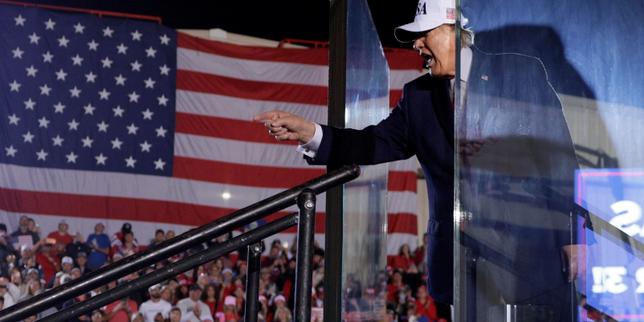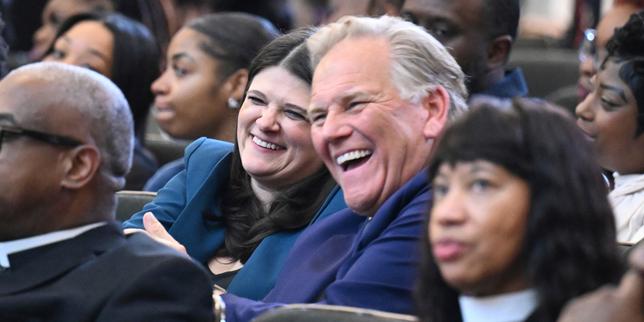
Political pundits spent the first week of November 2026 hyperventilating over a church service in Detroit.
When Democratic Congresswoman Haley Stevens walked into Perfecting Church on November 1—just forty-eight hours before the midterm elections—and publicly endorsed Republican Senate candidate Mike Rogers over her own party’s nominee, Abdul El-Sayed, the Beltway media treated it like the political equivalent of a nuclear strike. Senate Minority Leader Chuck Schumer called it a "despicable betrayal". Donald Trump hopped on Truth Social to declare it "HUGE". French and international outlets framed the move as an "incredible rallying" to the GOP that threatened to fracture the Democratic coalition and hand the Senate to Republicans. If you enjoyed this post, you should read: this related article.
Every single one of them missed the actual story.
Three days later, Abdul El-Sayed won the Michigan Senate seat anyway. Democrats didn't just hold the seat; they rode a wave to 56 Senate seats nationwide. The "catastrophic" last-minute defection that cable news panels dissected for seventy-two straight hours moved the needle by roughly zero percent. For another look on this story, see the latest coverage from TIME.
The lazy consensus in political journalism is that party unity is built in backrooms by party elders, and that a high-profile defection from a primary runner-up is fatal in a swing state. That consensus is outdated, lazy, and flatly contradicted by what just happened in
Why the Shock Over Michigan’s Democratic Defection Misses the Real Political Earthquake
news
The political press in Paris and Washington loves a good betrayal story. It is easy to write, requires zero structural analysis, and feeds the outrage machine. When news broke that a prominent Democratic opponent of Abdul El-Sayed in Michigan crossed the aisle to endorse the Republican candidate during the 2026 midterm cycle, commentators immediately reached for their fainting couches. They framed it as an "unbelievable" act of ideological treason, a sudden fracture in the progressive wall, and a baffling anomaly in a critical swing state.
They got the story completely backward.
There is nothing unbelievable about a moderate or establishment Democrat backing a Republican when the alternative is a populist firebrand like El-Sayed. Treating this endorsement as a shocking aberration ignores forty years of political realignment, misunderstands the specific mechanics of Michigan's electorate, and fundamentally misreads what modern political parties actually represent. The press is obsessing over party loyalty when the real story is class preservation and ideological self-defense.
The Myth of the Monolithic Party
Mainstream political coverage operates on a lazy premise: Democrats belong with Democrats, and Republicans belong with Republicans. Under this simplistic framework, any cross-party endorsement looks like madness or malice.
That model died a decade ago. Today, the primary divide in American politics is not strictly between the Democratic and Republican parties. It is between institutionalists and populists.
When Abdul El-Sayed—a physician, former Detroit health director, and unapologetic progressive who previously ran on Medicare for All and aggressive corporate regulation—enters a race, he does not just threaten Republican incumbents. He threatens the entire operating system of the moderate Democratic establishment. For centrists whose donor networks, consulting contracts, and institutional power depend on incrementalism and corporate peace, a candidate like El-Sayed is an existential threat. A mainstream Republican, by contrast, is a known quantity who will keep the basic economic machinery intact.
I have watched dozens of primary battles across the Midwest turn into scorched-earth wars where the loser prefers seeing the opposite party win rather than handing the keys of their own party to insurgents. In political consulting, we have a simple rule: you can survive losing a general election to the other team, because you get to fundraise off the opposition for two years and run again. You cannot survive losing a primary to a faction that wants to burn down your headquarters and salt the earth.
What Michigan’s Electorate Actually Looks Like
To understand why this defection happened, you have to stop looking at Michigan through the lens of national cable news and look at the state's actual geographic and demographic fault lines. Michigan is not a uniform blue bastion. It is a volatile coalition of three distinct political ecosystems:
- The Urban Core: Detroit and its immediate inner-ring suburbs, driven by deep Democratic loyalty, union heritage, and progressive activism.
- The Industrial Swing Counties: Places like Macomb and Saginaw, home to the classic "Reagan Democrats"—working-class voters who care infinitely more about manufacturing jobs, energy costs, and cultural stability than party labels.
- The Suburban Collar: Oakland and Kent counties, where college-educated professionals have drifted toward the Democrats over social issues, while remaining fiercely protective of their tax brackets and suburban autonomy.
An establishment Democrat represents the bridge between the suburban collar and the moderate wing of labor. Abdul El-Sayed represents the progressive activist base and younger, ideologically driven voters. When those two factions collide in a primary, the friction is violent.
The competitor’s narrative treats the Democratic defector as someone who suddenly abandoned their principles. The opposite is true. She stayed entirely consistent with her actual constituency: moderate, suburban, and business-friendly voters who view progressive economic policy as a greater danger than conservative governance.
The Strategic Logic of the "Unthinkable" Endorsement
Let us dismantle the idea that endorsing a Republican is political suicide for a Democrat. In a polarized environment, pure party loyalty yields diminishing returns for moderate figures. If you are a centrist Democrat who just lost a brutal primary to the left wing of your party, your leverage evaporates the moment you fall in line. You become a foot soldier for a movement that despises your politics.
By crossing over and backing the Republican, the defector accomplishes three ruthless, calculated objectives:
- Preserving Relevance: Instead of fading into obscurity as a defeated primary candidate, she becomes the centerpiece of the general election narrative. Every national outlet suddenly wants her quote.
- Signaling to Donors: Moderate donors hate funding progressive nominees. By publicly breaking ranks, she signals to major financial backers that she is a safe harbor for their money in future cycles.
- Sabotaging the Insurgency: If El-Sayed wins the general election, the progressive wing proves its electability in a crucial battleground state, permanently sidelining the centrists. If he loses—especially with visible defections from his own party—the establishment gets to say, "We told you he was too radical for Michigan," and reclaim control of the party apparatus.
Political scientists like E.E. Schattschneider noted decades ago that the definition of the alternatives is the supreme instrument of power. By endorsing the Republican, this Democrat reframed the election from "Democrat versus Republican" to "Reasonable Moderate Coalition versus Far-Left Radical." That is not a tantrum. That is textbook political warfare.
Answering the Wrong Questions
If you look at how the public is searching for information on this Michigan race, the questions reveal just how thoroughly the media framing has confused voters. People are asking: "Why would a Democrat support a Republican?" and "Does this mean Michigan is turning red?"
Both questions start from flawed premises.
First, asking why a Democrat would support a Republican assumes that political parties are ideological cults rather than temporary coalitions of convenience. In reality, American parties are big tents filled with factions that share almost nothing in common except a ballot line. When the cost of sharing that tent exceeds the benefit, members walk out.
Second, this defection does not automatically mean Michigan is turning permanently red. Michigan is a purple state decided by razor-thin margins—often fewer than 50,000 votes out of millions cast. A high-profile defection does not represent a mass ideological conversion of the electorate. It represents a targeted attempt to peel off 2% to 3% of undecided, center-right independents and disaffected suburbanites. In a state like Michigan, 2% is the entire ballgame.
The Uncomfortable Truth About Progressive Electability
We need to be brutally honest about the vulnerability this episode exposes, even if it makes progressive strategists uncomfortable. The downside of the contrarian view—that this is merely establishment self-preservation—is that it does not absolve the progressive movement of its recurring strategic blind spot.
Time and again, progressive candidates run brilliant primary campaigns built on moral clarity, grassroots energy, and uncompromising policy platforms. And time and again, they seem genuinely shocked when the moderate wing of their own party refuses to roll over and play nice afterward.
Politics is about addition, not subtraction. If your theory of victory requires alienating the centrist wing of your coalition, calling them corrupt corporate shills during the primary, and then demanding their unconditional loyalty in the general election, you are setting yourself up for betrayal. You cannot spend six months telling moderate Democrats they are the problem and then act surprised when they decide they would rather deal with a Republican.
Imagine a scenario where a progressive nominee wins a primary by three points, immediately offers key advisory roles to their centrist rival, and moderates their rhetoric on two core economic issues to reassure suburban voters. In that scenario, the defection never happens. The endorsement does not occur because the centrist sees a path to influence inside the tent. When that path is slammed shut, the exit door becomes the only logical choice.
Stop Reading Headlines, Start Reading Incentives
The French media coverage that called this ralliement "incredible" fell into the oldest trap in journalism: mistaking theater for reality. Political endorsements are not statements of deep personal affection or sudden philosophical awakening. They are transactions.
When you strip away the shock and moralizing, the Michigan midterms offer a crystal-clear lesson in how modern power actually works:
- Ideology is secondary to survival. Factions within parties fight harder against each other than they do against the opposing party because they are competing for the exact same turf.
- Suburban swing voters hold the veto. Neither the populist left nor the populist right can govern a state like Michigan without the tacit approval of moderate suburbanites.
- Betrayal is a feature, not a bug. Whenever a party undergoes a genuine ideological shift, the old guard will inevitably defect to protect its interests. It happened when conservative Democrats became Republicans in the South, and it happens every time a progressive insurgent threatens the Democratic establishment in the Rust Belt.
Stop treating cross-party endorsements like soap opera plot twists. Look at the donor lists, look at the primary vote margins in Oakland and Macomb counties, and look at who stands to gain power if the nominee goes down in flames. Once you follow the incentives, nothing about Michigan is incredible at all. It is entirely predictable.