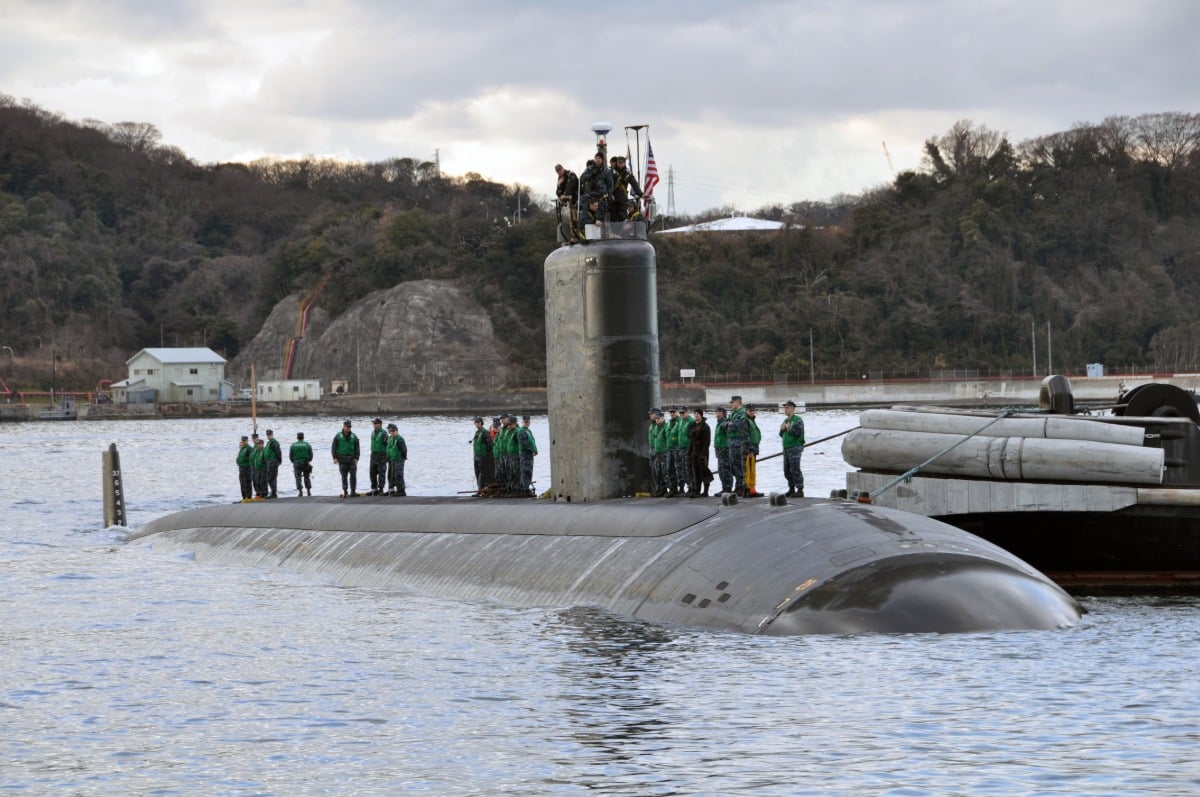
The Pentagon loves a good optics win. The recent homeport shift of the Los Angeles-class fast-attack submarine USS Tucson (SSN 770) from Pearl Harbor to Naval Base Guam is being cheered by defense analysts as a masterful stroke of forward deployment. The conventional narrative is painfully predictable: placing a nuclear-powered attack submarine west of the International Date Line shrinks transit times, projects raw American power, and puts a lethal hull right on Beijing’s doorstep.
It sounds brilliant on a PowerPoint slide. In reality, it is a legacy bureaucratic reflex passing for modern strategy.
Moving the USS Tucson to Guam does not terrify adversaries; it concentrates highly valuable, increasingly scarce underwater assets into a well-mapped, saturated bullseye. By tethering a vital fast-attack boat to an island lacking deep-tier industrial resilience, the U.S. Navy is prioritizing the illusion of immediate presence over the reality of sustained combat readiness. We are playing a 20th-century geopolitical game with platforms that need to survive a 21st-century theater.
The Transit Time Myth
The baseline argument for the Guam consolidation always comes down to math. A submarine operating out of Oahu takes roughly nine to eleven days to steam to the South China Sea. Operating out of Apra Harbor, Guam, cuts that transit down to a few days. The lazy consensus assumes that saving a week of transit time automatically translates to superior deterrence.
This view completely misunderstands how modern submarine warfare works.
Submarines do not operate like fighter jets sitting on a runway waiting for a scramble order. Their primary weapon is ambiguity. A fast-attack submarine is most effective when the adversary does not know which ocean it is currently prowling. When you homeport a vessel in Guam, you drastically simplify the adversary's intelligence collection requirements.
Every single departure from Apra Harbor is heavily monitored by commercial satellite imagery, electronic surveillance, and fishing fleets acting as maritime militia. The moment a boat leaves the pier, the clock starts ticking for opposing anti-submarine warfare (ASW) networks. By shortening the physical distance to the theater, the Navy has also shortened the cognitive distance an adversary needs to travel to locate the asset. You have traded the deep, unsearchable sanctuary of the mid-Pacific for a localized starting gate where your movements are instantly broadcast.
The Logistics Mirage of Apra Harbor
Having spent years evaluating maritime logistics chains and seeing how operational readiness degrades when stretched thin, I know exactly what happens when you overload a forward base. Guam is an outpost, not an industrial powerhouse.
The USS Tucson is a flight-III Los Angeles-class submarine. While still incredibly capable, these hulls are aging. They require intensive, specialized maintenance. Pearl Harbor possesses the robust infrastructure of a massive, established naval shipyard with deep pools of civilian technicians, extensive dry docks, and immediate access to complex supply lines. Guam relies heavily on submarine tenders like the USS Frank Cable or USS Emory S. Land, alongside a limited, overburdened shore detachment.
When a critical component fails on a submarine in Guam—whether it is an advanced sonar array component or a propulsion system valve—the parts often have to be flown in from the mainland or Hawaii. The technicians qualified to fix complex, specialized defects are frequently flown in on TDY (temporary duty) assignments.
What the Navy calls "forward deployment" often manifests as "extended downtime waiting for logistical miracles." If the USS Tucson suffers a mechanical casualty during a high-tempo deployment, the time saved on transit is instantly erased by the time spent waiting for a specialized part to clear a logistics hub in California or Hawaii. We are concentrated on the theater of operations while completely ignoring the theater of sustainment.
Consolidating Assets inside the Weapon Engagement Zone
The most egregious flaw in the Guam migration strategy is geographic. Guam is no longer a safe haven behind the front lines. It is squarely inside the weapon engagement zone (WEZ) of modern Chinese intermediate-range ballistic missiles and hypersonic cruise missiles. The DF-26, famously dubbed the "Guam Killer," exists specifically to neutralize Apra Harbor and Andersen Air Force Base in the opening hours of a kinetic conflict.
Imagine a scenario where tensions escalate rapidly in the Western Pacific. The Navy's plan relies on these forward-deployed submarines already being at sea. But what if they are caught in port during a snap inspection, a mid-cycle maintenance availability, or a crew swap?
By packing more nuclear submarines into Apra Harbor, the Navy creates a high-value target environment that can be struck by land-based missile systems long before a single torpedo can be loaded. It is a fundamental violation of force dispersion. Instead of distributing our crown jewels across a resilient, vast geographic network, we are packing them into a single, stationary target that our peer competitors have spent two decades learning how to target with pinpoint precision.
The Hidden Cost to Crew Retention
Strategy analysts rarely talk about people, because numbers on a spreadsheet do not complain. But ask anyone who has done a tour on a forward-deployed asset in Guam about the operational tempo.
Submarines stationed in Guam are ridden hard. Because they are already in theater, they are treated as the immediate solution to every sudden operational requirement or intelligence-gathering mission. This creates a crushing operational tempo that rapidly burns out crews.
When you couple a grueling schedule with the limited infrastructure, high cost of living, and relative isolation of Guam for naval families, retention plummets. Experienced nuclear-trained electronics technicians, machinists, and sonar supervisors do not stay in a Navy that grinds them to dust on an isolated outpost. You can have the most advanced stealth hull in the world, but if your most capable mid-career operators walk out the door to take high-paying civilian jobs, that hull becomes an expensive underwater paperweight.
The Real Power Play: Radical Decentralization
If the goal is genuine deterrence and survivability, the Navy needs to stop trying to recreate 1980s-style forward staging bases. The answer is not to gather our forces closer to the enemy's front door; it is to master the art of radical, unpredictable decentralization.
We should be leveraging America's deep-water geography, keeping the primary homeports of these complex assets tied to massive industrial bases like Pearl Harbor, Puget Sound, and San Diego. From there, the Navy must utilize distributed, austere logistics sites throughout the Pacific island chains to conduct rapid, unpredictable re-arming and re-provisioning maneuvers. A submarine should show up in places like Darwin, Australia, or Palau for forty-eight hours to take on food and torpedoes, then vanish back into the deep.
True forward presence is not a permanent parking spot in a missile crosshair. It is the ability to strike from anywhere, completely unannounced, supported by an unshakeable industrial base thousands of miles out of the enemy’s reach.
The relocation of the USS Tucson to Guam looks great for a press release meant to signal resolve to allies and adversaries alike. But signaling resolve is useless if you compromise tactical resilience to do it. The Navy has moved a vital asset closer to the fight, but it has also moved it closer to the fire. Stop celebrating the consolidation of targets. Start dispersing the force.