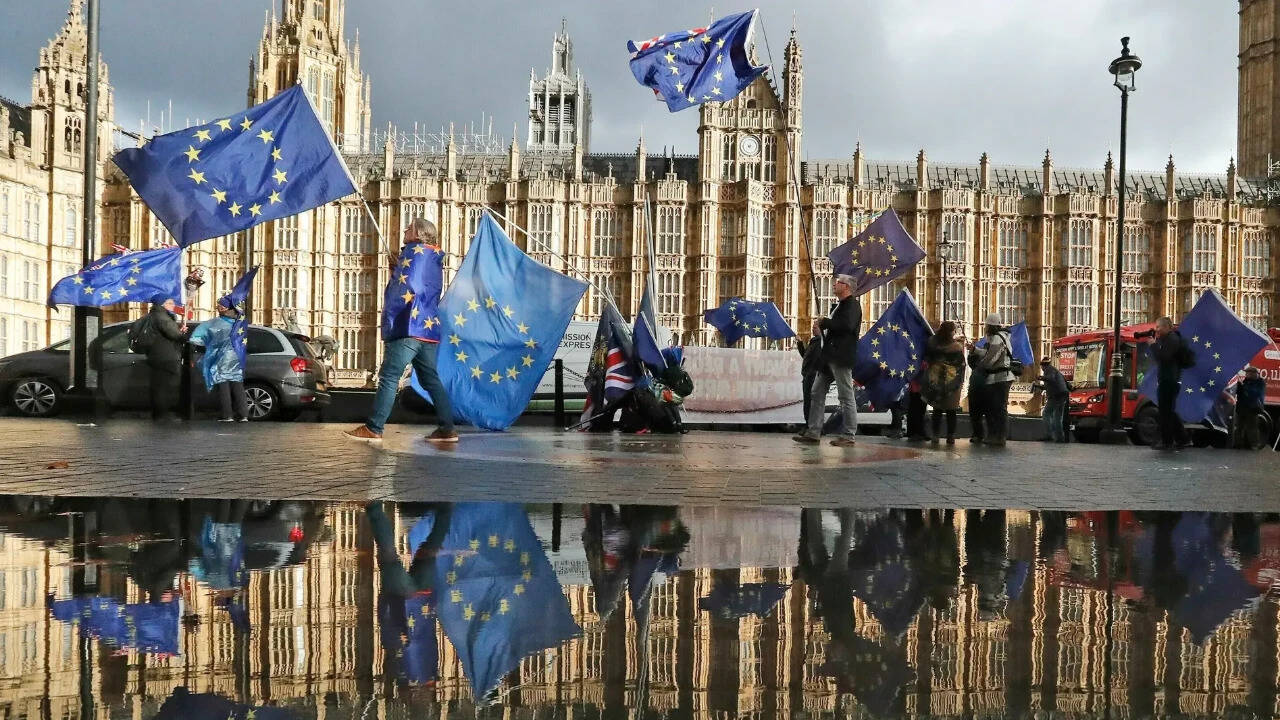
A decade after the historic referendum, the debate over Britain’s departure from the European Union has shifted from political theory to hard ledger balances. The promised economic renaissance has not materialized. Instead, the United Kingdom has entered a prolonged period of structural friction, marked by flatlining productivity, a severe investment drought, and a persistent labor mismatch. This is not a temporary adjustment period. It is a fundamental downshifting of the British economy, driven by the deliberate erection of trade barriers with its largest market. The core issue is that the UK swapped frictionless access to a half-billion consumers for regulatory sovereignty, and the market has priced that trade accordingly.
The Capital Strike and the Death of Business Investment
The most damaging consequence of the 2016 vote is not the visible chaos at the ports. It is the invisible money that never arrived. Immediately following the referendum, international boardrooms pressed pause on UK capital expenditure. That pause became a permanent policy.
Before 2016, British business investment tracked closely with the rest of the G7 economies. After the vote, the trend lines diverged sharply. While investment in the United States and the Eurozone rebounded strongly after various global shocks, UK business investment remained flat. By removing itself from the single market, the UK destroyed its primary value proposition for foreign direct investment: serving as a stable, English-speaking launchpad into Europe.
This capital strike has directly starved the country of productivity growth. When companies do not invest in machinery, software, and new facilities, workers cannot produce more value per hour. The result is a low-growth trap that constrains both corporate tax revenues and public spending capacity.
The Myth of Global Britain and the Regulatory Trap
The political architects of the split championed a vision of a deregulated, nimble island nation outcompeting the bureaucratic continent. They misjudged the reality of global supply chains.
Modern manufacturing relies on parts crossing borders multiple times before final assembly. Automotive and aerospace industries operate on thin margins and precise schedules. The introduction of rules of origin certificates, customs declarations, and duplicate product testing has added billions in administrative overhead.
The UK did not escape bureaucracy. It created a duplicate version of it. British businesses now face the choice of aligning with EU regulations without having a say in making them, or developing separate UK-specific standards that increase production costs and cut them off from economies of scale.
The Border Friction Reconfiguring British Trade
Small and medium-sized enterprises have borne the brunt of the new trade arrangements. While multinational corporations can afford compliance departments to navigate the Trade and Cooperation Agreement, smaller firms cannot.
+-----------------------------------------------------------+
|               Pre-Brexit vs. Post-Brexit Trade            |
+-----------------------------------------------------------+
| Pre-2016: Frictionless Single Market Access               |
| - Zero customs declarations required                      |
| - Shared regulatory alignment                             |
| - Seamless "just-in-time" supply chains                  |
+-----------------------------------------------------------+
| Post-2016: Third-Country Border Controls                  |
| - Millions of new customs declarations annually           |
| - Mandatory sanitary/phytosanitary checks on food        |
| - Strict rules-of-origin requirements                     |
+-----------------------------------------------------------+
Thousands of British exporters simply stopped selling to Europe. The cost of shipping a pallet of goods to France or Germany jumped significantly when accounting for customs agents, health certificates for animal products, and unpredictable border delays. This did not lead to a surge in domestic trade. It led to a shrinking of the export sector.
The replacement trade deals signed with distant nations like Australia and New Zealand have proved to be statistically insignificant. Macroeconomic analysis shows these agreements add a fraction of a percent to GDP over a decade, failing to offset even a fraction of the losses incurred by distancing the nation from its immediate neighbors. Geography remains the dominant force in trade economics.
The Great Labor Realignment
The end of the free movement of people was sold as a way to boost domestic wages and force companies to train British workers. The reality has been a chaotic structural shock to the labor market.
Sudden shortages hit sectors heavily reliant on European labor, including agriculture, hospitality, logistics, and social care. Fields went unharvested, and restaurants cut their hours. While nominal wages did rise in some specific roles, like heavy goods vehicle drivers, those increases were rapidly eaten alive by systemic inflation.
       [ End of Free Movement of Labor ]
                       │
                       ▼
       [ Structural Labor Shortages ]
                       │
         ┌─────────────┴─────────────┐
         ▼                           ▼
[ Low-Wage Sectors Shorted ]  [ Non-EU Visa Influx ]
 (Hospitality, Agriculture)    (Health & Social Care)
         │                           │
         ▼                           ▼
  [ Higher Costs ]             [ Net Migration
  [ Reduced Hours]               Record Highs ]
To keep essential services from collapsing, the government was forced to open alternative visa routes. This shifted the demographics of immigration from the EU to non-EU nations, particularly in health and social care. Net migration actually reached record highs in the years following the split, contradicting the political rhetoric of tight border control while failing to solve the specific labor deficits in the private sector.
The Fiscal Squeeze and the Starvation of Public Services
The promised financial windfall for public services has proved to be a costly illusion. The famous campaign pledge of redirecting hundreds of millions of pounds a week to the National Health Service ignored the broader fiscal impact of a smaller economy.
A smaller GDP means a smaller tax base. The Office for Budget Responsibility has consistently maintained that the long-term output of the UK economy will be roughly 4% lower than it would have been inside the EU. That economic hit translates directly into tens of billions of pounds in lost tax revenues every year.
Instead of funding public services, the government is stuck managing an structural deficit, forcing a choice between tax hikes on an already strained population or deeper cuts to infrastructure, education, and healthcare. The nation is visibly poorer, its infrastructure is fraying, and its institutions are starved of resource.
The Divergent Path of Northern Ireland and the Union
The constitutional integrity of the United Kingdom itself remains under severe pressure. The unique solution required to keep the Irish land border open effectively left Northern Ireland inside the EU single market for goods.
This arrangement created an internal trade border down the Irish Sea, separating Northern Ireland from Great Britain. While this caused immense political instability in Belfast, it created an unexpected economic divergence. Northern Ireland, retaining access to both the UK and EU markets, has outpaced the rest of the UK in several economic metrics.
This economic reality is shifting political alignments. The economic gravity of the island of Ireland is strengthening, while Scotland remains deeply divided over its own constitutional future inside a diminished UK. The decision to leave Europe has exacerbated the internal fractures of Britain, turning long-standing constitutional questions into urgent economic calculations.
The Permanent Friction
The idea that Britain will eventually find a comfortable equilibrium outside the European single market misinterprets the nature of global economics. Trade blocs are designed to favor their members and penalize outsiders. The United Kingdom chose to become an outsider, and it is experiencing the exact institutional exclusion the system was built to deliver. There is no hidden lever to pull, no single deregulatory bonfire that can compensate for the loss of geographic proximity and market integration. British industry must now operate permanently with higher costs, less talent, and less capital than its continental rivals.