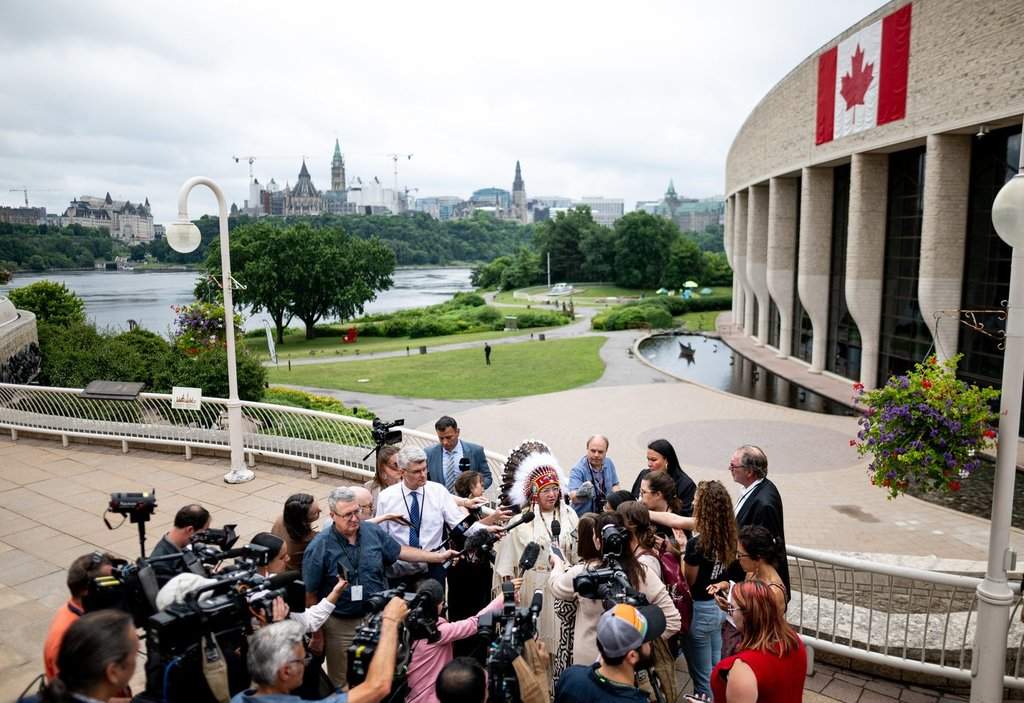
Ceremonial optics at federal-provincial-Indigenous summits function as a critical stress test for constitutional legitimacy rather than mere diplomatic theater. When Prime Minister Mark Carney, provincial premiers, and First Nations leadership convene for a formal ceremony ahead of a high-stakes intergovernmental meeting, the ritual itself establishes the procedural baseline for resource allocation, jurisdictional authority, and economic development across Canada. Mainstream coverage reduces these gatherings to symbolic milestones, missing the underlying mechanics of multi-level governance, Section 35 constitutional obligations, and capital deployment risk that dictate whether subsequent closed-door negotiations produce binding policy or institutional gridlock.
Understanding what happens before the doors close requires dissecting the structural friction between Crown sovereignty, provincial resource jurisdiction, and inherent Indigenous rights. The ceremony preceding a First Ministers' Meeting (FMM) operates as a de facto protocol agreement—a visible acknowledgment of nation-to-nation standing designed to lower transaction costs before parties negotiate over federal transfer payments, critical mineral supply chains, and regulatory timelines.
The Structural Anatomy of Pre-Summit Protocol
In Canadian intergovernmental relations, protocol dictates power. Historically, First Ministers' Meetings operated as closed bilateral or multilateral negotiations between Ottawa and the provinces, relegating National Indigenous Organizations (NIOs)—such as the Assembly of First Nations (AFN), Inuit Tapiriit Kanatami (ITK), and the Métis National Council (MNC)—to peripheral consultation roles. Integrating a formal ceremony at the outset alters the institutional geometry of the summit through three distinct mechanisms.
- Jurisdictional Signaling: Under the Constitution Act, 1867, provinces control natural resources (Section 92A) while the federal government holds jurisdiction over "Indians, and Lands reserved for the Indians" (Section 91(24)). However, Section 35 of the Constitution Act, 1982 recognizes and affirms existing Aboriginal and treaty rights. A joint opening ceremony visually collapses the traditional two-tier hierarchy, signaling to domestic courts and international capital markets that provincial resource development cannot proceed independently of federal-Indigenous alignment.
- Procedural Legitimacy and the Duty to Consult: The Supreme Court of Canada’s jurisprudence—specifically Haida Nation v. British Columbia and Tsilhqot’in Nation v. British Columbia—established that the Crown cannot outsource its constitutional duty to consult and accommodate, nor can it ignore title claims when approving major infrastructure. Pre-summit ceremonies establish a baseline of procedural good faith, insulating subsequent policy communiqués from immediate judicial review claims alleging bad-faith exclusion.
- Political Capital Allocation: For a Prime Minister balancing fiscal consolidation with industrial policy, shared ceremonial space distributes political accountability. When premiers stand alongside First Nations leaders and the federal executive, unilateral provincial resistance to federal regulatory frameworks becomes harder to sustain without incurring reputational damage among voters and institutional investors.
The Three Pillars of Intergovernmental Friction
While ceremonial alignment projects unity, the substantive negotiations that follow revolve around three competing structural imperatives. Analysts tracking the output of these summits must evaluate outcomes against these specific pressure points rather than rhetorical commitments.
1. Regulatory Velocity vs. Free, Prior, and Informed Consent (FPIC)
The federal passage of the United Nations Declaration on the Rights of Indigenous Peoples Act (UNDA) requires Ottawa to align federal laws with UNDRIP, including the principle of Free, Prior, and Informed Consent (FPIC). Simultaneously, provincial premiers prioritize rapid permitting for energy transmission, critical mineral extraction, and housing infrastructure to address productivity deficits.
This creates an acute operational bottleneck. Provinces view federal impact assessment frameworks and extended Indigenous consultation timelines as a drag on capital expenditure. First Nations leadership views expedited permitting without equity participation or consent mechanisms as an infringement on Section 35 rights. When these three actors meet, the core negotiation is not over whether projects should proceed, but over who holds the regulatory veto and how consent is operationalized in statute.
2. Fiscal Federalism and Own-Source Revenue
Provincial governments routinely demand increases to the Canada Health Transfer (CHT) and infrastructure funding without federal strings attached. Concurrently, First Nations leaders demand long-term, predictable statutory funding to close infrastructure gaps in water, housing, and education, alongside mechanisms to capture own-source revenue from resource extraction on traditional territories.
Because the federal fiscal envelope is finite, these demands operate as a zero-sum allocation problem unless the parties agree on revenue-sharing models that expand the tax base. Without a clear formula dividing resource royalties between provincial treasuries and Indigenous governments, federal mediation devolves into short-term bridge financing that fails to resolve underlying structural deficits.
3. The Implementation Gap in Co-Governance
Signing joint declarations or establishing bilateral tables is operationally inexpensive; executing co-governance frameworks across disparate provincial bureaucracies is notoriously difficult. A major limitation of high-level summits is the principal-agent problem: commitments made by premiers and the Prime Minister must be implemented by mid-level provincial ministry officials and regional federal administrators who operate under legacy statutory mandates.
Even when a summit produces a consensus communiqué, implementation routinely stalls when provincial land-use registries, environmental assessment agencies, and municipal zoning boards lack the statutory authority or operational capacity to integrate Indigenous co-decision-making.
The Economic Cost Function of Jurisdictional Uncertainty
To grasp why Mark Carney and provincial premiers invest significant political capital in pre-summit alignment with First Nations, one must examine the capital markets mechanics governing Canadian infrastructure.
Institutional investors—pension funds, sovereign wealth funds, and private infrastructure equity—price regulatory and legal uncertainty directly into the weighted average cost of capital (WACC) for Canadian projects. When federal, provincial, and Indigenous authorities operate at cross-purposes, project timelines elongate, litigation risk spikes, and expected internal rates of return (IRR) compress.
Consider the mechanics of a multi-billion-dollar critical minerals corridor or hydro-electric intertie:
- Scenario A (Unaligned Jurisdiction): A province issues permits without robust federal-Indigenous alignment. First Nations file for judicial review under Section 35. Courts grant an interlocutory injunction halting construction for 24 to 36 months. Debt servicing costs accrue without cash flow, forcing equity sponsors to write down asset values or abandon the project.
- Scenario B (Aligned Co-Governance): Federal, provincial, and Indigenous leaders establish upfront equity participation—supported by federal loan guarantees—and unified environmental assessment protocols prior to final investment decision (FID). Litigation risk drops sharply, sovereign-backed Indigenous equity lowers the cost of debt, and construction proceeds on schedule.
The ceremony ahead of the meeting is an attempt to shift the macroeconomic environment from Scenario A toward Scenario B. By demonstrating alignment at the executive level, leaders aim to de-risk Canadian jurisdictions for global capital allocation.
Distinguishing Known Facts from Analytical Hypotheses
Rigorous evaluation of intergovernmental summits requires separating verifiable institutional realities from speculative political projections.
Known Institutional Facts:
- Constitutional Authority: Section 35 rights are constitutionally entrenched and cannot be extinguished by unilateral provincial legislation or federal executive order.
- Statutory Obligations: The federal government is legally bound by the UNDA Action Plan to co-develop legislative and policy reforms with Indigenous partners.
- Economic Leverage: Indigenous loan guarantee programs at both the federal and provincial levels have become primary instruments for facilitating Indigenous equity ownership in major energy and resource projects.
- Jurisdictional Asymmetry: National Indigenous Organizations represent distinct rights-holders (First Nations, Inuit, Métis) with varying legal histories—numbered treaties, modern land claims, and unceded territories—meaning no single provincial or federal template applies uniformly across the country.
Educated Hypotheses on Summit Dynamics:
- Macro-Economic Framing: Given Mark Carney’s background in central banking and global finance, federal negotiation strategy will likely frame Indigenous economic reconciliation not merely as a social justice obligation, but as a prerequisite for macroeconomic competitiveness, productivity growth, and industrial decarbonization.
- Coalition Fragmentation: Provincial premiers will likely maintain a unified front when demanding federal fiscal transfers and opposing unilateral federal carbon or emissions caps, but that coalition will fracture rapidly when negotiating specific resource revenue-sharing formulas, as resource-rich provinces (Alberta, Saskatchewan, British Columbia) face vastly different fiscal pressures than manufacturing or service-oriented provinces.
- Bilateral Carve-Outs: If multilateral consensus proves unattainable during the main session, Ottawa will likely pivot to bilateral side-agreements with willing provinces and specific First Nations coalitions to prevent total summit failure.
Evaluating the Limitations of Summit Diplomacy
While high-profile gatherings generate momentum, executive-level summitry has severe structural limitations that observers must account for:
- Representation Bottlenecks: National Indigenous Organizations are advocacy bodies, not rights-holding nations. Under Canadian law, Aboriginal and treaty rights belong to specific First Nations, Inuit communities, and Métis collectives. Agreements struck with national leadership at a summit cannot legally bind individual First Nations on specific land-use decisions, creating a recurring gap between national political consensus and local community consent.
- Electoral Cycle Mismatches: First Ministers operate on four-year electoral cycles that incentivize short-term announcements and immediate ribbon-cutting. Indigenous governance systems and ecological stewardship frameworks operate on multi-generational timelines. This temporal mismatch frequently causes governments to prioritize rapid, superficial deliverables over durable statutory reform.
- Asymmetric Bureaucratic Capacity: Federal and provincial ministries deploy thousands of policy analysts, legal counsel, and technical experts to prepare for FMMs. Many First Nations governments operate with constrained administrative budgets, forcing them to spread limited technical capacity across dozens of simultaneous consultation requests. Without dedicated capacity funding, structural parity at the ceremonial table does not translate into operational parity at the drafting table.
Operationalizing Post-Summit Alignment
To convert ceremonial goodwill into measurable economic and governance outcomes, policymakers and institutional stakeholders must move past declarative communiqués and execute concrete structural reforms.
First, federal and provincial governments must standardize Single-Window Regulatory Assessments that incorporate Indigenous co-management from project inception rather than treating consultation as a late-stage permitting hurdle. Duplicative federal and provincial environmental reviews must be consolidated into unified processes where Indigenous governing bodies hold formal decision-making seats.
Second, fiscal negotiators must transition from discretionary grant programs to Statutory Resource Revenue-Sharing Frameworks paired with expanded sovereign loan guarantees. Providing First Nations with direct, predictable equity stakes in infrastructure and resource extraction aligns economic incentives across all three orders of government, turning potential litigants into co-owners with shared interest in project execution.
Third, institutional metrics must shift from tracking the number of meetings held to measuring Time-to-Permitting and Capital Deployment Velocity within co-governed jurisdictions. Only when aligned governance demonstrably reduces project timelines and lowers the cost of capital will the ceremonial unity witnessed ahead of the summit prove its structural durability.