The wind in the Yukon doesn’t just blow. It scrapes. It carries a fine, biting silt that gets into your eyes, your teeth, and the seams of your jacket. When you stand on the edge of an exposed mud cliff in the Klondike gold fields, surrounded by the mechanical roar of modern mining equipment, you are looking at a graveyard of time.
Most people come here for the gold. They want the heavy, glittering flakes trapped in the gravel. But a few years ago, a team of paleontologists frozen to the marrow found something infinitely more valuable, wrapped in a package no one would ever romance.
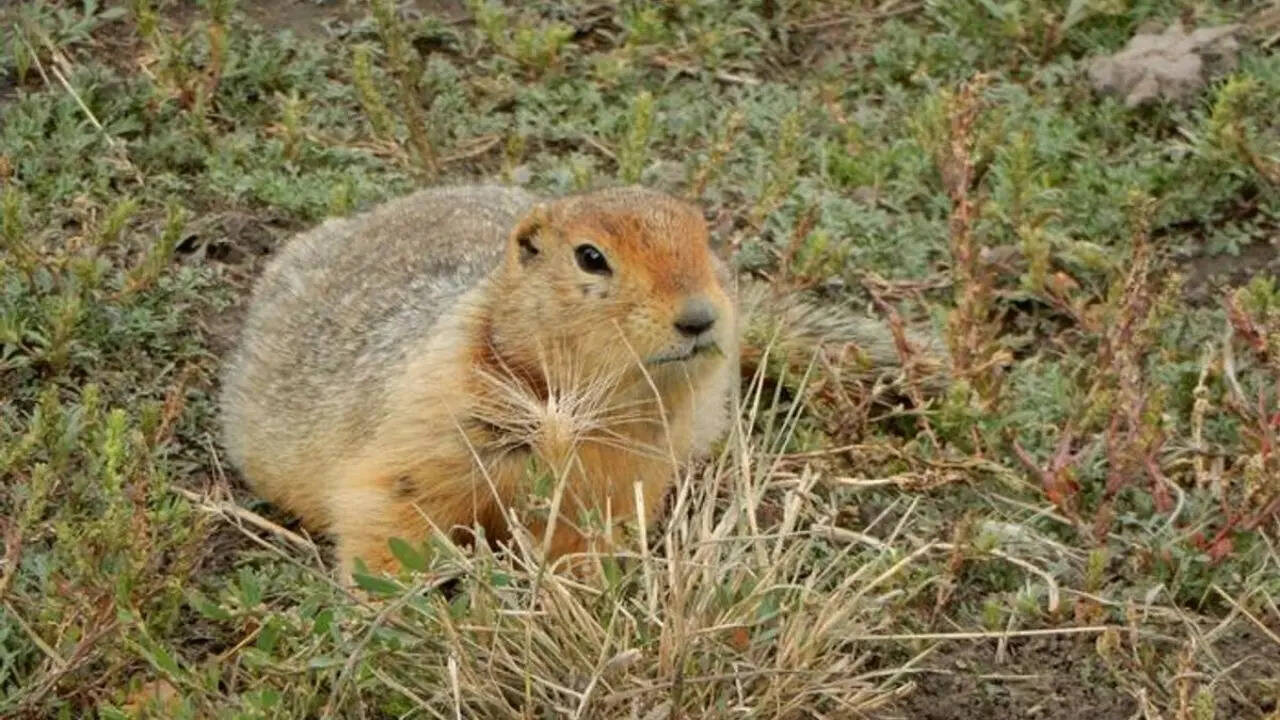
It was a lump of ancient feces. Specifically, the fossilized droppings of an Arctic ground squirrel.
To the untrained eye, it was just a clod of dirt. To science, it was a time capsule sealed 700,000 years ago. It is a biological miracle that it survived at all, let alone preserved the genetic blueprints of an ecosystem so radically different from our own that it feels like science fiction.
We tend to view the deep past as an abstract concept. We look at museum skeletons and see monsters. We look at textbook maps and see flat shapes. But when you hold a piece of preserved life from nearly a million years ago, the distance evaporates. The past stops being a story. It becomes a place.
The Architect of the Underground
To understand how a tiny rodent became the ultimate historian of the Ice Age, you have to understand the squirrel itself. Let’s call our specific, hypothetical narrator from 700,000 years ago Kik.
Kik was not a creature of grand proportions. He weighed perhaps two pounds. His life was a relentless cycle of gathering, eating, and avoiding the terrifying array of predators that ruled the Pleistocene sky and tundra. But Kik had a superpower: he was an obsessive hoarder and an aggressive excavator.
The world Kik inhabited was the mammoth steppe. This wasn't the barren, icy wasteland we often picture when we think of the Ice Age. It was a hyper-productive, sweeping grassland that stretched from western Europe across Siberia and into the Yukon. It was dry, cold, and bursting with life.
To survive the brutal winters where temperatures plummeted far below what modern humans can comfortably comprehend, Kik dug deep. He carved out intricate networks of burrows beneath the topsoil, penetrating the permafrost. Inside these subterranean chambers, he built nests. He lined them with grasses, seeds, and the hair of the giants walking above him.
Then, he went to the bathroom.
In the unique chemistry of the Arctic underground, these burrows became nature’s deep freezer. Shortly after Kik’s lifetime, the climate shifted, or a mudslide sealed the chamber, locking out oxygen and moisture. The permafrost claimed it. For 700 millennia, while civilizations rose and fell, while humans learned to split the atom and build digital worlds, Kik’s latrine sat perfectly preserved in the dark.
Reading the Ghost DNA
When researchers finally thawed the sample in a clean lab, they weren't just looking at structural remains under a microscope. They were hunting for environmental DNA (eDNA).
Think of eDNA as a forensic crime scene report left behind by the wind. Every living thing sheds genetic material. A mammoth brushing against a willow tree leaves skin cells. A horse drinking from a stream leaves saliva. A giant short-faced bear exhaling in the cold throws hair into the breeze.
Kik’s digestive tract and his nest gathered all of it. By sequencing the highly degraded, ancient strands of DNA trapped within the fossilized droppings, scientists managed to reconstruct an entire lost world with astonishing fidelity.
The data revealed a vibrant botanical catalog. The steppe was covered in a rich carpet of nutritious grasses and flowering plants known as forbs. This wasn't a fragile ecosystem; it was a sprawling, resilient engine that supported millions of massive herbivores.
The DNA confirmed the presence of the woolly mammoth, its genetic signature loud and clear. But it also revealed the presence of the Yukon horse, a stout, pony-sized wild horse that roamed in massive herds. It painted a picture of a landscape thick with life, where the air hummed with the sounds of grazing herds stretching from horizon to horizon.
Consider the sheer scale of information packed into a single square inch of this ancient material. It holds more truth about the history of our planet than a library full of speculative texts. It forces us to confront a humbling reality: our current global environment is just a temporary snapshot in a book that has been writing itself for billions of years.
The High Stakes of the Deep Freeze
There is an underlying anxiety that accompanies these discoveries. As a modern observer, it is easy to marvel at the science while missing the quiet warning whispered by the permafrost.
The only reason we are finding Kik’s world now is because the Arctic is melting.
The golden fields of the Yukon and the vast expanses of Siberia are thawing at an unprecedented rate. Industrial mining and rising global temperatures are stripping away the frozen shield that kept these ancient secrets safe. When the permafrost melts, it doesn't just reveal squirrel droppings and mammoth tusks. It releases organic matter that has been locked away for hundreds of thousands of years.
When that matter thaws, microbes wake up. They begin to consume the ancient plants and animal remains, releasing massive amounts of carbon dioxide and methane into the atmosphere.
The stakes are entirely invisible until they aren't. We are using the decay of an ancient world to accelerate the changing of our own. It is a profound irony that the very mechanism allowing us to map the history of the Ice Age with such stunning clarity is also a symptom of a destabilized modern climate.
Looking at the genetic map generated from that 700,000-year-old sample fills you with a strange mix of awe and dread. It shows us how quickly an ecosystem can vanish. The mammoth steppe was one of the most successful, long-lasting landscapes in Earth's history. It survived multiple glaciations. It supported creatures that possessed immense power and adaptability.
Yet, it disappeared. A shift in climate, a change in moisture patterns, and the great grasslands gave way to the mossy, acidic tundra and stunted boreal forests we see today. The giants died out, leaving only their bones, their teeth, and the contents of a squirrel’s burrow to prove they were ever here.
The Thread That Connects Us
It is incredibly easy to feel disconnected from this narrative. A squirrel living three-quarters of a million years ago feels entirely irrelevant to the daily grind of the twenty-first century. We have bills to pay, traffic to navigate, and immediate crises to manage.
But this discovery matters because it reframes our place in the lineage of the planet. We are not outsiders looking in on nature; we are characters in the middle of the story.
The technology used to extract DNA from Kik's ancient deposit is the exact same technology we use to track modern pandemics, monitor endangered species, and understand how ecosystems are responding to current environmental pressures. The past is giving us the tools to map our own future.
When you look closely at the data from that tiny frozen latrine, you realize that the Ice Age wasn't a alien world. It was a loud, messy, thriving community. The mammoths were real, heavy, breathing animals that kicked up dust you would have coughed on. The horses whinnied in the crisp morning air. And a tiny squirrel, terrified of the shadow of a passing eagle, scampered into the dirt to save his own life, completely unaware that his ordinary day would become a message in a bottle thrown across an ocean of time.
The dirt of the Yukon still holds millions of these stories. As the frost continues to recede, more of them will come to light, forcing us to look into the mirror of the deep past to see exactly how fragile our own world might be.