The humidity in Hong Kong doesn't just sit on your skin; it anchors you to the pavement. It is a thick, salty weight that carries the scent of roasted goose and harbor diesel. Most people walking past the Tsim Sha Tsui waterfront are focused on the immediate—the glare of a smartphone screen, the ferry schedule, or the cooling blast of air conditioning from a nearby luxury mall. But every so often, someone stops. They look up at a bronze figure frozen in a strike that never lands, yet carries enough kinetic energy to vibrate the air around it.
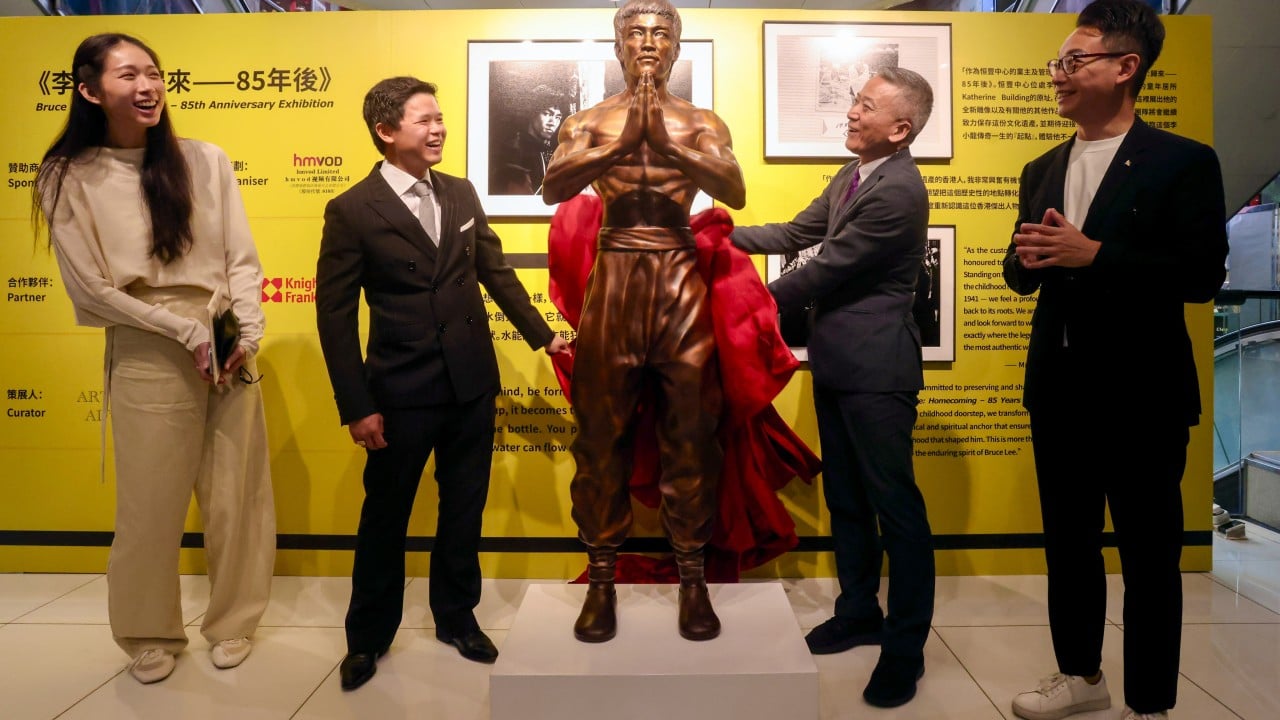
Eighty-five years ago, a boy was born in San Francisco’s Chinatown while his father was on a theatrical tour. That boy would return to Hong Kong as an infant, navigate the jagged streets of a colony under transition, and eventually become the most recognizable face of Asian masculinity in history. Today, the city is celebrating that 85th anniversary of Bruce Lee’s arrival. They are doing it with statues and exhibitions, with curated glass cases and hushed museum tones.
But Bruce Lee was never meant for a glass case.
He was a creature of friction. He was a man who understood that a person is defined by what they resist and what they allow to flow through them. To understand why Hong Kong is currently obsessed with his return is to understand a city trying to find its own reflection in the ripples of a harbor that never stays still.
The Bronze Heart of the Promenade
If you stand near the Avenue of Stars, you will see the new commemorative installations. There is a specific kind of reverence here. It isn’t the dry, academic worship of a historical politician. It is visceral. You see teenagers in oversized hoodies miming the Jeet Kune Do stance. You see elderly men, their skin like cured leather, nodding at the statue as if acknowledging an old friend who finally made it home.
The exhibition curators have gathered the ephemera of a life lived at high velocity. There are the handwritten notes where he theorized about the "soul" of martial arts. There are the yellow tracksuits that launched a thousand imitations. Yet, the real story isn't in the fabric. It’s in the struggle that preceded the fame.
Consider a hypothetical young artist today, struggling to find a voice in a digital sea of noise. In 1940, the stakes were different. Lee wasn't fighting for "likes." He was fighting against a world that told him he was too "oriental" for the West and too "westernized" for the East. He was a man without a country who built a nation within himself. When we look at his statue, we aren't just looking at a movie star. We are looking at the patron saint of the misfit.
The Philosophy of Disruption
Most people remember the screams and the high kicks. They remember the Nunchaku clicking against the floor. What they miss is the radical intellectualism of the man. Lee was a student of philosophy at the University of Washington. He didn't just want to hit people; he wanted to understand why we hit things at all.
His primary doctrine was the "Style of no Style." In a world obsessed with silos, categories, and rigid borders, Lee argued for the erasure of boundaries. He saw the traditional martial arts of his time as "organized despair." They were too stiff. Too caught up in the way things had always been done.
The current exhibition highlights this fluidity. It documents his evolution from a child actor in black-and-white Cantonese films to a global icon. But if you look closely at the timelines, you see the gaps. You see the years of rejection in Hollywood. You see the moments where he had every reason to quit and fade into a comfortable life as a private instructor to the stars.
He chose the harder path. He returned to Hong Kong to make movies on his own terms because he knew that if he didn't define himself, the world would do it for him—and the world’s version was a caricature.
The Invisible Stakes of Memory
Why does a city stop to celebrate an anniversary like this? It’s rarely about the past. It’s about the present.
Hong Kong has changed. The skyline is taller, the politics are more complex, and the old neighborhoods where Lee once walked are being swallowed by glass and steel. In this context, Lee represents a version of the city that was gritty, defiant, and unapologetically bold. He is the personification of "Lion Rock Spirit"—the idea that through sheer will and adaptability, one can overcome any obstacle.
The statue on the waterfront isn't just a tourist photo op. It is a stake in the ground. It says: This happened here. This man, who moved like water, came from these streets. There is a quiet power in seeing his personal belongings—the scuffed training gear and the private letters. These objects bridge the gap between the myth and the man. They remind us that the "Dragon" had to brush his teeth, pay his bills, and deal with the crushing anxiety of being an outsider. By humanizing him, the exhibition makes his greatness feel attainable. It suggests that if we, too, can learn to be "water," we might survive the pressures of our own lives.
The Weight of the Anniversary
As the sun sets over Victoria Harbour, the lights of the skyscrapers begin to blink on, creating a shimmering mosaic on the water. The exhibition halls are full of people who weren't even born when Lee died at the tragically young age of 32.
Death usually shrinks a person. It turns them into a footnote or a trivia answer. With Lee, it did the opposite. It distilled him. He became a concept.
The 85th anniversary is a celebration of that distillation. It’s a recognition that some people are too large for a single lifetime. They spill over. They influence hip-hop culture in New York, philosophy in London, and street art in São Paulo. But they always belong, most fundamentally, to the place that shaped their bones.
Walking through the gallery, you feel the tension between the global icon and the local son. The facts of his arrival in 1940 are recorded in ink, but his presence is felt in the way the city carries itself. It is in the hustle of the wet markets and the silent focus of the practitioners in the parks at dawn.
The Lesson in the Motion
We often mistake movement for progress. We think that by running faster, we are getting closer to something. Lee’s life taught us that the most important movement is internal. It is the shedding of the unnecessary.
The "water" metaphor is famous, but people rarely discuss the destruction water can cause. Water doesn't just flow; it erodes. It wears down the hardest stone. Lee eroded the stereotypes of his era. He wore down the barriers that kept Asian stories from being told on a global stage.
If you visit the exhibition, don't look for the "secrets" of his technique. There are no secrets. There is only the relentless pursuit of honesty. He famously said that to him, martial arts meant "honestly expressing yourself."
That is a terrifying prospect for most of us. To be honest is to be vulnerable. It is to show the cracks in the armor. The exhibition doesn't shy away from this. It shows a man who was constantly refining, constantly questioning, and never satisfied with "good enough."
The Final Strike
The crowd around the statue thins as the evening deepens. A small boy, perhaps six years old, stands in front of the bronze Dragon. He tries to match the pose. His father watches, a slight smile on his face, perhaps remembering when he did the same thing thirty years ago.
This is how a legacy survives. Not through cold facts or 85th-anniversary banners, but through the transmission of an idea. The idea that you are not defined by your circumstances, but by your response to them.
The exhibition will eventually close. The artifacts will be packed into crates. The banners will be taken down and replaced by advertisements for the next big thing. But the statue will remain. It will continue to face the harbor, braving the typhoons and the heat, a permanent reminder of the boy who arrived 85 years ago and decided to change the world.
He is still there, caught in that eternal moment of tension, waiting for us to realize that the fight isn't against an opponent. It’s against the version of ourselves that wants to stay still.
The harbor water laps against the stone, restless and persistent. It moves around the obstacles, find the gaps, and keeps going. It is exactly as he said. It is beautiful. It is dangerous. It is home.