The mud in the Donbas does not just stick to your boots. It swallows them. When the artillery opens up, that same mud turns into a liquid wall, spraying into trenches, filling the mouths of terrified teenagers, and burying the living alongside the dead. For years, the calculus of this war has been brutally simple: to hold a line, you must put flesh and bone in the path of iron.
Until now.
Step into a dimly lit basement somewhere in the Zaporizhzhia region. It smells of damp concrete, energy drinks, and the distinct, ozone tang of overheated soldering irons. There are no rifles stacked against the wall. Instead, a twenty-four-year-old former software developer named Dmytro sits in a plastic lawn chair, his eyes bloodshot, fixed on a cracked tablet screen. Outside, the world is ending in a cascade of heavy mortar fire. Inside, Dmytro twitches his thumbs on a modified gaming controller.
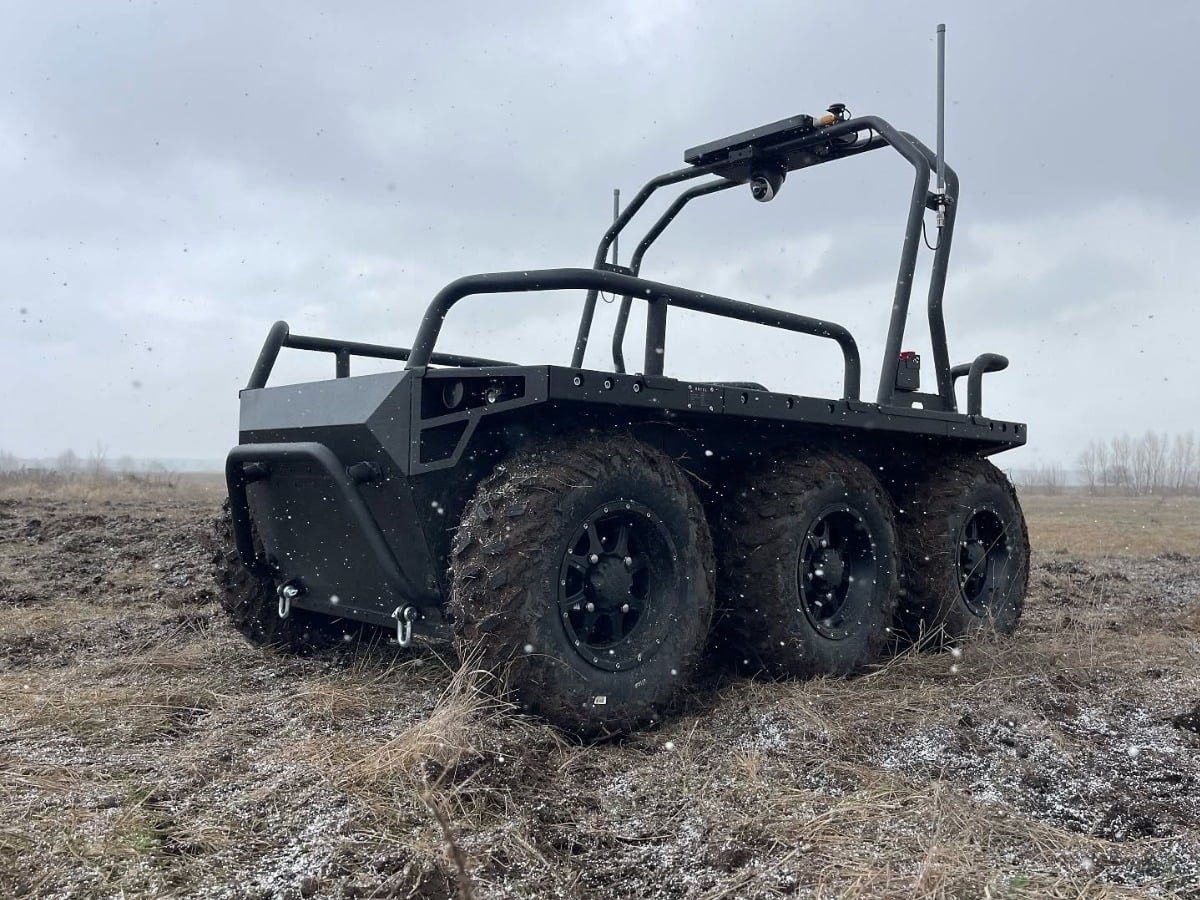
Two kilometers away, out in the blinding gray expanse of no-man's-land, a low-slung, four-wheeled steel box grinds through the craters. It has no face. It feels no fear. It is an unmanned ground vehicle, a rudimentary robot born from spare car parts, agricultural drones, and desperate Ukrainian ingenuity. Right now, it is dragging a wounded platoon commander out of the kill zone.
The machine takes a direct hit from a shrapnel fragment. A wheel jams. Dmytro curses, adjusting his frequency to compensate for the interference. The robot groans, digs its remaining tires into the clay, and keeps moving. Flesh would have torn. A human rescuer would have become a second casualty. The machine just keeps crawling.
This is the quiet mutation of modern warfare. Ukraine is systematically replacing the human body on the front line with silicon, steel, and radio waves. It is not happening because of some grand, futuristic vision dreamt up in a Silicon Valley boardroom. It is happening because the country is running out of people.
The Arithmetic of Survival
Every military commander faces the same agonizing equation. You have a position that must be held, a trench that must be cleared, or a casualty who must be retrieved. To do any of these things, you must order humans to walk into a storm of lead. In a war of attrition against a neighbor with three times the population, that equation is a slow-motion national suicide.
The dry press releases from defense ministries call it "force multiplication." They talk about "technological asymmetric advantages."
Let us call it what it actually is: a desperate attempt to keep young men and women alive long enough to see peace.
The shift started in the sky. We all watched the viral videos of small, civilian quadcopters dropping grenades into open hatches. But the sky has become crowded, jammed, and lethal. The true evolution has dropped back down to the earth.
Consider the logistics of a single machine gun nest. Traditionally, you need at least two soldiers to man it, a steady supply of ammunition crates carried across open fields, and a medic nearby when the position is invariably targeted by enemy artillery. It is a magnet for violence.
Now, Ukrainian engineering clusters are deploying remote-controlled machine gun turrets. These systems, bolted to heavy steel tripods, are lowered into trenches while the operators sit in bunkers hundreds of meters away. They view the battlefield through high-definition cameras, aiming and firing via encrypted fiber-optic cables that cannot be jammed by electronic warfare.
When an enemy shell hits the position, the camera goes dark. The steel twists. The gun is destroyed. But the soldier who would have been standing behind it is currently opening a thermos of hot tea in a bunker, shivering but entirely whole.
The Scrap-Yard Engineers
To understand how this happened, you have to look past the official state defense industry. The real revolution is decentralized, messy, and fiercely chaotic. It takes place in garage workshops, converted tractor factories, and makeshift labs funded by localized crowdsourcing campaigns.
I spoke with a civilian engineer who goes by the callsign "Tesla." Before the invasion, he repaired electric vehicles in Kyiv. Today, he manages a team of eight people who build automated logistics platforms.
"The military came to us and said they were losing too many men just carrying soup and bullets to the forward positions," Tesla told me, wiping grease from his forehead. "A man carrying two thirty-kilogram crates of ammunition through the mud is slow. He is loud. He is a target. So we took the motors from old electric delivery vans, built a chassis from scrap metal, and added a basic remote receiver."
These machines are not beautiful. They look like motorized coffee tables on tracks. They squeak, they rattle, and their paint jobs are uneven. But they can carry two hundred kilograms of supplies through terrain that would break a soldier's ankles. They operate in the dead of night, navigating by pre-programmed GPS coordinates or thermal cameras.
If the enemy captures one, they get a pile of cheap batteries and a recycled motor. If the machine gets through, a isolated squad gets the anti-tank missiles they need to survive the dawn.
The scale of this deployment is accelerating dramatically. Hundreds of these small-scale robotic platforms are now humming across the eastern front. They are clearing minefields using attached rollers, laying their own mines in the path of advancing armored columns, and acting as mobile radio relays to extend the reach of aerial drones.
The Weight of the Invisible Tether
It is easy to look at this shift and feel a sense of clinical detachment. We see the videos of machines doing the dirty work and think of it as a bloodless war.
It is not. The trauma has simply changed its address.
Talk to the operators like Dmytro, and you realize the psychological toll of fighting via proxy. When you are in a trench, adrenaline takes over. Your survival instincts dictate your every movement. You fight to stay alive, and you fight for the person to your left and right.
When you operate a robot, you are physically safe, but your mind is violently displaced. You are looking at a screen, watching your comrades retreat, watching the enemy advance, feeling every explosion through the static on your monitor. When your robot gets stuck, or when its battery dies fifty meters short of a wounded soldier who is crying out for help, the helplessness is paralyzing.
"You feel like a ghost," Dmytro whispered, his eyes leaving the tablet for the first time. "You are there, but you cannot bleed. You want to run out there and use your hands, but you are trapped in this basement. If the machine fails, it feels like your personal failure, even if it was just a dead battery."
There is also the terrifying reality of the counter-evolution. The enemy is not blind. They see the robots, they track the radio signals back to the transmitters, and they hunt the operators with a terrifying intensity. A basement filled with drone pilots is a high-value target. The moment an operator switches on their equipment, they are broadcasting their potential death sentence to every electronic ear in the sky.
The Ethical Fog
We are entering a strange, uncharted territory. For now, the vast majority of these ground systems require a human finger on the trigger or a human thumb on the joystick. The decisions to move, to retreat, and to kill are still human decisions.
But the radio spectrum is becoming a wasteland. Electronic warfare jamming is now so intense along the front lines that the invisible cords connecting the operator to the machine are constantly snapping.
This reality is pushing engineers toward a dark frontier: autonomy.
If a robot loses its connection to its human handler, what should it do? Should it turn around and come home? Or should its onboard computer take over, using rudimentary artificial intelligence to identify shapes, distinguish between a uniform and a civilian coat, and make its own determination on when to fire?
The people building these systems do not have the luxury of debating this in academic seminars. They are watching their towns burn in real-time. When asked about the morality of autonomous weapons, a workshop commander in Kharkiv gave a chillingly pragmatic answer: "The dead have no ethics. If an autonomous machine prevents our lines from collapsing today, we will argue about the philosophy of it tomorrow."
This is the uncomfortable truth that the rise of the machines forces us to confront. Technology is not a savior; it is a mirror. It reflects our desperation, our limitations, and our relentless will to survive.
The Last Line
The sun is setting over the Donbas, casting long, bloody shadows across the ruined landscape. The artillery has quieted down to a sporadic, rhythmic thumping in the distance.
In the basement, Dmytro plugs a fresh battery pack into his controller. On his screen, the four-wheeled robot has finally cleared the ridgeline. The wounded commander it dragged across the mud is now in the hands of the field medics. The machine itself is missing its front-left fender, its metal frame is pockmarked with shrapnel scars, and one of its cameras is completely shattered.
It looks broken. It looks exhausted.
But it did not die. And neither did the man it carried.
Out in the dark, the ghost soldiers of the eastern front are waiting for the next command. They do not need letters from home. They do not need medals. They just need enough power to crawl through the mud for one more mile, taking the blows that were meant for the living.