At three in the morning, forty nautical miles off the coast of Palawan, the ocean does not look like a geopolitical chessboard. It looks like black glass.
Consider a hypothetical fisherman we will call Mateo. He is fifty-four years old, his knuckles swollen from four decades of hauling wet hemp, and his wooden outrigger relies on a single-cylinder engine that coughs like an old man in winter. On a moonless Tuesday, Mateo watches a wall of steel emerge from the fog. The vessel is three hundred feet long, gray-hulled, and running completely dark. Its Automatic Identification System—the digital transponder every commercial ship is legally required to broadcast—has been switched off. To the global shipping registries in London and Singapore, this boat does not exist. To Mateo, it is a floating mountain about to split his hull in two. Also making news lately: Asymmetric Chokepoint Attrition How Naval Mines Reprice Maritime Risk in the Strait of Hormuz.
He has no radar. He has no satellite phone. When the massive wake tosses his boat sideways, spilling his catch and flooding his bilge, there is no one to call because, officially, nothing was ever there.
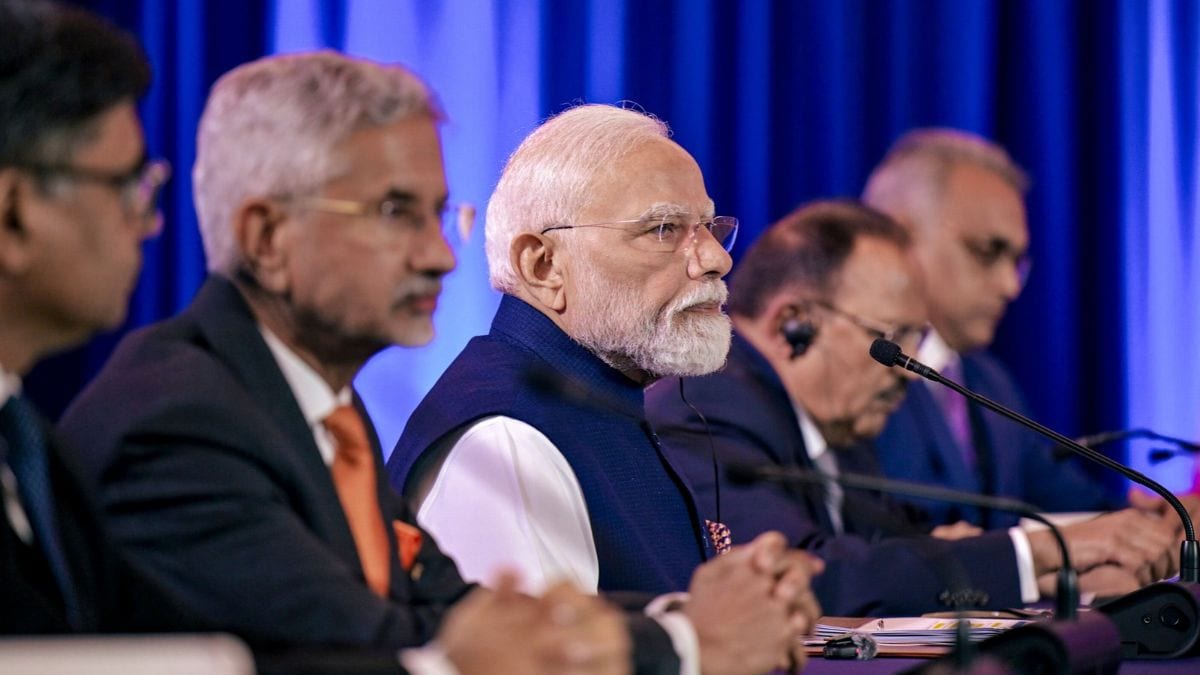
This is the reality behind the sterile headlines coming out of diplomatic summits. When Prime Minister Narendra Modi and the leaders of the Quad—Australia, India, Japan, and the United States—stepped up to the podiums in Wilmington, Delaware, in late 2024 to announce a new maritime surveillance system, joint military exercises, and sweeping cybersecurity initiatives, the news wires translated it into bureaucratic cardboard. They talked about "domain awareness." They talked about "interoperability." They talked about "capacity building." Further information regarding the matter are explored by Reuters.
They missed the point entirely.
The Quad is not merely signing papers. They are building a floodlight for the darkest corners of the Indo-Pacific, and the stakes are measured in the survival of people like Mateo, the price of the groceries in your pantry, and the invisible digital threads holding your bank account together.
The Architecture of Invisibility
To understand why four of the world’s largest democracies are pooling their satellites, warships, and cyber-commandos, you have to understand the weaponization of silence.
For years, a quiet crisis has been unfolding across the Indian and Pacific Oceans. Illegal, unreported, and unregulated fishing—often conducted by massive, state-subsidized distant-water fleets—has stripped local waters bare. These vessels routinely engage in "dark shipping." By turning off their transponders, they vanish from conventional civilian tracking maps. They slip into the Exclusive Economic Zones of smaller nations, dredge the seabed, intimidate local coast guards, and disappear before dawn.
I remember standing on a dock in Chennai a few years ago, talking to a marine biologist who spent his life tracking fish stocks in the Bay of Bengal. He pulled out a printed satellite map covered in red dots. "Those aren't storms," he told me, tapping a cluster near the Andaman Islands. "Those are hulls. They turn off their radios, so the coastal radar misses them. By the time a patrol boat gets out there, the water is empty."
When the fish vanish, coastal economies collapse. When coastal economies collapse, desperation breeds piracy, smuggling, and political instability. The ocean, which covers seventy percent of our planet and carries over eighty percent of global trade by volume, becomes a lawless frontier.
This is the exact problem the Quad’s expanded Indo-Pacific Partnership for Maritime Domain Awareness (IPMDA) was designed to solve.
Until recently, tracking a dark ship required expensive, military-grade reconnaissance aircraft—assets that smaller nations in Southeast Asia and the Pacific Islands simply do not have. The Quad’s breakthrough is a masterclass in technological jujitsu. Instead of relying on ships to announce themselves via radio, the new system uses commercial satellites equipped with radio-frequency sensors. Even if a captain switches off his location transponder, his ship still uses navigation radar, satellite phones, and basic marine radios to avoid hitting rocks or talking to crewmates. Those devices leak faint electronic whispers into space.
The Quad’s satellite network listens for those whispers, triangulates the ship's exact coordinates from orbit, and beams that data directly to regional fusion centers in India, Singapore, Vanuatu, and the Solomon Islands in near real-time.
Suddenly, the ghost ships have shadows.
The New Coast Guard Reality
Technology on a screen means nothing if nobody can reach the water. That brings us to the second major pillar of the Quad’s announcement, one that carries a distinctly human weight: the Quad-at-Sea Ship Observer Mission.
In 2025, for the first time in history, coast guard personnel from India, Japan, Australia, and the United States began boarding each other's vessels, sailing together across the Indo-Pacific. Think about what this actually looks like on a rolling deck in the middle of a monsoon swell.
A lieutenant from the Indian Coast Guard, accustomed to the warm, choppy waters of the Arabian Sea, stands shoulder-to-shoulder on the bridge of a U.S. Coast Guard cutter with a petty officer from Yokohama and a navigator from Sydney. They are sharing binoculars. They are comparing boarding protocols. They are learning the cadence of each other's voices over the roar of twin diesel engines.
Why does this matter more than a fleet of aircraft carriers?
Because in the gray zone of modern geopolitics, naval destroyers are often too big. If a grey-hulled warship confronts an aggressive fishing trawler, it risks triggering an international military incident. A white-hulled coast guard cutter, however, is a law enforcement vessel. It enforces maritime law, checks permits, inspects cargo, and rescues stranded sailors. By training together and sharing deck space, the Quad coast guards are creating a unified, peacetime policing presence across millions of square miles of ocean.
At the same time, the Quad launched the Maritime Initiative for Training in the Indo-Pacific (MAITRI). The name itself—Maitri, a Sanskrit word meaning friendship and goodwill—signals the intent. It is not about the four big powers patrolling the ocean on behalf of everyone else; it is about handing the keys to the neighborhood watch. Through MAITRI, smaller Indo-Pacific nations gain the legal, technical, and operational training to use that satellite data to police their own waters.
When a Pacific Island nation with a population the size of a mid-sized suburb can suddenly spot an illegal trawler three hundred miles off its coast and dispatch a trained patrol crew to intercept it, the balance of power shifts. The bully loses the advantage of the dark.
The Cables Beneath the Keel
If you think this only affects fishermen in the South China Sea or islanders in the Pacific, look at the device you are reading this on.
Ninety-nine percent of intercontinental internet traffic—your emails, your bank transfers, your streaming movies, and the encrypted diplomatic cables of governments—does not travel through satellites. It travels through fiber-optic cables resting on the ocean floor. These cables are roughly the thickness of a garden hose, wrapped in steel wire and copper, lying miles beneath the surface in crushing darkness.
And they are extraordinarily vulnerable.
In recent years, undersea cables in the Red Sea, the Baltic Sea, and near Taiwan have been severed by dragging anchors and mysterious "accidents." Simultaneously, the digital infrastructure that manages ports, shipping logistics, and telecommunications grids has come under relentless assault from state-sponsored hackers. A cyberattack on a major port terminal in Mumbai, Los Angeles, or Tokyo doesn't just freeze computers; it stops cranes from moving containers, strands medicine on docks, and halts supply chains within hours.
This is why the Quad leaders paired their maritime announcements with a sweeping set of cybersecurity initiatives, including the Quad Senior Cyber Group and new joint frameworks to secure undersea cables and critical infrastructure.
Let us use an analogy to make this concrete. Imagine your house has the strongest deadbolts in the neighborhood, reinforced steel doors, and an alarm system connected directly to the police station. None of that matters if the city's main water pipe runs exposed through an unguarded alley behind your fence, and someone decides to take a sledgehammer to it.
For decades, the world treated undersea cables and port software as commercial utilities—boring plumbing best left to private telecom companies. The Quad’s new cyber architecture recognizes them for what they actually are: the central nervous system of modern civilization.
Under the new initiatives, the four nations are sharing threat intelligence on ransomware groups and state-backed intrusions in real time. They are establishing shared software security standards so a vulnerability in a Japanese port crane doesn't become a backdoor into an American naval logistics network. Most importantly, through initiatives like the Cable Connectivity and Resilience program, they are investing directly in building, maintaining, and protecting the physical subsea cables that connect the Indo-Pacific, ensuring that countries aren't forced to rely on compromised hardware built by authoritarian regimes.
The Fragility of Trust
I will be honest with you: when I first began following the Quad’s revival years ago, I was deeply skeptical.
History is littered with grand diplomatic acronyms that dissolve the moment national interests collide. Look at the four countries involved. India guards its strategic autonomy fiercely, refusing to enter formal military alliances and maintaining historical defense ties with Russia. Japan is bound by a post-war pacifist constitution that limits how it projects force. Australia’s economy is deeply intertwined with Chinese trade, making every diplomatic step a high-wire act. And the United States is perpetually distracted by domestic political turbulence and crises in Europe and the Middle East.
It is entirely reasonable to look at this quartet and wonder if they can actually hold the line when the weather turns rough. When a crisis hits at two in the morning, will these four capitals really act as one, or will bureaucracy and domestic politics paralyze them?
The honest answer is that nobody knows for sure. Alliances are living things; they require constant feeding, and they can wither if neglected by future leaders.
Yet, what makes these recent announcements different from standard diplomatic theater is their sheer, unglamorous practicality. They are not built on vague promises to defend each other in a hypothetical war. They are built on shared data pipes, interoperable radio frequencies, joint coast guard logistics, and standardized cybersecurity patches.
Once you wire four nations' coast guards into the same satellite feed, once you train their officers on the same ships, and once you align their national cyber-defense protocols, you create institutional muscle memory. You build habits of cooperation that survive election cycles.
The Malabar Horizon
Consider what happens next when these systems move from policy papers to open water.
Every year, the navies of India, Japan, Australia, and the United States gather for Exercise Malabar. What began in 1992 as a modest bilateral drill between the Indian and U.S. navies in the Indian Ocean has evolved into one of the most sophisticated maritime exercises on earth.
With the newly announced expansions in maritime surveillance and cyber defense, Malabar is no longer just about destroyers practicing formation maneuvers or submarines hunting each other beneath the thermocline. It has become a live-fire laboratory for the entire Quad ecosystem.
Picture a future Malabar exercise in the Bay of Bengal. High above the atmosphere, commercial radio-frequency satellites detect an unflagged vessel behaving erratically near a major shipping lane. The data drops into the regional fusion center in Gurugram, India. Within minutes, that intelligence is pushed to an Australian P-8A Poseidon maritime patrol aircraft flying overhead, which confirms the visual identity of the vessel. Simultaneously, a cyber-defense team simulates a ransomware attack attempting to blind the shore-based logistics network, while Japanese and American destroyers coordinate an electronic warfare response to keep communications open.
No shots are fired. No borders are crossed. Yet, a clear, unmistakable message is broadcast across every frequency in the region: We see you, we are talking to each other, and the dark is no longer yours to own.
The Light on the Water
Critics in Beijing have routinely dismissed the Quad as an "Asian NATO," an exclusive clique trying to contain China’s rise and drag the region back into a Cold War mentality. That critique relies on a deliberate misreading of what is actually happening on the water.
NATO is a mutual defense treaty built around Article 5—an attack on one is an attack on all. The Quad has no mutual defense treaty. It has no permanent headquarters. It has no standing army.
What it has is a shared recognition that the rules governing the global commons—the open sea, the seabed, and the digital networks above them—are under sustained assault. When a single country claims ninety percent of a vital international sea as its personal territory, rams the coast guard vessels of its neighbors, cuts undersea cables, and plunders the fish stocks of developing nations, the response isn't containment. It is self-preservation.
The ultimate measure of Prime Minister Modi and the Quad leaders' announcements will not be found in the communiqués signed in air-conditioned conference rooms. It will be found out on the open water, in the quiet hours before dawn.
Think back to Mateo, our hypothetical fisherman forty miles off Palawan, bailing seawater out of his wooden hull with a cracked plastic bucket while a three-hundred-foot steel shadow disappears into the fog.
In the world the Quad is trying to build, that shadow never gets to be a ghost. The moment its captain switches off his transponder, a satellite four hundred miles above the earth catches the stray pulse of his radar. A fusion center in Manila or Singapore flags the anomaly. By sunrise, a white-hulled coast guard cutter—crewed by officers trained under MAITRI, backed by shared intelligence from four democracies—cuts across the horizon, its spotlight sweeping the waves, demanding a name, a flag, and an answer.
The ocean is vast, cold, and indifferent to human politics. For thousands of years, its sheer size has been a shield for those who wish to operate without accountability. That era is ending. The lights are coming on, one satellite, one coast guard cutter, and one fiber-optic cable at a time.