Walk into any lively shop in Kagawa Prefecture at noon, and your senses are assaulted by a beautiful, heavy wall of steam. The air smells of rich, salty dashi broth and boiled wheat. You hear the rhythmic, wet thwack of fresh noodles hitting the chopping board, followed by the deep, guttural sighs of exhausted salarymen slurping down bowls of Sanuki udon. This thick, chewy noodle is not just lunch here. It is a regional religion.
But if you stay until the shop lights dim, a different reality emerges.
Behind the kitchen counter, the owner tips the remaining contents of the massive boiling vats into the trash. It is a heartbreaking ritual. Udon is highly temperamental. Once boiled, the noodles lose their signature elastic bite within a shockingly short window. If a batch sits too long waiting for customers who never show up, it becomes soft, starchy sludge. It cannot be served.
Every single day, thousands of pounds of this culinary heritage become garbage. It is an invisible tax on local culture, a quiet mountain of waste generated by our collective obsession with freshness.
For years, this loss was accepted as the unavoidable cost of doing business. But a few miles away at Kagawa University, a microbiologist named Naotaka Tanaka looked at those soggy scraps and saw something else entirely. He saw carbon. He saw sugars. He saw the raw materials for a completely unexpected resurrection.
The Microscopic Factory
To understand what happens next, we have to look past the steaming bowls and enter the silent world of microbiology. Professor Tanaka spent years studying the quirks of Acetobacter aceti—acetic acid bacteria. These tiny, living organisms possess a unique superpower: when given the right nutrients, they spin an incredibly dense, ultra-strong membrane of pure cellulose.
Standard paper requires cutting down trees, stripping the bark, and using massive, energy-hungry industrial machinery to crush wood pulp into flat sheets. Tanaka wondered if he could bypass the forest entirely.
Consider the hypothetical daily routine of a small, local noodle shop we will call "Udon Ichiban." The owner prepares fifty pounds of fresh dough each morning. By 3:00 PM, rainy weather has kept the usual crowds away. Ten pounds of perfectly good wheat noodles are now unsellable.
Instead of heading to an incinerator to release carbon into the atmosphere, those ten pounds of leftover noodles are collected and dropped into a blender with water. This is where the biological alchemy begins.
First, researchers introduce specific enzymes to break down the dense wheat starch. It is a literal liquidation process, transforming the solid noodles into a sweet, milky glucose broth. This broth is the ultimate fuel. When the acetic acid bacteria are introduced to this sugary pool, they feast.
Over several quiet days, a strange and elegant phenomenon occurs on the surface of the liquid. The microscopic organisms weave a pale, translucent film. They are building paper from the top down, one molecule at a time, without a single machine or chemical bleach. The scientists carefully lift this wet membrane from the liquid, place it on a tray, and let the air do the rest.
Strength Born from Scraps
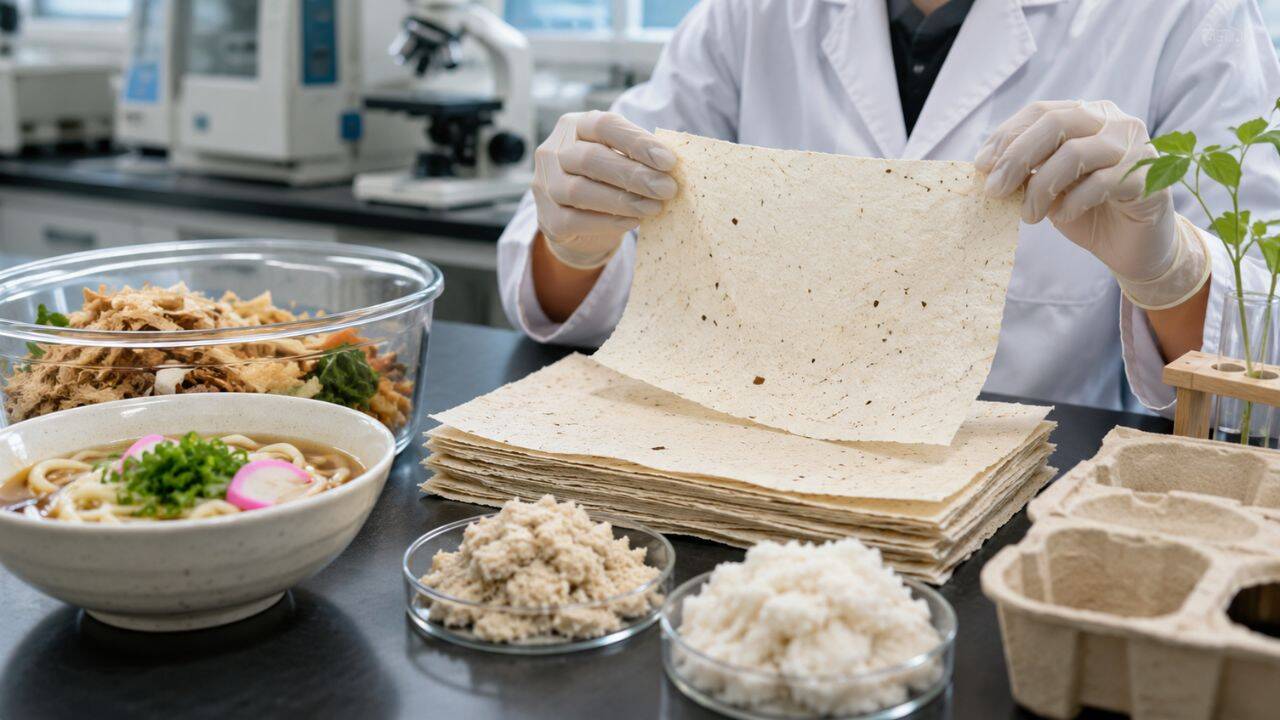
The resulting material is deceptive. Touch a sheet of this udon-derived paper, and it feels remarkably like washi, the traditional, textured handmade paper that Japan has spent centuries perfecting. It is thin and light.
Yet appearances lie.
When you try to rip it, the paper resists. Because the bacteria weave the cellulose fibers at a molecular level, the resulting mesh is vastly tighter and stronger than standard wood-pulp paper. It handles moisture with surprising resilience. A single, standard bowl of discarded udon yields five to ten pristine sheets of A4-sized paper.
Yet, this durability comes with a built-in expiration date. The moment this paper is no longer needed and is buried in ordinary soil, the spell breaks. Naturally occurring earth microbes recognize the material as organic. They consume it entirely. Within weeks, the paper completely dissolves back into the dirt, leaving behind absolutely zero toxic residues or microplastics.
It is a completely circular existence. The wheat comes from the earth, passes through a noodle bowl, transforms into a piece of stationery, and returns to the earth to nourish the next crop.
The Human Circuit
If this were just a story about a clever lab experiment, it would end there. But the real magic of Kagawa’s noodle paper is found in the hands of the people who now make it.
After perfecting the chemical process, Kagawa University did something unusual: they handed the entire methodology over to a local social welfare organization, completely free of charge. They did not lock the technology behind a corporate patent. They wanted it to live in the community.
The production line requires zero heavy lifting or dangerous factory equipment. It is an intentional, gentle process of mixing, waiting, skimming, and drying. This makes it an ideal workplace environment for individuals with intellectual and physical disabilities who often struggle to find meaningful employment in rigid industrial settings.
The rollout was not easy. At first, the facility’s open rooms were vulnerable to the invisible currents of the natural world. Wild bacteria drifted into the vats, contaminating the mixtures. Black mold bloomed across the delicate cellulose sheets before they could dry, ruining weeks of work.
The workers refused to give up. They adapted by building small, temperature-controlled incubation boxes to protect the growing membranes from the environment. Today, the facility reliably produces roughly one hundred sheets of high-grade, sustainable paper every month.
A quiet, beautifully human network has stabilized across the prefecture. Local restaurants save their over-boiled scraps. The welfare facility collects them, transforming the starch into durable sheets. The university then purchases the finished paper to use for official promotional goods and artistic certificates, funding the system and keeping the circle turning.
To thank the restaurants for their raw materials, the university provides them with meticulous data tracking daily food waste alongside local weather patterns. It gives small business owners the precise predictive insight they need to adjust their daily production, cutting down the waste before it even reaches the bowl.
A Material That Remembers
We are surrounded by things designed to outlive us. Our landfills are packed with plastic packaging that will remain intact for five hundred years, all used to protect items we discarded after five minutes.
The delicate sheets drying in Kagawa offer a quieter, more humble alternative. The university is already experimenting with using the material to create biodegradable artificial fishing bait—an elegant solution to the massive problem of lost plastic gear polluting the oceans. If a line snaps, the bait simply becomes food for the environment.
There is something deeply moving about holding a piece of this paper. It carries the faint, ghost-like texture of a meal that someone ran out of time to eat. It is a physical manifestation of a second chance, proof that with enough patience and a small army of microscopic allies, even our waste can be redeemed into something beautiful.