Stand on any freshly poured stretch of city pavement on a Tuesday morning, and you will smell nothing at all. Just the faint, chalky tang of curing lime and damp aggregate. Beneath the soles of your shoes, however, an invisible chemical debt is still being paid off in factories three hundred miles away.
Concrete is the second most consumed substance on Earth, trailing only water. We pour it for hospital foundations, highway overpasses, and the quiet cul-de-sacs where children learn to ride bicycles without training wheels. Yet the binder that holds all that crushed rock together—ordinary Portland cement—carries a brutal atmospheric price tag. Heating limestone and clay in massive rotary kilns requires temperatures north of 1,400 degrees Celsius, an inferno fed largely by fossil fuels. Worse still, the chemical reaction itself forces carbon dioxide out of the stone and straight into the sky. Roughly eight percent of global carbon dioxide emissions come from cement production alone. If the cement industry were a country, it would be the third-largest emitter on the planet, sitting right behind China and the United States.
For decades, civil engineers treated this as an unbreakable law of physics. You want bridges that hold forty-ton trucks? You pay the carbon tax to the atmosphere.
Then someone started looking at the gray dust left over at the bottom of municipal garbage incinerators.
The Alchemy of What We Throw Away
To understand what German researchers and infrastructure builders are currently testing on rural roads and industrial yards, picture a hypothetical municipal engineer named Lukas. Lukas spends his mornings staring at two piles of trouble that have nothing to do with each other on paper.
The first pile sits outside a waste-to-energy plant in North Rhine-Westphalia. Germany recycles aggressively, yet millions of tons of non-recyclable household trash still go into incinerators every year to generate electricity and district heating. What remains after the flames die down is bottom ash and fly ash—a gritty, mineral-rich residue laced with heavy metals, salts, and calcium oxides. Historically, most of this waste ash ended up buried in specialized landfills or tucked beneath layers of protective clay, treated as an awkward liability nobody wanted near groundwater.
Lukas's second pile of trouble is an aging stretch of municipal road crumbling under delivery vans and winter frost. Patching it requires fresh asphalt or concrete, both of which carry steep financial and carbon budgets that his city council has pledged to cut by half before 2030.
The breakthrough happens when those two headaches collide.
In pilot projects across Germany—led by materials scientists, waste management operators, and regional road authorities—engineers are subjecting municipal waste incineration ash to a process called accelerated carbonation. Think of it as fast-forwarding geology. In nature, calcium-rich rocks slowly absorb carbon dioxide from rainwater over thousands of years, locking the gas away as solid limestone. Inside specialized treatment chambers, technicians expose dampened waste ash to concentrated carbon dioxide captured from industrial flue gases.
Within hours, not millennia, a chemical marriage takes place.
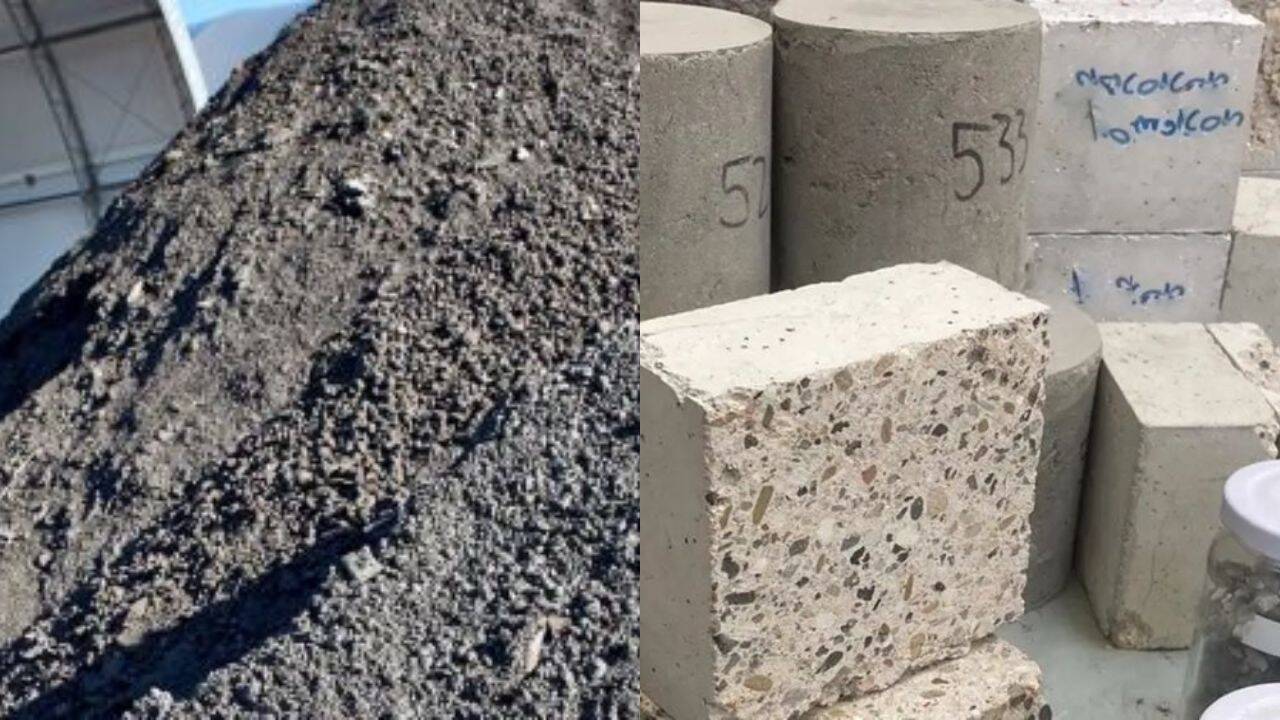
The free lime and calcium silicates inside the gray dust react with the injected carbon dioxide, crystallizing into stable calcium carbonate. Two things happen simultaneously during that reaction. First, the gas is permanently mineralized; it cannot leak back into the air unless you bake the stone at blast-furnace temperatures again. Second, the newly formed carbonate crystals bind the loose ash particles together and lock trace heavy metals inside a dense mineral matrix, drastically reducing the risk of toxic elements leaching into soil or groundwater.
The garbage dust turns into synthetic stone.
Why Your Drive to Work Matters More Than You Think
I spent three years living beside a major highway expansion project in central Europe, watching forty-foot concrete mixers rumble past my bedroom window at five in the morning. Before that, concrete was just background noise to me—grey, inert, boring. Watching thousands of cubic meters of it vanish into retaining walls and bridge abutments changed how I saw the ground beneath my tires. Every guardrail post, every stormwater culvert, every meter of sub-base gravel represents an astonishingly heavy industrial supply chain.
When we talk about climate technology, our imaginations rush toward gleaming solar farms, sleek electric sedans, or towering offshore wind turbines. We rarely get romantic about road base.
We should.
A single kilometer of two-lane highway consumes thousands of tons of aggregate and binder. Unlike an experimental battery chemistry that might take fifteen years to scale, road construction is an immediate, bottomless sink for bulk materials. If you can replace even fifteen or twenty percent of traditional virgin aggregate and clinker-heavy cement with carbonated waste ash, the math stops looking like a laboratory curiosity and starts looking like an industrial lever.
Consider what happens next on a German test strip.
Instead of hauling pristine limestone out of a quarry—blasting hillsides, crushing rock, and trucking it across state lines—contractors lay down a sub-base layer made from treated municipal bottom ash. Above it, test formulations of concrete pavers and structural mixes incorporate finely ground carbonated ash as a supplementary cementitious material. Sensors embedded beneath the frost line measure everything: load-bearing capacity under heavy axle weights, freeze-thaw durability during wet February nights, and runoff water chemistry after spring downpours.
Skeptics, and there are plenty inside conservative civil engineering circles, raise valid alarms. Waste ash is notoriously inconsistent. What goes into household trash bins in December looks different from what goes in during July. High chloride levels in untreated ash can corrode the steel rebar inside reinforced concrete, turning a fifty-year bridge deck into a rusting hazard in ten. And if heavy metals like lead, zinc, or copper are not completely immobilized during carbonation, rain filtering through roadbeds could carry contaminants toward local streams.
Nobody in these German test labs pretends the dust is magic. Washing steps, magnetic separation of scrap metals, and strict chemical batch testing happen long before a single shovel of treated ash touches a concrete mixer. The honesty of the engineering lies in admitting that municipal ash will never replace structural cement in a skyscraper core tomorrow morning. It does not need to. Non-structural concrete, kerbstones, noise barriers, cycle paths, and highway sub-bases account for an enormous slice of national construction volume—and they do not require aerospace-grade tensile strength.
The Economics of Locking Smoke in Stone
Follow the money, because good intentions never paved a highway.
For a waste-to-energy operator in Germany, landfilling incineration ash costs real euros per ton, and regulatory space for hazardous or mineral landfills is shrinking across Western Europe. Meanwhile, industrial emitters—from cement kilns to chemical plants—face escalating carbon pricing under the European Union Emissions Trading System. Paying to vent carbon dioxide into the sky gets more expensive every single year.
Accelerated carbonation flips both balance sheets at once.
Instead of paying a landfill operator to bury waste ash, the plant transforms that residue into a certified secondary building material that contractors actually buy. Instead of paying carbon penalties on captured flue gas, the emitter sells or transfers that carbon dioxide to mineralize the ash. You take two expensive waste streams—one solid, one gaseous—and fuse them into a salable commodity.
To see how tightly these numbers interlock, look at the three-way exchange happening inside a typical commercial pilot:
- The incinerator operator avoids landfill disposal fees and recovers valuable ferrous and non-ferrous metals during ash pre-treatment before mineralizing the remaining mineral fraction.
- The carbon emitter offloads captured carbon dioxide into permanent mineral storage without needing deep underground geological pipelines or offshore North Sea storage wells.
- The concrete and road builder gains a local, low-carbon aggregate and binder substitute that lowers the embodied carbon score required to win public infrastructure tenders.
That third point is quietly rewriting procurement rules across Germany and neighboring European markets. Public works departments are no longer awarding contracts purely to the lowest bidder; increasingly, they score bids using shadow carbon prices and lifecycle emissions audits. A construction firm that can prove its roadbed locked away several tons of carbon dioxide inside recycled ash wins the contract over a rival still relying entirely on virgin quarry stone.
What Could Still Break the Promise
I used to think industrial revolutions announced themselves with ribbon-cutting ceremonies and dramatic speeches. Watching materials science up close teaches you the opposite. Real shifts stall out in standards committees, insurance underwriting rooms, and unglamorous permit hearings.
The biggest hurdle facing carbon-storing waste ash is not chemistry. It is trust codified into building standards.
Germany’s DIN construction standards are famously rigorous, written to ensure that roads and buildings survive decades of abuse without catastrophic failure. Certifying a novel building material derived from household garbage requires years of longitudinal field data. Architects and municipal liability insurers want ironclad proof that carbonated ash blocks will not swell, crack, or leach sulfates twenty winters from now. Until blanket national approvals replace case-by-case experimental permits, every new road project using the material requires piles of regulatory paperwork that small contractors simply cannot afford to navigate.
There is also a logistical catch that enthusiasts often gloss over: concentration.
Carbonation works best when you have a concentrated source of carbon dioxide sitting close to a concentrated source of calcium-rich ash. If you have to compress captured gas into tanker trucks and haul it two hundred miles to an ash treatment plant, the diesel burned on the highway eats straight into your net climate benefit. The model shines brightest in industrial clusters—places like the Ruhr Valley—where power plants, cement kilns, waste incinerators, and precast concrete factories already sit within a few kilometers of one another.
And even at full scale, waste ash will never swallow all of construction’s carbon problem. There simply is not enough garbage ash in Germany to replace every ton of Portland cement poured nationwide. Anyone selling this technology as a silver bullet is selling snake oil. What it offers instead is a crucial wedge—one solid, practical piece of a puzzle that also demands electrified kilns, alternative clays, and designing structures that use less concrete in the first place.
Walking on Locked Sky
Go back to that quiet stretch of test road on a damp autumn evening in northern Germany.
Cars pass over it at eighty kilometers an hour, headlights sweeping across pale grey concrete curbs and smooth asphalt. To the commuters inside, rushing home for dinner, it looks utterly unremarkable. Just another piece of public infrastructure doing its silent, thankless job beneath the tires.
Yet inside the aggregate beneath their wheels sits carbon that once drifted toward the upper atmosphere from an industrial smokestack, bound tight to minerals salvaged from yesterday’s household trash. Two things our civilization normally treats as poison—smoke and garbage—pressed together under human ingenuity until they became solid ground.
Next time you step off a curb onto a city street, look down at the grey stone under your shoes and ask yourself a simple question: is the ground beneath us merely something we dig up, or could it become the place where we finally put the sky back?