Two miles beneath the surface of the South Pole, buried inside a block of ice so ancient it predates human civilization by millennia, a single cubic kilometer of frozen stillness is listening.
It does not listen for sound. Sound dies in the crushing pressure and eternal dark of the Antarctic glacier. Instead, it waits for flashes of blue light. Faint. Ghostly. Impossible.
For decades, mainstream physics told us that the universe’s most elusive messengers—neutrinos—were practically uncatchable ghosts. They pass through your body by the trillions every second, slipping through the Earth itself as if it were empty space. They leave no track, no charge, no shadow. Trying to catch one is like trying to snare a hurricane with a butterfly net.
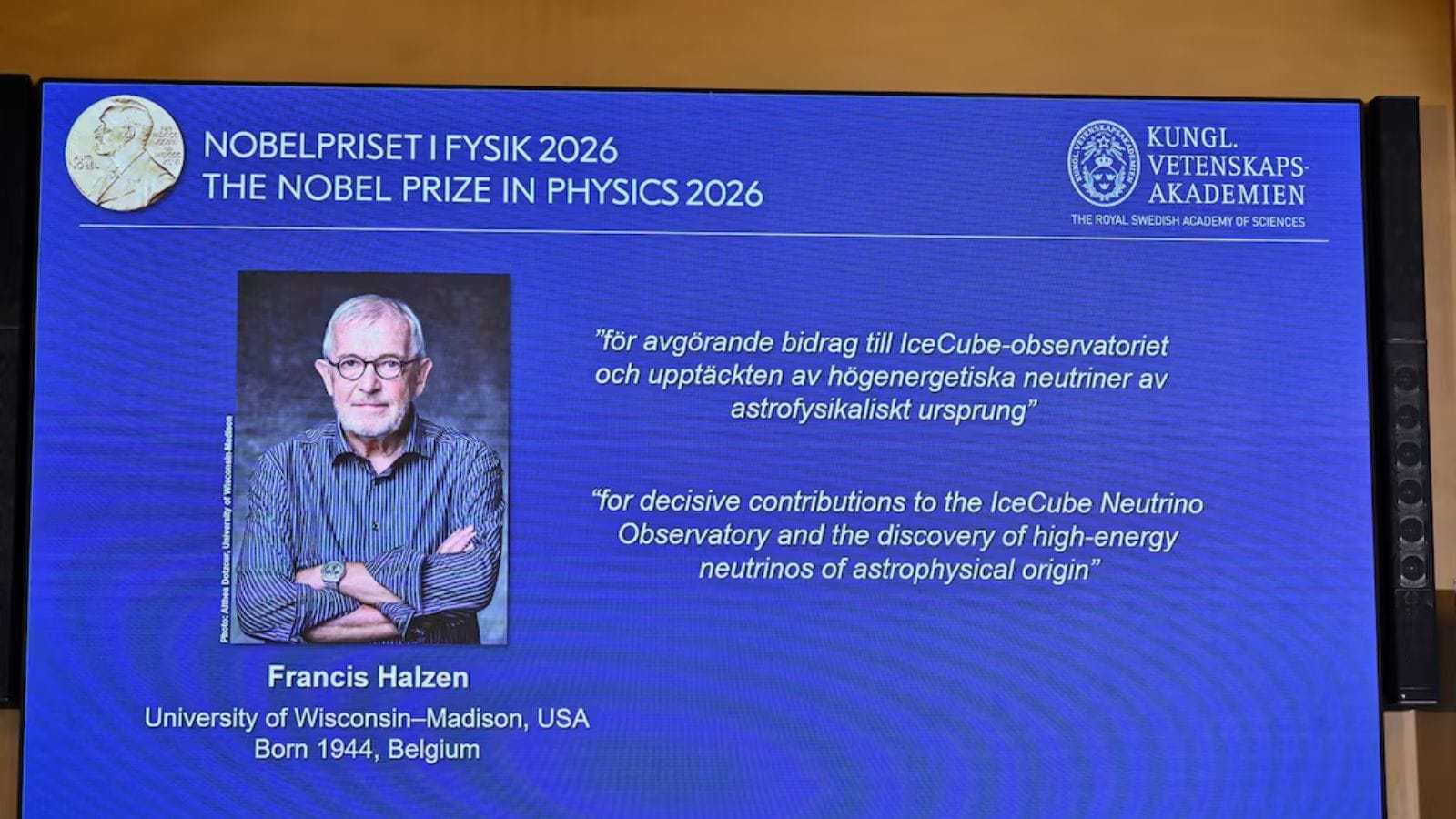
Yet today, Francis Halzen holds the 2026 Nobel Prize in Physics.
To understand why that matters, you have to leave behind the sanitized comfort of modern textbooks and stand on the blinding, wind-scoured expanse of the polar plateau, where the temperature drops low enough to freeze exposed skin in seconds. You have to imagine a man who spent decades convincing the global scientific community to drill holes into solid ice with boiling water, sinking thousands of basketball-sized sensors into the abyss. They called it a fool's errand. They said the ice would be too murky, the signals too faint, the cost too astronomical.
They were wrong.
Consider what happens when a high-energy neutrino, born in the catastrophic heart of a distant galaxy or the death throes of a supermassive black hole, finally collides with an atomic nucleus inside that Antarctic glacier. For a fraction of a microsecond, a particle breaks the speed of light in water. It creates a shockwave of blue radiation known as Cherenkov light. The optical sensors of IceCube catch that blue flare in the dark.
Suddenly, the universe stops being a silent movie. It has a voice.
Halzen did not just build a detector. He built an eye for the invisible. For years, the IceCube Neutrino Observatory sat at the bottom of the world, quietly mapping a sky we could never see with ordinary telescopes. Light gets blocked by dust clouds, gas, and stars. X-rays and gamma rays get absorbed. But neutrinos? They travel straight from the edge of creation, unbended by magnetic fields, untamed by distance.
When the first high-energy extraterrestrial neutrinos were finally isolated, the physics community realized they were looking at a map of cosmic accelerators. They were tracing the high-energy engines of active galactic nuclei. They were touching the violent birthplaces of cosmic rays that have battered our planet since before Earth had an atmosphere.
We live in a noisy world. We spend our lives glued to glowing screens, obsessed with the immediate, the tangible, the loud. We measure progress in gigabytes and market caps. But out there, past the thin blue ribbon of our atmosphere, the cosmos is engaged in silent, unimaginable violence. Colliding galaxies. Cannibalizing stars. Supermassive black holes tearing matter apart atom by atom.
And until Francis Halzen and his team lowered those strings of sensors into the ice, we were deaf to it all.
The Nobel Prize is not merely a recognition of a formula or a paper published in a high-impact journal. It is a monument to stubbornness. It honors the kind of scientific grit that survives decades of skepticism, institutional doubt, and the crushing loneliness of a hypothesis that everyone else thinks is impossible.
The ice remembers everything. Every snowflake that fell a hundred thousand years ago packed down tighter and tighter, squeezing out the air until it became a crystal cathedral of pure, transparent blue. And now, frozen into that ancient monument, human ingenuity has found a way to catch the ghosts of the cosmos.
Look up at the night sky the next time the stars are clear. Know that you are swimming in an ocean of invisible particles, carrying secrets from the very edge of time. And deep down at the bottom of the world, in the dark, the ice is still watching.