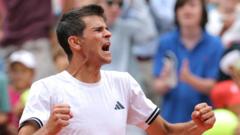
The dirt stays under your fingernails for weeks. If you spend enough time sliding across the red clay of Court Philippe-Chatrier, the crushed brick becomes a part of your biology. It ruins socks. It stains baseline shoes. For two decades, that dust belonged to one man. When Rafael Nadal stepped onto the dirt in Paris, it wasn’t a tennis match; it was a foreclosure. He didn’t just defeat opponents; he dismantled their belief systems.
But the knees eventually give out. The back stiffens. The unstoppable force meets the immovable object of time.
Now, the tennis world is frantically looking at the horizon, desperate for a mirror image. The media needs a sequel. The fans need a savior. Every time a young left-hander from Spain hits a heavy topspin forehand, the machinery of expectation begins to whir. They slap a label on his chest before he even learns how to handle a press conference: The New Rafa.
It is a beautiful, terrifying, and fundamentally flawed narrative.
To understand the weight of this inheritance, you have to look past the radar guns and the flashy sponsorships. You have to stand at the fence of an outer court in the blistering May heat, watching a nineteen-year-old kid whose shoulders are practically bruised by the sheer gravity of comparison.
The Blueprint of a Monster
Tennis is a cruel sport because it forces you to play against a ghost. When Carlos Alcaraz broke through, the comparison was easy. Too easy. Right country, right passion, right biceps. Then came the next wave of teenagers, grinding through the lower tiers of the ATP tour, possessing that specific, vicious western grip that makes a tennis ball bounce above an opponent’s shoulder.
Let us be clear about what made the original model work. Rafael Nadal’s greatness was not built on talent alone. It was built on a psychological pathology. He treated every single point like a matter of literal life and death. Down 5-0, 40-0 in the first set of a first-round match? He would still sprint into the side advertising boards to retrieve a lost cause.
When you tell a young athlete that they are the next iteration of that ethos, you aren't just complimenting them. You are cursing them.
Consider a hypothetical kid named Mateo. He is eighteen, raised on the hard courts of Valencia, but forced onto the clay because that is where Spanish legends are minted. He hits his forehand with an average of 3,200 revolutions per minute. The commentators rave. The algorithms predict greatness. But Mateo is sitting in a locker room before a second-round match at Roland Garros, sweating through his shirt because he knows that if he drops a set, the headlines tomorrow will call him a disappointment.
The data tells us that the ball speed is there. The footwork metrics match the historical baselines. But the data cannot measure the tightness in a teenager's throat when the crowd starts chanting a name that isn't yours, demanding that you recreate a miracle that happened before you were old enough to drive.
The Myth of the Metamorphosis
We want the transition to be smooth. We want a passing of the torch, a clean ceremony where the old king kneels and places the crown on the new prince.
It never happens that way.
The dirt at Roland Garros is slower than it used to be. The balls are heavier. The modern game favors the giants—the two-meter-tall serving machines who can win points in three shots or less. To survive on clay today, the "new Rafa" cannot actually play like Rafa. The tactical reality has shifted beneath our feet.
To win seven matches over a fortnight in Paris requires an absurd level of physical preservation. The old style—the brutal, five-hour baseline wars that left both players looking like casualty victims—is unsustainable for the new generation's bodies. The joints are different. The training regimens are hyper-optimized.
When you watch the kids currently tipped to conquer Paris, you notice something fascinating if you look closely enough. They are trying to shorten the points. They are using the drop shot not as a luxury, but as a survival mechanism. They are stepping inside the baseline, trying to mimic Roger Federer while wearing the colors of Nadal.
It is a tactical identity crisis played out on the world's most public stage.
The Invisible Scar Tissue
Every athlete hides something. By the time a tennis player reaches the main draw of a Grand Slam, their body is a map of micro-tears and compensated pain. We see the trophy lift; we don’t see the three hours of physical therapy at midnight, the ice baths that make the skin turn blue, or the anti-inflammatory pills taken on an empty stomach.
The real danger for anyone trying to claim the clay-court throne isn't the opponent across the net. It is the temptation to emulate the pain tolerance of a man who was famously willing to play with a numbed foot.
I remember sitting near the player's lounge a few years ago, watching a young prospect walk down the stairs. The public saw a vibrant, smiling kid who had just won a grueling four-setter. Up close, away from the lenses, he limped like an old man leaving a coal mine. His team looked at him with a mixture of awe and profound worry.
They knew the truth. You can copy the swing. You can copy the grunt. But you cannot copy the ability to destroy your own body for a silver cup without paying the bill eventually.
Redefining the Kingdom
The search for the next ruler of Paris is ultimately a search for comfort. Tennis fans are terrified of an vacuum. We spent decades spoiled by a golden trio, and the thought of an open draw—where anyone can win and the tennis is unpredictable—feels chaotic. We want a dominant force because dominance gives the sport a narrative structure.
But the clay doesn't care about storylines.
The surface is alive. It changes with the humidity. If it rains, the court becomes heavy, turning the tennis ball into a lead weight. If the sun blazes, the clay hardens into concrete, making the ball fly like a bullet. To conquer it, a player needs an elasticity of mind that cannot be taught by a coach or bought by an agency.
The next great champion of Roland Garros will not look like Rafael Nadal. He might be a right-hander from Eastern Europe who wins with flat, icy groundstrokes. He might be a soft-spoken kid from an island who doesn't pump his fist or yell at his box.
We need to let the old ghost rest in the stands.
The shadows are long on Court Philippe-Chatrier as the sun begins to dip behind the upper tiers. The groundskeepers come out with their brooms, sweeping away the marks of the day's battles, smoothing the red dust until it looks perfectly clean, perfectly blank. A fresh canvas, waiting for someone brave enough to leave their own footprints, instead of trying to step into shoes that were always too big to fill.