Concrete is heavy. It wants to fall.
Every morning on the Interstate 880 corridor through Oakland, California, hundreds of thousands of commuters roll across miles of raised asphalt without a second thought to what holds them up. They listen to morning radio, sip lukewarm coffee, watch the brake lights ripple ahead like a red spine. They trust the earth beneath the bridge. But earth is finery we borrow, and beneath the highway, the ground is soft. It is mud, silt, and ancient bay sediment that shifts like sleeping dough under the weight of eighteen-wheelers.
Engineers lose sleep over mud.
To understand why California buried more than six hundred thousand shredded tires beneath an Oakland on-ramp in the year 2000, you have to stand in a civil engineer's office at two in the morning, staring at a cross-section of saturated soil that looks less like solid ground and more like chocolate pudding.
In the late nineties, the state Department of Transportation faced a quiet crisis. The approach to the I-880 overpass was sinking. The native soil could not carry the constant, hammering load of heavy freight traffic heading toward the port. Every truck that rumbled past pushed the road downward into the muck. Standard fill dirt was too dense; piling more rock on top only made the whole structure heavier, causing it to sink faster. They needed something strong enough to support tons of concrete, yet light enough to float on butter.
They needed rubber.
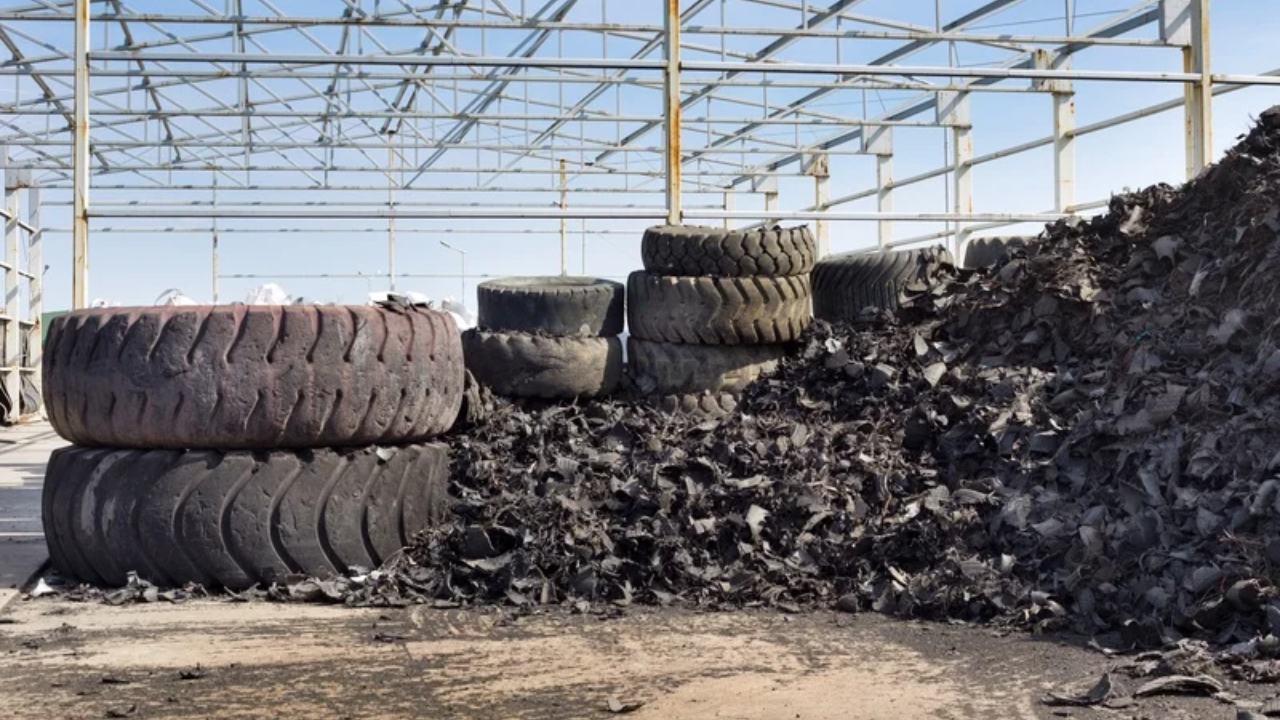
Consider what happens to a tire when its road life ends. We picture vast graveyards under the desert sun, black oceans of discarded rubber breeding mosquitoes and waiting for a spark. In the year 2000, California was drowning in its own debris, generating millions of scrap tires annually. They were an environmental headache, a fire hazard, a monument to our relentless mobility.
Then someone looked at a pile of shredded rubber and saw air.
Rubber shreds, when chopped into specific dimensions, are remarkably light. They weigh roughly one-third as much as traditional earthen fill. More importantly, they do not pack down into a dense, heavy sludge. They form a porous, elastic blanket that distributes weight evenly while refusing to sink.
Picture the logistics of it. Trucks arrived at the construction site not carrying gravel or crushed stone, but mountains of jagged, steel-belted rubber chips harvested from discarded passenger cars and commercial trucks. Workers laid geotextile fabrics across the unstable marshland, then began dumping the tire shreds in massive lifts, compacting them layer by layer.
To the casual observer driving past, it looked like a bizarre municipal dumping ground. To the geotechnical team, it was a masterclass in lateral thinking. They were building a sponge beneath the steel and stone.
When you use waste tires as lightweight aggregate, you solve two entirely different problems with a single stroke of stubborn creativity. You rescue mountains of rubber from the waste stream, and you trick physics into letting you build a highway where a highway has no business standing.
Over the years, as the rubber settled into its new subterranean life, something remarkable happened. It stayed put. The settlement stopped. The road stopped warping. While the rest of the transit network battled constant foundation cracks and expensive shoring projects, the rubber-backed ramp held its ground. Millions of tons of freight rolled over those buried tires, day after day, year after year, completely oblivious to the fact that they were driving over the ghosts of a thousand old sedans and delivery vans.
We rarely think about the invisible engineering that underpins modern civilization. We assume roads are just poured stone and eternal asphalt. We forget that beneath every smooth commute lies a hidden war against gravity, moisture, and decay.
The next time you cross an overpass, listen to the low, rhythmic hum of the tires against the expansion joints. Somewhere beneath your wheels, buried deep in the dark, an old Goodyear or Michelin from the twentieth century is still doing its job, holding up the world so you can get home in time for dinner.