The Accidental Experiment off the Georgia Coast
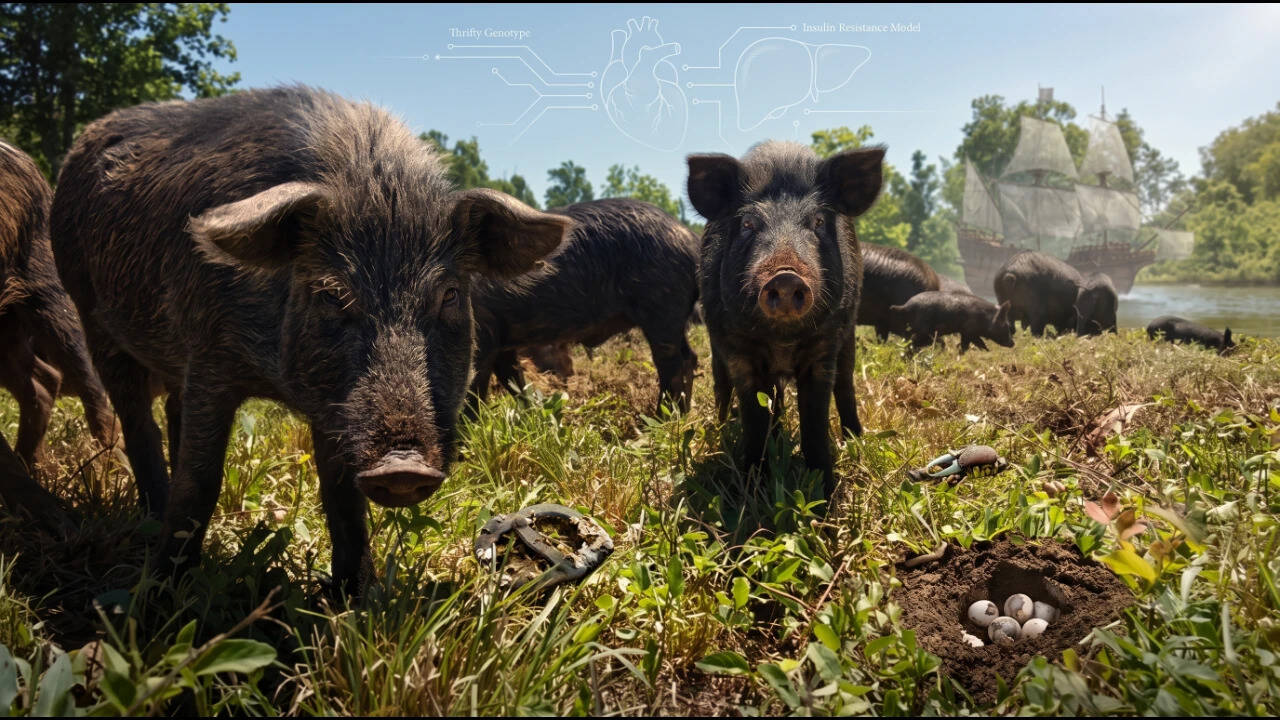
Five centuries ago, Spanish galleons dropped anchor off the barrier islands of North America, unloading livestock meant to serve as mobile larders for future expeditions. On Ossabaw Island, off the coast of Georgia, some of those Iberian pigs slipped into the maritime forests and stayed. Cut off from mainland gene pools, these animals faced a brutal, unyielding ecological filter. Winters brought sparse pickings of roots, acorns, and the occasional marine scavenger, while summers offered a sudden abundance of caloric bounty.
Natural selection does not care about modern aesthetics. It cares about survival. Over hundreds of years, the island pruned away any animal that could not hoard calories with maximum efficiency. The survivors developed a specialized biochemical pathway designed to store excess energy as adipose tissue almost instantly.
Today, those feral descendants are no longer just a historical footnote of maritime exploration. They have become one of the most critical animal models in modern medical research for understanding human metabolic syndrome, insulin resistance, and the relentless creep of obesity.
Decoding the Thrifty Phenotype
To understand why a feral hog from Georgia matters to a biomedical laboratory, you have to look at how evolutionary pressure alters physiology. When food fluctuates wildly between feast and famine, populations develop what geneticists call a thrifty phenotype.
In a hypothetical scenario where two animals face a month of starvation, the one with standard metabolic feedback loops will waste energy trying to maintain baseline functions and perish. The animal with downregulated energy expenditure and hyper-efficient fat storage survives.
On Ossabaw Island, this mechanism became absolute law. These pigs did not just get fat; their cellular machinery rewired itself. When they consume surplus calories in captivity, their bodies respond by rapidly expanding fat tissue, triggering a domino effect of metabolic distress that mirrors human pathology down to the molecular level.
Unlike standard agricultural pigs, which are bred purely for lean muscle mass and fail to replicate human metabolic disorders accurately, Ossabaw hogs develop full-blown metabolic syndrome. They get insulin resistant. Their blood pressure spikes. Their arteries collect plaque, and their livers accumulate fat.
Why Traditional Models Fall Short
Medical researchers spent decades trying to model human obesity using rodents. Mice are cheap, easy to house, and breed quickly. Yet murine models possess a fundamental biological flaw when mapped against human physiology. Mice handle high-fat diets with metabolic resilience that often frustrates translational research. They do not age, process lipids, or develop cardiovascular complications in the same cascade pattern seen in humans.
Pigs share a much closer anatomical and physiological kinship with humans. Their cardiovascular layout, organ size, and digestive tracts match our own with startling precision. When researchers want to study how chronic juvenile obesity damages microvascular blood flow in the human brain or why early insulin signaling failures stiffen cerebral arteries, standard lab swine require extreme, artificial genetic manipulation to show symptoms.
The Georgia island hogs arrive at the laboratory already pre-programmed by centuries of natural selection. They provide a living baseline of a body reacting precisely as modern human bodies react when flooded with sedentary, high-calorie environments.
The Brutal Irony of Modern Metabolism
The real value of studying these hogs lies in confronting an uncomfortable biological truth. The very traits that kept sixteenth-century livestock alive through maritime isolation and maritime starvation are the exact traits destroying modern human populations.
Human bodies evolved under similar conditions of localized scarcity. For most of our history, food was an uncertain reward chased by physical exertion. When civilization engineered a permanent state of agricultural and industrial abundance, our ancient survival mechanisms did not turn off. They simply kept storing.
When researchers feed these island-descended pigs a standard American high-fat, high-fructose diet, the animals stop moving, their metabolic rates plummet, and their blood vessels begin to show premature aging markers within weeks. It is a harsh mirror reflecting modern urban populations back to themselves. The biology is not broken. It is working precisely the way evolution designed it to work in a world that no longer exists.
Translating Feral Genetics into Therapeutics
Laboratories across the country now use the data harvested from these models to test interventions that break the chain between caloric intake and vascular destruction. By tracking how insulin resistance starts in the microvessels of skeletal muscle and the brain long before systemic failure shows up on standard blood panels, scientists are shifting the diagnostic window earlier.
The irony remains sharp. The key to unlocking the biochemical mysteries of twenty-first-century metabolic disease swims in the saltwater marshes of a barrier island, rooted in the discarded provisions of sixteenth-century conquistadors who were simply trying to ensure they did not starve on their next voyage. Nature keeps its own ledger, balancing survival against adaptation, turning yesterday's livestock into tomorrow's warning system.