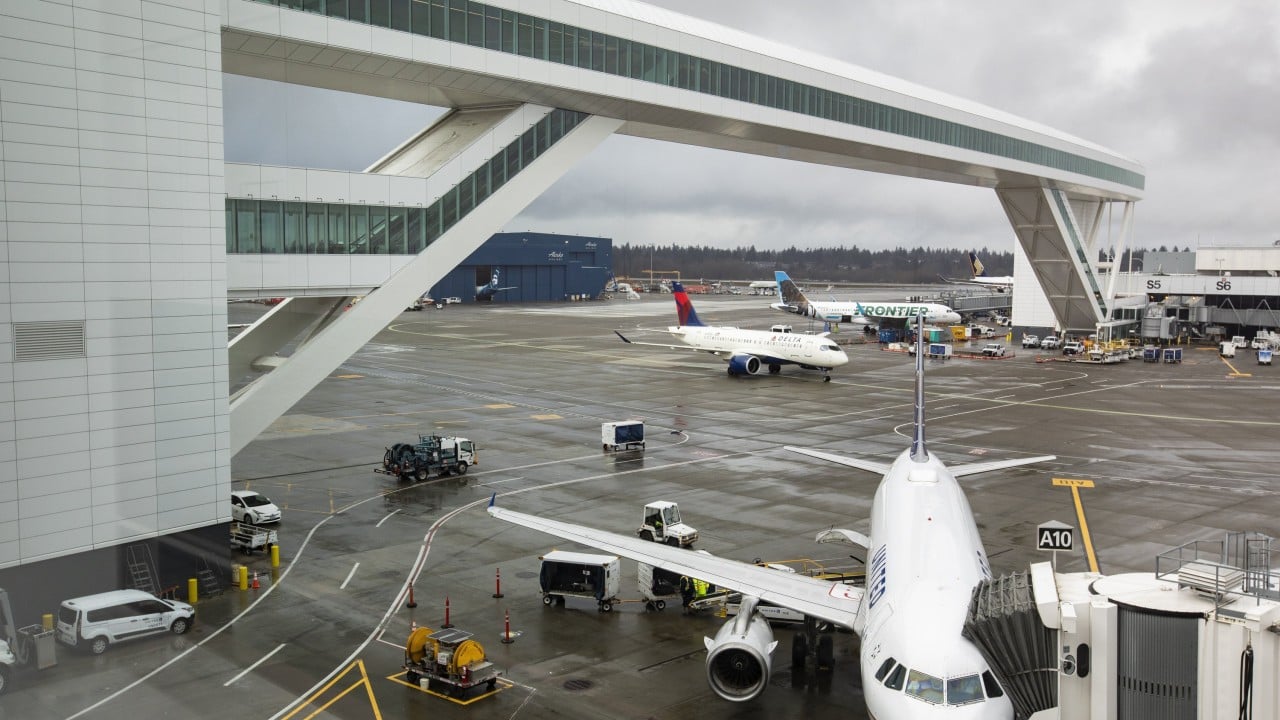
The diplomatic advisory issued by the Chinese Ministry of Foreign Affairs regarding Seattle-Tacoma International Airport (SEA) represents more than a localized travel warning; it is a manifestation of the "Securitization of Academic Exchange." When border officials deny entry to postgraduate researchers, they are not merely enforcing individual visa compliance. They are executing a high-level risk mitigation strategy aimed at preventing intangible technology transfer. This friction creates a systemic bottleneck for international research collaboration, transforming a transit hub into a geopolitical choke point.
The Tripartite Framework of Border Enforcement Escalation
To understand why Seattle has emerged as a focal point for these incidents, one must analyze the intersection of three distinct operational pressures.
- The Proximity-Innovation Correlation: Seattle serves as a primary gateway for the Pacific Northwest’s aerospace and cloud computing sectors. The concentration of dual-use technology firms—those producing hardware or software with both civilian and military applications—increases the perceived "threat surface" for Customs and Border Protection (CBP) officers.
- Proclamation 10043 Implementation: This executive action remains the primary mechanism for entry denials. It targets individuals associated with entities involved in China’s Military-Civil Fusion (MCF) strategy. The ambiguity of "association" allows for broad discretionary interpretation by CBP agents during the primary and secondary inspection phases.
- The Information Asymmetry Gap: Travelers often arrive with visas issued by the Department of State, assuming legal clearance is absolute. However, CBP operates under the Department of Homeland Security with a different mandate: the immediate assessment of intent and admissibility at the port of entry. The discrepancy between a consular approval and a border denial is where the highest level of diplomatic friction occurs.
The Mechanics of Secondary Inspection and Electronic Search
The "black box" of the Seattle airport experience for denied academics usually occurs within the secondary inspection environment. This process is governed by a specific logic of digital forensic extraction. Under current US legal standards, the border is considered a "search-free zone" where the Fourth Amendment protections against unreasonable searches are significantly attenuated.
CBP officers utilize automated tools to scan mobile devices and laptops for keywords related to sensitive research fields: semiconductors, artificial intelligence, quantum computing, and advanced materials science. If a researcher’s device contains unencrypted data or communications linked to prohibited institutions, the burden of proof shifts entirely to the traveler. The inability to provide a transparent, real-time explanation for specific files or institutional affiliations leads to an immediate finding of "inadmissibility."
This creates a Risk-Utility Paradox. To maintain academic integrity, researchers must carry their data; yet, carrying that data through a high-scrutiny port of entry like Seattle increases the probability of visa revocation.
The Cost Function of Diplomatic Advisories
China’s decision to name Seattle specifically serves a dual purpose: it acts as a retaliatory signal and a risk-mitigation tool for its citizens. The advisory functions as a "Soft-Power Counter-Incentive." By labeling a specific airport as high-risk, Beijing attempts to shift the flow of human capital toward alternative hubs or domestic institutions, thereby reducing the exposure of its elite researchers to US law enforcement scrutiny.
From a structural perspective, the costs are distributed across three sectors:
- Institutional Reputational Risk: US universities in the Pacific Northwest face a declining "yield rate" for top-tier international talent. If prospective PhD candidates perceive the Seattle gateway as hostile, they opt for institutions in the UK, EU, or Australia.
- Operational Friction for Airlines: Carriers operating transpacific routes into SEA must manage the logistics of "inadmissible passengers" (INADs). When a passenger is denied entry, the airline is often responsible for the immediate return flight, creating scheduling complexities and financial liabilities.
- Intelligence Gathering Costs: Every denial provides a data point for Chinese intelligence services to map the specific criteria and questioning tactics used by US border agents. Over time, this allows for the development of "traveler hardening" techniques to bypass scrutiny.
The Shift from Specific to General Admissibility Logic
Historically, border denials were triggered by specific criminal records or clear fraudulent documentation. The current trend at Seattle-Tacoma indicates a shift toward Predictive Inadmissibility. This logic suggests that even if a traveler has not yet committed a violation, their institutional pedigree makes them a high-probability candidate for future intellectual property diversion.
This shift is fundamentally non-linear. A researcher from a "Seven Sons of National Defense" university in China faces a mathematical probability of denial that far exceeds a peer from a non-aligned institution, regardless of the actual content of their current research project. This categorization creates a "Permanent Yellow Light" status for certain demographics of travelers, regardless of their individual merit.
Strategic Logistics for High-Stakes Travelers
For entities managing the movement of personnel between these two jurisdictions, the operational reality requires a departure from standard travel protocols. Relying on the validity of a visa is no longer a sufficient risk-management strategy.
- Digital Hygiene Protocols: The "Clean Device" policy is no longer optional. Travelers should utilize cloud-based storage with multi-factor authentication, ensuring no sensitive data is physically resident on hardware during the border crossing.
- Institutional Documentation: A "Letter of Admissibility Support" from the host US institution, detailing the specific non-classified nature of the visit, must be physically present. While not legally binding for CBP, it provides a structured narrative that can preemptively answer common secondary inspection questions.
- Port Diversification: While Seattle is the focus of the current advisory, logic dictates that high-scrutiny environments are contagious. Analyzing entry data for San Francisco (SFO) or Los Angeles (LAX) might reveal lower denial rates per capita, suggesting a tactical advantage in rerouting travel despite the increased domestic transit time.
The Terminal Trajectory of Academic Decoupling
The Seattle incidents are not isolated glitches in a functional system; they are the intentional features of a hardening border. As the US and China move further into a "Small Yard, High Fence" technological standoff, the definition of the "yard" is expanding to include the very individuals who facilitate global knowledge exchange.
The immediate outlook suggests a contraction in bilateral academic mobility. We are witnessing the transition from a "Global Talent Commons" to a "Bifurcated Knowledge Ecosystem." In this new environment, the physical port of entry serves as the first line of defense in a broader conflict over technological primacy. Organizations must now account for "Geopolitical Transit Risk" as a fixed line item in their operational budgets.
The final strategic move for academic and corporate stakeholders is the decentralization of research nodes. If the physical transit of researchers through hubs like Seattle remains high-risk, the logical response is the further virtualization of high-level research and the establishment of "Neutral Zone" laboratories in third-party jurisdictions that do not enforce the same level of entry scrutiny. This bypasses the border bottleneck entirely, though it risks the eventual dilution of the US-based innovation ecosystem.