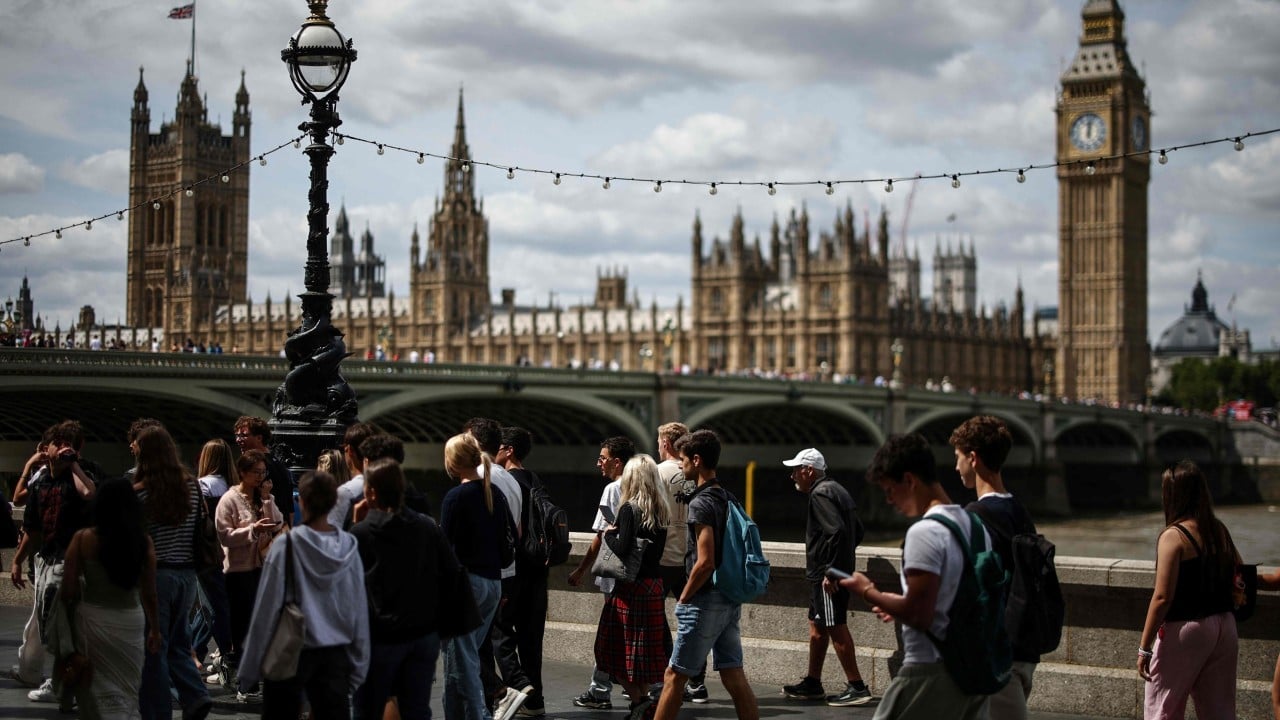
The rain in Manchester does not fall the way it falls in Kowloon. In Kowloon, summer storms arrive like a slammed door—violent, warm, drenching the neon and concrete in ten chaotic minutes before evaporating into steam. In Manchester, it is a cold, persistent mist that settles into the wool of your coat and stays there until April.
If you walk down the damp brick streets of Sale or Altrincham on a Tuesday morning, you will hear Cantonese floating out of bakery doorways alongside the hiss of espresso machines. Look closer at the people carrying reusable grocery bags past the red-brick semis. You are looking at one of the largest, quietest mass migrations in modern British history.
Since January 2021, more than 140,000 Hong Kongers have arrived in the United Kingdom under the British National (Overseas) visa scheme. They came because Beijing imposed its sweeping National Security Law in 2020, dismantling the political freedoms that had defined their home. Britain, acknowledging a historic obligation stretching back to the 1997 handover, opened a door.
The terms of that door were simple. Come to the UK. Work, pay taxes, build a life, stay out of trouble. After five years, you can apply for Indefinite Leave to Remain—permanent settlement. One year after that, British citizenship.
Then came the whispers out of Westminster.
As net migration figures climbed to record highs and political anxiety over immigration reached a fever pitch in Britain, policy proposals began circulating in Whitehall and across the front pages of London newspapers. One idea gained sudden, terrifying traction: doubling the standard qualifying period for permanent settlement from five years to ten.
For an immigration policy analyst in Westminster, extending a qualifying period is a line item on a spreadsheet. A lever pulled to cool public anger.
For a family sitting around a secondhand dining table in Sutton or Solihull, it was a trapdoor opening beneath their feet.
The Invisible Clock in the Living Room
To understand why a five-year rule change feels like an existential threat rather than an administrative tweak, you have to understand what it actually costs to uproot a life in mid-air.
Consider a hypothetical family—let’s call them the Chans, though their composite details belong to thousands of real households scattered across England. David was a senior logistics manager in Tsuen Wan; Mei was an accountant. In 2021, they sold their flat, pulled their two children out of school, packed six suitcases, and boarded a one-way flight to Heathrow.
They did not arrive as wealthy oligarchs. Under the BN(O) rules, migrants have no access to public funds—no state benefits, no housing assistance. They paid thousands of pounds upfront in visa fees and the Immigration Health Surcharge just to step onto British soil. Because overseas qualifications rarely translate cleanly into British corporate hierarchies, David took a job managing night-shift warehouse inventory for half his former salary. Mei started over as a junior bookkeeper.
Why do people in their forties willingly accept downward mobility, freezing winters, and profound loneliness?
Because they are running on a five-year battery.
Every sacrifice has a deadline. The damp rental flat with the temperamental boiler is tolerable because in five years, when Indefinite Leave to Remain arrives, mortgage lenders will stop treating you like a temporary flight risk and offer you normal interest rates. The university tuition fees for your eldest daughter—currently billed at astronomical international rates of £20,000 to £38,000 a year—will drop to domestic rates once settlement is secured. Your career can wait until Year Five, when employers stop hesitating over visa expiration dates.
When the British government began floating the idea of a ten-year wait for settlement, that battery suddenly looked like it might die halfway across the ocean.
Doubling the timeline would have meant another five years of paying the Immigration Health Surcharge—recently hiked to over £1,000 per adult per year—on top of full UK income taxes and National Insurance. For a family of four, a ten-year wait meant tens of thousands of additional pounds in visa renewals and healthcare surcharges. Worse, it meant watching a fourteen-year-old child age out of domestic university eligibility before the clock ever ran out.
I remember speaking to a former Hong Kong secondary school teacher in Reading last autumn, standing outside a community center while wind whipped dead leaves across the car park. His hands were shoved deep into his pockets, his shoulders hunched against the chill. "We did not come here to shop around for a better lifestyle," he told me quietly. "We burned our bridges behind us. If the rules change halfway through the race, where exactly are we supposed to go?"
You cannot go back to Hong Kong once you have publicly relocated under a scheme Beijing refuses to recognize as a valid travel document. For tens of thousands of BN(O) holders, there is no Plan B.
A Promise Kept Under Pressure
That is why the confirmation from the UK government carries such immense emotional weight: Hong Kong BN(O) visa holders are explicitly exempt from the proposed ten-year settlement wait.
The five-year pathway to Indefinite Leave to Remain remains intact.
Let us strip away the bureaucratic phrasing and look at what that exemption actually means in practice. Despite broader tightening across the British immigration system—measures aimed at curbing overall numbers and lengthening the road to permanent residency for other work and visa categories—the UK government drew a clear boundary around the BN(O) route.
Those on the BN(O) pathway will still be able to apply for Indefinite Leave to Remain after five continuous years in the UK, provided they meet the existing criteria: passing the Life in the UK test, demonstrating required English language proficiency, and adhering to absence limits (spending no more than 180 days outside the UK in any 12-month period). Twelve months after obtaining settlement, they remain eligible to apply for full British citizenship.
In an era where political pledges are routinely treated as disposable drafts, keeping this commitment was neither automatic nor effortless.
Behind the scenes, advocacy groups, cross-party parliamentarians, and community organizations spent months hammering home a fundamental distinction. You cannot lump economic migrants responding to labor shortages into the same regulatory bucket as people fleeing the dismantling of an international treaty Britain itself co-signed.
Think of the BN(O) scheme not as a standard immigration visa, but as an escrow account of national honor. In 1984, Britain signed the Sino-British Joint Declaration, promising Hong Kong fifty years of autonomy and preserved freedoms after 1997. When those guarantees collapsed twenty-three years early, the BN(O) visa was Britain’s way of honoring the spirit of its word. Moving the goalposts from five years to ten after families had already liquidated their life savings and boarded planes would not have been immigration reform. It would have been a breach of contract.
The Hidden Mechanics of the Five-Year Finish Line
Relief, however, is not the same thing as a free pass.
Because the first wave of BN(O) arrivals landed in early 2021, the earliest cohort is now reaching—or standing right on the doorstep of—their five-year eligibility window. The exemption protects the timeline, yet the final hurdle still trips up people who assume settlement happens automatically on their fifth anniversary.
It does not.
Consider what happens next for a household approaching Year Five. The Home Office does not send a congratulatory letter inviting you to become permanent. You have to build an airtight evidentiary dossier proving you kept every rule of the bargain.
First, there is the math of absence. Many Hong Kongers returned briefly over the past few years to settle elderly parents' affairs, sell property, or attend funerals. If those trips exceeded 180 days in any rolling twelve-month period, the five-year clock resets to zero. One miscalculated flight booking can cost a family another half-decade of waiting.
Second, there is the administrative bottleneck. Unlike the initial BN(O) visa application, which could often be completed smoothly via a smartphone app using biometric passport chips, Indefinite Leave to Remain applications require rigorous verification, biometric appointments, and substantial application fees—currently sitting at £2,885 per applicant. For a family of four, crossing that final threshold still requires more than £11,500 in liquid cash just to submit the forms.
Third, there is the subtle psychological shift that hits right when the finish line appears.
For five years, survival mode keeps you moving. You focus on the immediate: learning how British council tax works, figuring out why British plumbing has separate hot and cold taps, helping your children navigate playgrounds where nobody speaks their mother tongue, studying flashcards about Henry VIII and the Battle of Hastings for the Life in the UK test.
When the Home Office confirms that your five-year horizon is safe, the adrenaline finally drops. And in the quiet that follows, a different question surfaces: What does it actually mean to belong here?
Why Britain Needs the People It Almost Pushed Away
Walk into almost any neighborhood where Hong Kongers have settled in numbers—Kingston upon Thames, Warrington, Bristol, Birmingham—and you can see the economic reality that dry immigration statistics routinely miss.
Unlike many migration waves, BN(O) arrivals skewed heavily toward working-age professionals with high educational attainment and substantial household savings brought into the UK economy. According to Home Office impact assessments and independent think tank analyses, BN(O) visa holders generate a significant net fiscal surplus for the British Treasury. They pay income tax, National Insurance, VAT, and council tax from day one while drawing virtually nothing from the welfare state.
Yet numbers on a Treasury ledger fail to capture the texture of what they actually bring.
They brought the meticulous work ethic of a city that never stops moving. In towns across northern England where high streets had hollowed out into shuttered storefronts and vape shops, Cantonese bakeries, independent bubble tea cafes, logistics startups, and community tutoring centers began flickering to life. British schools struggling with declining enrollment suddenly welcomed classrooms full of diligent students whose parents treated education as sacred.
When politicians talk about "reducing immigration," they often speak as though every newcomer is a drain on an overburdened system. The BN(O) story exposes the flaw in that blanket narrative. Had the UK subjected Hong Kongers to a ten-year settlement wait, it would not have deterred new arrivals—most who intended to leave Hong Kong had already made the leap. Instead, it would have punished the very people who trusted Britain’s word, trapped productive families in prolonged financial limbo, and signaled to the world that a British promise expires whenever the political weather turns cold.
By exempting BN(O) visa holders from the ten-year proposal, Westminster preserved more than an immigration route. It preserved credibility.
The Smell of Fresh Paint and Pineapple Buns
Late on a Saturday afternoon in a suburb south of Manchester, inside a terrace house whose front garden still holds a stack of flattened cardboard moving boxes, a kettle clicks off.
On the kitchen table sits a folder stuffed with five years of proof: council tax bills, P60 tax forms, tenancy agreements, boarding passes carefully logged in an Excel spreadsheet, and a dog-eared copy of the official Life in the United Kingdom study guide. Beside the folder rests a plate of warm bo lo bao—pineapple buns baked from scratch because the nearest Asian supermarket is forty minutes away by bus.
Outside, the drizzle has finally stopped, leaving the slate rooftops gleaming dark silver under a pale evening sky.
In a few weeks, those documents will be uploaded to a government portal. A biometric appointment will be booked. A fee that took three years of overtime shifts to save will be wired across the internet. And if all goes well, an email will arrive bearing four words that turn five years of holding one's breath into solid ground: Indefinite Leave to Remain.
The rain here still does not fall the way it falls in Kowloon. It probably never will. Yet when the letter finally lands on the doormat, the house will no longer feel like a waiting room.