The modern commute is an exercise in low-grade hostility. We slam car doors, curse at delayed trains, and bury our faces in glowing screens to escape the suffocating proximity of strangers. Speed is our god. Efficiency is our religion. We have traded the joy of the journey for the tyranny of the arrival time, sprinting through life without ever looking up.
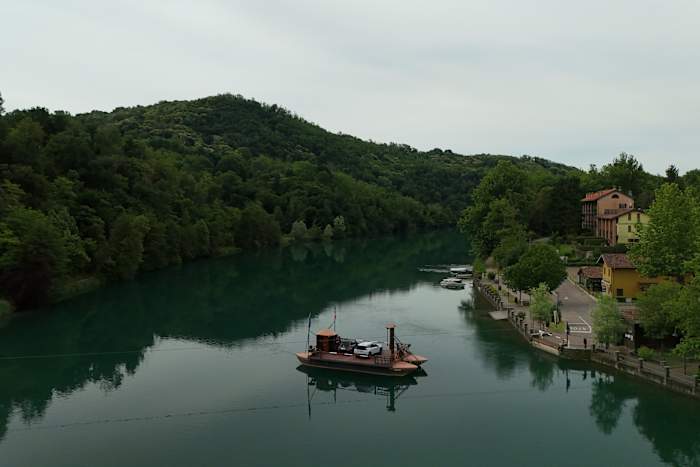
But on a quiet stretch of water between the Italian provinces of Bergamo and Lecco, a centuries-old wooden vessel defies the frantic rhythm of the twenty-first century.
It is called the Traghetto di Leonardo. It requires no diesel, no electricity, and no roaring engine. To cross the Adda River here, you do not step on the gas. You step into the mind of a Renaissance genius, and for five minutes, you are forced to slow down.
The Physics of Peace
Imagine a cold morning in Imbersago. The fog hangs low over the Adda, thick enough to blur the treeline on the opposite bank. A handful of commuters—nurses, teachers, shopkeepers—stand on the wooden deck. They aren’t looking at their phones. They are watching the water.
The ferry is deceptively simple. Two heavy wooden hulls are bound together, supporting a wide platform capable of carrying a couple of cars and roughly a hundred people. A thick steel cable spans the river high overhead, anchored firmly to both shores. The boat is attached to this cable by a system of ropes and pulleys.
There is no motor. Instead, the ferryman uses a long wooden pole to push off from the bank, angling the vessel against the river’s current.
Then, a quiet miracle happens.
The force of the rushing water hits the angled hulls. Instead of sweeping the boat downstream, the river’s energy is deflected by the mooring cable, pushing the ferry sideways across the channel. It is the exact same aerodynamic principle that allows a sailboat to tack against the wind, or a kite to climb into the sky. The river itself becomes the engine. The very obstacle preventing the crossing is harnessed to facilitate it.
It takes roughly five minutes to make the journey. Five minutes of absolute silence, save for the rhythmic lapping of the water against the timber and the faint hum of the overhead cable.
To the casual tourist, it is a charming relic. To the locals who use it every day, it is a psychological sanctuary.
Sketched in the Margins of History
We tend to think of Leonardo da Vinci as a man of grand, impossible dreams—flying machines that never flew, armored tanks that never rolled onto a battlefield. We picture him in the courts of kings and dukes, painting masterpieces or designing fortifications for war.
But Leonardo was also a man deeply obsessed with the mundane problems of ordinary people.
In the late fifteenth and early sixteenth centuries, Leonardo spent significant time in the service of the Sforza family in Milan. He studied the waterways of Lombardy, fascinated by the fluid dynamics of rivers and canals. He filled his notebooks with sketches of locks, dams, and bridges.
Sometime during his stays in the region, perhaps while visiting the nearby sanctuary of Madonna del Bosco, he turned his attention to the Adda River. The water here was swift and unpredictable. Building a permanent bridge was expensive, dangerous, and militarily risky in a fractured Italy where rivers served as vital borders.
Leonardo’s solution was elegant in its restraint. He sketched a ferry that used the river’s own kinetic energy to conquer the river. He didn't try to master nature with brute force; he collaborated with it.
The current ferry operating at Imbersago is not the original wooden structure from the 1500s, of course. Timber rots. Cables fray. Over the centuries, the boat has been rebuilt multiple times, most recently reconstructed to match the historical specifications. Yet, the engineering remains entirely unchanged from the drawings found in Leonardo's Codex Windsor.
The Invisible Stakes of a Five-Minute Delay
Consider a hypothetical commuter named Elena. She lives in Imbersago but works a stressful shift at a clinic on the opposite side of the river. If she takes the highway, she faces twenty-five minutes of bumper-to-bumper traffic, the toxic exhaust of diesel trucks, and the aggressive jockeying of drivers desperate to gain a single car length.
By the time Elena arrives at work, her cortisol levels are spiked. She is already exhausted.
Instead, Elena drives her small hatchback onto the wooden deck of the Traghetto. She pays the ferryman a nominal fee—a fraction of the cost of highway fuel—cuts her engine, and steps out of the car.
For five minutes, Elena cannot accelerate. She cannot pass anyone. She cannot optimize her route. She is entirely at the mercy of the Adda River's current.
During a recent crossing on a crisp autumn afternoon, the water was running sluggishly. A tourist grew visibly anxious, checking his watch, pacing the wooden deck, muttering about the delay. He was trapped in the modern mindset, viewing the river as a barrier to be overcome as quickly as possible.
But the locals just smiled. They leaned against the wooden railing, breathing in the damp, clean air. One elderly man pointed out a grey heron wading near the reeds on the far bank.
In those five minutes, the ferry acts as a decompression chamber. It creates a mandatory buffer between the pressures of home and the anxieties of work. You cannot rush the river. You can only exist upon it. When Elena steps back into her car on the opposite bank, the world hasn't changed, but her relationship to it has.
The Art of Non-Extraction
Our relationship with technology today is almost entirely extractive. We strip-mine resources to build faster processors; we burn fossil fuels to shave seconds off our travel times; we extract human attention to feed digital algorithms. We have internalized the belief that if a machine doesn't require fuel and noise, it isn't working.
Leonardo's ferry offers a radical alternative: a technology of alignment rather than extraction.
The boat takes nothing from the river. It leaves no oil slick in its wake. It emits no carbon. It does not alter the flow of the water or disrupt the habitat of the fish. When the ferry reaches the shore, the river flows on, entirely undiminished by the work it has just performed.
It is a humbling reminder that true innovation does not always require high-voltage complexity. Sometimes, the most sophisticated solution is the one that removes the most moving parts.
There is a profound vulnerability in stepping onto a vessel that relies entirely on a current you cannot control. If the river floods, the ferry stops. If the water drops too low during a summer drought, the ferry rests. It forces the human beings who use it to adapt to the rhythms of the earth, rather than demanding that the earth adapt to them.
The Fragile Thread of Continuity
The ferryman’s job is physically demanding. It requires an intuitive understanding of the water—how the current shifts after a heavy rain, how the weight distribution of the cars affects the angle of the hulls, how to catch the subtle momentum of the river near the banks. It is a craft passed down through generations, a form of tacit knowledge that cannot be learned from a textbook or simulated by an algorithm.
Yet, like many beautiful, quiet things, the survival of the ferry is never guaranteed.
Bridges are more convenient. Tunnels are faster. Political priorities shift, and budgets tighten. There are always voices whispering that a centuries-old ferry is an anachronism, a slow bottleneck in a world that demands speed.
But to lose the Traghetto di Leonardo would be to lose something far more valuable than a tourist attraction or a historical novelty. It would mean cutting a tangible thread that connects us directly to the mind of the Renaissance, a physical manifestation of a time when art, science, and nature were viewed as a single, harmonious whole.
The sun begins to dip below the hills of Brianza, casting long, golden shadows across the water. The ferryman steps to the bow, his hands calloused from years of gripping the wooden pole. He pushes off from the stone slipway. The ropes tauten. The overhead pulleys give a low, comforting groan.
The boat glides out into the middle of the river, caught once more in the eternal embrace of the current, carrying its small cargo of human beings safely, silently, and beautifully across the divide.