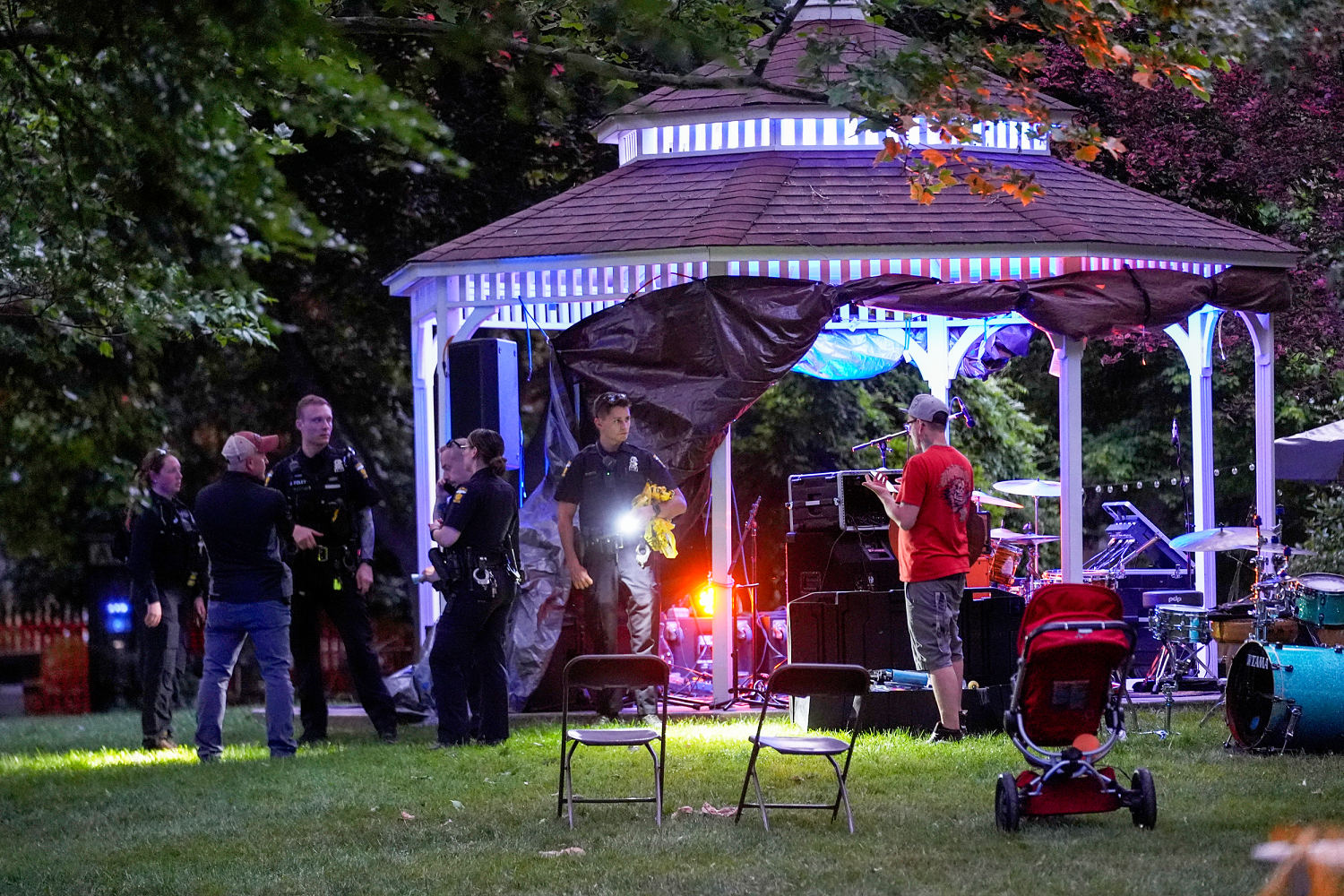
Twelve people lie wounded in Ohio. The standard media engine fires up on cue. We get the predictable flood of articles tracking the police hunt for a named suspect, dissecting the emergency response times, and cataloging the community shock. It is a formulaic ritual. The press fixates on the post-incident theater, treating the manhunt like a high-stakes sports event while local officials promise more checkpoints, more perimeter fencing, and more visible enforcement at the next public gathering.
This hyper-focus on the individual actor and the physical perimeter is a dangerous distraction.
Public safety infrastructure is fundamentally broken because it relies on the illusion of the hard perimeter. We are told that if we just deploy enough metal detectors, hire enough private guards, and track down the bad guy fast enough, we can preserve the open, democratic nature of a public festival. It is a lie. You cannot secure a sprawling, multi-block soft target with standard police tactics without turning our shared spaces into open-air prisons.
The Illusion of the Hard Perimeter
I have spent two decades analyzing threat vectors and crowd dynamics in urban environments. I have watched municipalities burn millions of dollars on temporary fencing and bag checks, only to create massive, dense bottleneck crowds outside the venue.
Look at what actually happens at a festival shooting. The media treats the event space as a distinct ecosystem that was somehow breached. But in modern urban geography, the line between the festival and the city does not exist.
When you place a security checkpoint at a street corner, you do not eliminate risk. You merely displace it.
[Traditional Security Logic]
Perimeter Security -> Safe Zone Inside -> Risk Neutralized

[The Reality of Displacement]
Perimeter Checkpoint -> Massive Bottleneck Outside -> Concentrated Vulnerability
By forcing thousands of attendees to queue up on a public sidewalk waiting to pass through a metal detector, security planners create a high-density, completely unprotected target outside the secured zone. The irony is total. The apparatus designed to keep people safe actually aggregates them into a more vulnerable configuration before they even step foot inside the event.
Why The Suspect Hunt is Post-Mortem Theater
The breathless coverage of police identifying a suspect misses the point entirely. A suspect identification is an autopsy report disguised as news.
- The Deterrence Failure: Mass shooters and perpetrators of public violence are rarely deterred by the prospect of being caught.
- The Reactive Trap: Law enforcement resources are heavily weighted toward reactive investigations rather than proactive disruption.
- The Resource Drain: Hundreds of manpower hours are spent hunting a single individual after the damage is done, while the underlying systemic vulnerabilities of the venue remain unaddressed.
Criminologists like those at the Violence Project have repeatedly demonstrated that public attackers operate with a high degree of nihilism. They expect to be caught or killed. Plastering a suspect’s face across the news does not deter the next attacker; it provides a blueprint.
Dismantling the Public Safety Questions That Matter
When these tragedies occur, the public asks the wrong questions. The media feeds them flawed premises. Let us dismantle the standard inquiries and replace them with brutal reality.
Can We Make Large Public Festivals 100% Safe?
No. And anyone who claims otherwise is selling hardware or seeking re-election. A public festival is, by definition, an open system. It requires fluid ingress and egress, high crowd density, and integration with existing city infrastructure.
If you want absolute safety, you cancel the festival. You cannot have a vibrant, open-air celebration of culture or music that is also a Level IV security facility. The moment you implement total access control, you kill the event's cultural utility. We must accept a baseline of ambient risk as the price of a free, open society. The current strategy tries to hide this truth behind a facade of private security guards making $15 an hour turning out pockets.
Do More Police at Events Prevent Shootings?
Rarely. Visible law enforcement acts as a deterrent for low-level property crime and minor skirmishes. They do not stop a determined attacker with a firearm from initiating an action from a distance or within a dense crowd before officers can react.
In crowds of tens of thousands, the ambient noise, visual occlusion, and sheer physical mass make immediate tactical intervention nearly impossible. By the time an officer identifies the source of gunfire over the roar of a festival sound system, the incident is usually over. The data from major public shootings over the last decade shows that the duration of active shooting phases is measured in seconds, while police reaction times, even on-site, are measured in minutes.
The Economics of Security Theater
Cities are bankrupting their cultural budgets to fund defensive measures that do not work. The line-item costs for barricades, overtime pay for police details, and private security contractors eat up the razor-thin margins of community festivals.
| Security Measure | Perceived Value | Actual Operational Reality |
|---|---|---|
| Bag Checks | High visibility comfort | Easily bypassed; creates massive external queues. |
| CCTV Monitoring | Post-event utility | Rarely prevents active chaos in real-time. |
| Armed Static Guards | Psychological deterrent | Limited mobility in dense crowds; vulnerable to ambush. |
The hard truth is that our current approach is driven by liability mitigation, not actual tactical efficacy. Cities and organizers implement these measures so they can point to a checklist in a courtroom after an incident occurs. They are protecting themselves from lawsuits, not protecting the attendees from bullets.
Re-Engineering the Soft Target
If we want to actually mitigate the harm of these inevitable incidents, we have to abandon the perimeter mindset entirely. We need to stop trying to stop the unstoppable and focus on structural resilience.
Decentralization Over Containment
The traditional festival layout concentrates stages, food vendors, and crowds into single, massive choke points. This is a design flaw.
We must design public events with radical decentralization. Spread the attractions across wider geographic areas with natural architectural barriers. Instead of one massive stage drawing 20,000 people into a tight crush, utilize smaller, staggered performances that naturally segment the crowd. If an incident occurs in a decentralized model, the maximum casualty potential is mathematically capped.
Architectural Intervention
Stop relying on plastic snow fencing and bike racks. Cities should integrate permanent, passive security elements into their urban design.
Strategic tree placement, integrated concrete planters, and subtle changes in street elevation can disrupt lines of sight and prevent vehicular access without making a park look like a green zone. These interventions are passive, permanent, and do not create the psychological tension that heavy policing brings to a community space.
Honest Risk Communication
We need to treat the public like adults. Organizers should stop promising "completely safe environments." Instead, they need to provide clear, actionable situational awareness data to attendees. Clear evacuation routing that bypasses primary bottlenecks, real-time communication channels that do not rely on overloaded cellular networks, and immediate medical staging areas that are accessible from the exterior are what save lives when panic sets in.
The obsession with the Ohio suspect's identity and the subsequent police press conferences change nothing about the fundamental vulnerability of our public squares. We can keep playing the game of reactive outrage and cosmetic security upgrades, or we can admit that the hard perimeter is dead.
Stop building fences that only serve to trap people inside when the chaos starts. Change the architecture, accept the inherent risk of open spaces, or stop hosting festivals altogether. Choose one, because the current middle ground is just theater paid for in blood.