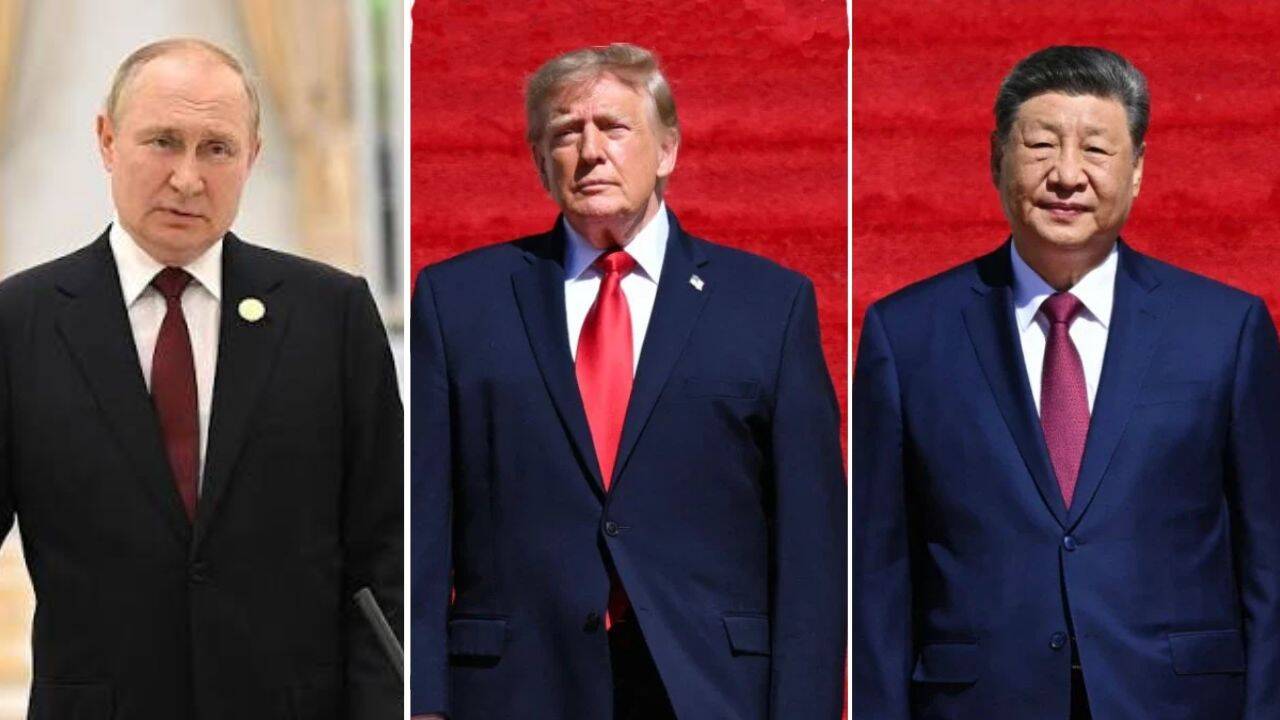
Every time rumors surface about a three-way sit-down between Donald Trump, Xi Jinping, and Vladimir Putin, foreign policy circles in Washington, Brussels, and Taipei hit the panic button. They immediately dust off the same historical label. Yalta 2.0.
It's a heavy accusation. Whenever talk of a trilateral great-power summit heats up, diplomats start worrying that the leaders of the United States, China, and Russia are preparing to carve the globe into private spheres of influence while smaller nations get locked outside the room. Whether a formal three-way summit is on the calendar for next week or merely floating through diplomatic backchannels, the anxiety behind the headline is very real.
Honestly, people misunderstand what Yalta actually was, and they get even more confused about how a modern version would play out today. If you want to read the geopolitical tea leaves without falling for cable-news hysteria, you have to look at why this specific comparison triggers so much dread—and where the historical parallel completely falls apart.
What Yalta 2.0 Actually Means in Modern Geopolitics
To understand why critics throw around the phrase "Yalta 2.0," you have to go back to February 1945. World War II was winding down. Winston Churchill, Franklin D. Roosevelt, and Joseph Stalin met at the Livadia Palace in the Crimean resort town of Yalta to decide the shape of postwar Europe.
They didn't ask Poland, Romania, or the Baltic states what they wanted. The Big Three drew lines on maps, traded political concessions, and effectively handed Eastern Europe over to Soviet control for the next four decades. For millions of Europeans, Yalta became shorthand for cynical backroom betrayal—a moment when superpowers traded away the sovereignty of weaker democracies to buy temporary peace for themselves.
When analysts warn about a modern Trump-Xi-Putin summit turning into Yalta 2.0, they're describing a specific nightmare scenario. In that scenario, the three leaders bypass traditional alliances like NATO, ignore the United Nations, and strike a grand bargain based on raw power.
Here is what critics fear gets traded on that table:
- Eastern Europe and Ukraine. Russia demands formal recognition of occupied Ukrainian territory and a permanent veto over NATO expansion into its neighborhood.
- Taiwan and the South China Sea. Beijing pushes Washington to dial back arms sales to Taipei, weaken mutual defense commitments in the Indo-Pacific, and accept Chinese dominance over key maritime chokepoints.
- Economic and energy zones. In exchange for stepping back from regional flashpoints, Washington extracts trade concessions, tariff relief, or commitments on global energy markets and supply chains.
It's transactional politics at the highest possible stakes. Instead of a rules-based international order where borders are supposed to be inviolable, the world reverts to nineteenth-century spheres of influence. Might makes right. Small countries become bargaining chips.
Why Diplomats Panic Whenever Trump Xi and Putin Enter the Same Orbit
The anxiety isn't coming out of nowhere. Each of these three leaders brings a worldview that clashes directly with the post-Cold War consensus that shaped global politics since 1991.
Start with Putin. For over twenty years, the Kremlin has openly argued that the collapse of the Soviet Union created an unfair security architecture in Europe. Putin's entire foreign policy rests on the idea that great powers deserve buffer zones—and that countries like Ukraine or Georgia shouldn't get to choose their own security alliances if Moscow objects. From the Kremlin's perspective, sitting down as an equal with Washington and Beijing validates Russia's status as an indispensable superpower, regardless of Western sanctions or battlefield losses.
Xi Jinping approaches the table from a very different position of strength, yet the underlying logic overlaps. Beijing routinely calls for a "multipolar world," which sounds polite in diplomatic speeches until you translate it. In practice, multipolarity means ending American primacy in Asia. China wants Washington to stop interfering in what Beijing considers its core regional interests, starting with Taiwan. A trilateral summit puts Xi at the center of global decision-making while signaling to Asian neighbors that the United States is willing to negotiate over their heads.
Then you have Trump. Unlike conventional American presidents who treat alliances as sacred moral commitments, Trump views foreign policy through the lens of leverage, costs, and bilateral deals. He has spent years questioning why American taxpayers fund European defense while European allies run trade surpluses with the United States. He prefers face-to-face negotiations with strongmen over multilateral summits packed with bureaucratic communiqués.
Put those three instincts in the same room and traditional diplomats break out in a cold sweat.
I've watched European officials react to even minor hints of Washington-Moscow bilateral talks, and the reaction is always visceral. In capitals like Warsaw, Vilnius, and Tallinn, history isn't an abstract textbook chapter. When leaders in Eastern Europe hear talk of a "grand bargain" to end regional conflicts quickly, they immediately ask what price they'll be forced to pay for someone else's peace deal.
The Big Flaw in the Yalta Comparison
As dramatic as the Yalta 2.0 narrative sounds, it breaks down fast once you look at actual power dynamics. Critics love the headline because it's punchy, yet comparing today's world to February 1945 misses three massive realities.
First, the world of 1945 was exhausted and occupied. When Roosevelt, Churchill, and Stalin met in Crimea, their armies physically controlled the territory they were dividing. Germany and Japan were on the verge of total unconditional surrender. Europe's economies were in ruins. Nobody in Warsaw or Prague had the military capacity to reject whatever the Big Three decided.
Today is nothing like that. Ukraine has spent years fighting a brutal war of survival and has zero intention of signing away its sovereignty just because foreign leaders shake hands at a conference table. Poland fields one of the largest, best-equipped armies in Europe. Taiwan is a wealthy, technologically vital democracy that produces the advanced semiconductors the entire global economy runs on—and its population has no desire to accept Beijing's rule. You cannot simply draw a line on a map in 2026 and expect 40 million Ukrainians or 23 million Taiwanese people to shrug and comply.
Second, Russia is not the Soviet Union of 1945. At Yalta, Stalin commanded the Red Army, which had just crushed the bulk of the German Wehrmacht and occupied half of Europe. Today, Russia is heavily dependent on Chinese economic lifelines, energy purchases, and dual-use industrial goods just to keep its economy afloat. In any three-way room with Trump and Xi, Putin isn't an equal partner holding a third of the cards. He's the junior partner to Beijing trying to play Washington and China off each other.
Third, domestic constraints in the United States still exist. Even a U.S. president with broad executive authority over foreign policy cannot unilaterally erase treaty obligations, lift congressional sanctions overnight, or force allies like Japan, South Korea, and Germany to abandon their own national security interests. Any deal that looks like an outright surrender to Beijing or Moscow would trigger immediate bipartisan pushback in Congress and spark a frantic nuclear proliferation race among nervous U.S. allies.
If South Korea or Japan ever believed Washington had traded away Indo-Pacific security in a backroom summit, they wouldn't quietly accept Chinese hegemony. They'd start building their own nuclear arsenals within months. Nobody in Washington—or Beijing—actually wants that outcome.
Why a Three-Way Summit Is So Hard to Pull Off
Even if all three leaders wanted a dramatic trilateral spectacle, getting them into the same room requires solving a tangle of competing agendas before anyone even boards a plane.
Look at the friction points between Moscow and Beijing alone. Western commentators often talk about China and Russia as an unbreakable bloc, yet their interests diverge sharply once you get past their shared dislike of American dominance. China wants global economic stability so it can keep exporting manufactured goods and manage its own domestic economic headwinds. Russia thrives on geopolitical disruption, higher energy prices, and weakening Western cohesion.
Xi Jinping has no interest in letting Trump peel Putin away from Beijing—a classic "reverse Nixon" fantasy that some Washington strategists still kick around. At the same time, Xi doesn't want to get dragged into backing Russian territorial demands in Europe if doing so wrecks China's trade relationship with the European Union.
Meanwhile, any pre-summit agenda runs straight into a sequencing trap:
- Washington wants immediate concessions on trade imbalances, fentanyl precursor chemicals, strategic arms control, and a rapid freeze to active military conflicts without looking weak at home.
- Beijing demands tariff rollbacks, an end to high-tech semiconductor export controls, and explicit U.S. language opposing Taiwanese independence before making meaningful economic commitments.
- Moscow insists on sanctions relief, security guarantees halting NATO enlargement, and recognition of territorial gains on the ground before agreeing to any durable ceasefire.
You don't bridge gaps that wide over a weekend photo op. In real diplomacy, high-level summits only succeed after months of grueling, quiet groundwork by lower-level envoys who hammer out draft agreements beforehand. When leaders jump straight to a high-stakes meeting without pre-cooked deliverables, you usually get theatrical handshakes followed by rapid diplomatic collapse—just like the 2019 Hanoi summit between Trump and Kim Jong Un.
What Really Happens Behind Closed Doors at Great-Power Summits
If you strip away the apocalyptic Yalta metaphors, great-power meetings usually serve a much more practical—and frankly more cynical—purpose than redrawing world maps.
Leaders use them for domestic political theater, crisis management, and leverage signaling. For Trump, sitting across from Xi and Putin projects the image of the ultimate dealmaker willing to talk to anyone to prevent World War III. For Xi, hosting or attending an equal-footing summit reinforces his image at home as a global statesman steering China through turbulent waters. For Putin, standing next to the American and Chinese presidents shatters years of Western diplomatic isolation in a single afternoon.
That doesn't mean these meetings are harmless. Even without a formal treaty dividing the globe, ambiguous statements made at a podium can create dangerous miscalculations.
When a superpower leader hints that alliance commitments are conditional, or suggests that regional disputes are someone else's problem, adversaries test those boundaries immediately. You see it in grey-zone tactics—cyberattacks, undersea cable disruptions, airspace violations, and maritime blockades that stay just below the threshold of open war. The real danger of a poorly prepared trilateral summit isn't a neat, signed Yalta treaty. It's the strategic confusion that follows when allies stop trusting security guarantees and rivals assume nobody will stop them.
How to Spot Real Shifts vs. Diplomatic Noise
Whenever headlines warn that a Trump-Xi-Putin meeting is imminent and democracy is about to be sold out, don't react to the loudest commentary. Watch the concrete indicators that actually tell you whether spheres of influence are shifting:
- Troop deployments and weapons deliveries. Ignore warm summit rhetoric and watch whether Pentagon aid packages, joint military exercises in the Indo-Pacific, or NATO forward deployments in Eastern Europe actually slow down or get canceled.
- Sanctions and export control enforcement. Real accommodation shows up in Treasury Department waivers and Commerce Department tech-export rules, not press conference soundbites.
- Allied reactions in Tokyo, Warsaw, and Taipei. Frontline capitals have the sharpest intelligence and the most skin in the game. If Japan suddenly accelerates defense spending or European leaders launch emergency security summits without Washington, something substantive just shifted behind closed doors.
- Joint communiqués vs. separate readouts. When a summit ends without a shared statement and each capital releases wildly different summaries of what was agreed, no grand bargain was struck.
Great-power politics rarely turns on a single dramatic weekend in a palace room anymore. Keep your eye on the hardware, the trade rules, and the alliances on the ground—because that's where the real map of the world gets drawn.