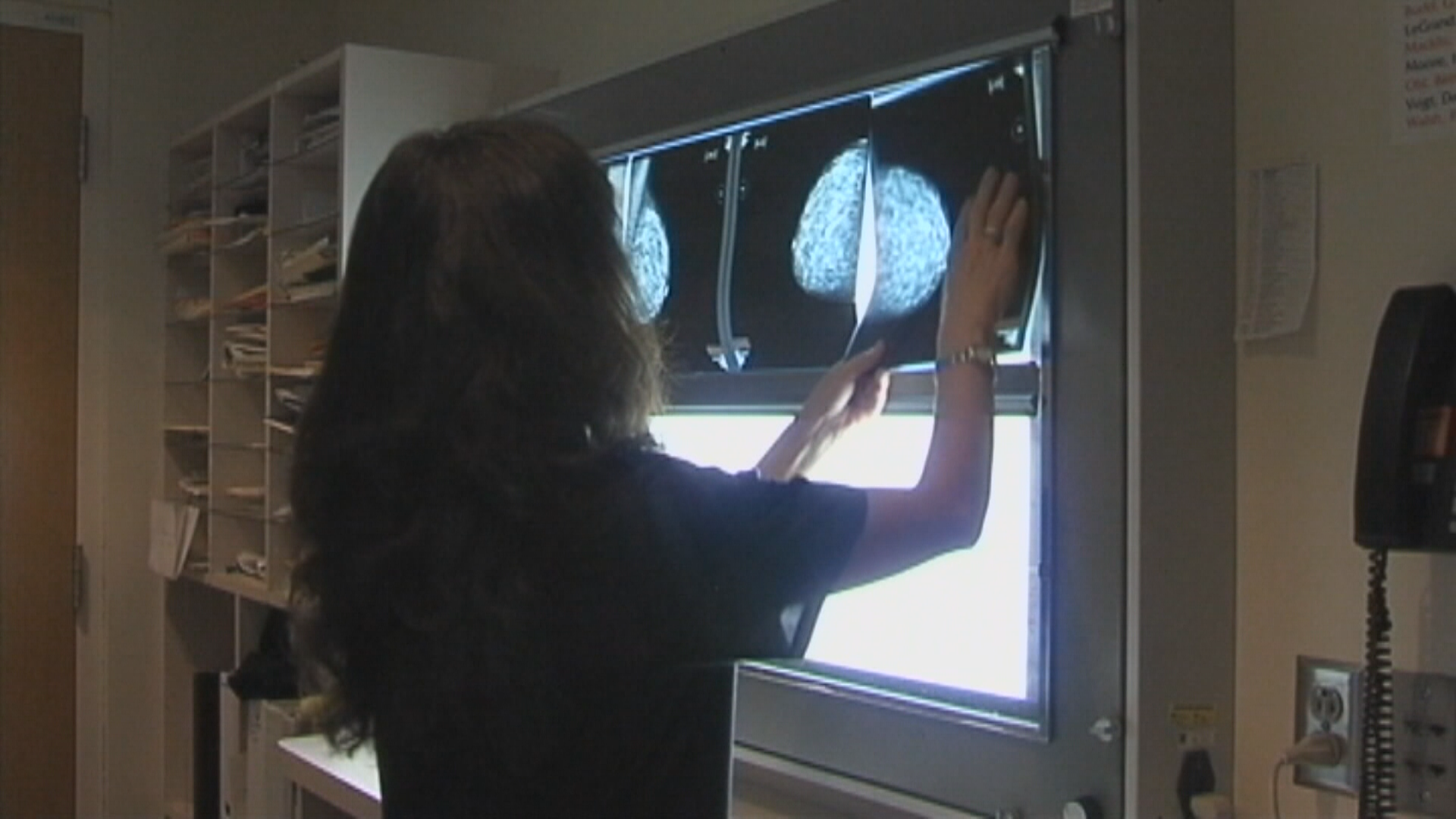
The Saskatchewan government is taking a victory lap because they’ve shipped breast cancer patients across provincial lines to Alberta. They call it an "initiative." They call it "reducing the wait list." I call it a white flag.
When a healthcare system starts outsourcing its core responsibilities to its neighbors, it isn't "innovating." It’s admitting total internal collapse. The narrative being fed to the public is one of efficiency and compassion, but if you look at the mechanics of healthcare logistics, this is a desperate, expensive, and unsustainable band-aid that masks a deeper rot. We are witnessing the "Amazon-ification" of oncology, where patients are treated like parcels to be routed to the nearest functioning fulfillment center because the local warehouse is on fire.
The Geography of Incompetence
The official line is simple: Send people to Calgary, get them seen faster, and the numbers on the spreadsheet look better. It’s a classic shell game. Moving a patient from one list to another doesn't "reduce" the wait; it just rebrands it.
Wait lists are a symptom of a capacity crisis, specifically in medical imaging and pathology. Saskatchewan isn't lacking in physical buildings; it's lacking in the specialized human capital required to operate them. By sending patients to Alberta, the government is essentially paying a premium to "rent" Alberta’s staff and equipment. This creates a massive capital flight. Instead of investing those millions into local retention bonuses, competitive salaries for radiation therapists, or modernizing Saskatoon’s diagnostic suites, the money is exported.
Every dollar spent on an Alberta hotel room for a Sask. patient is a dollar that didn't go toward hiring a technician in Regina. We are cannibalizing our own future to fix today's PR disaster.
The False Economy of "Out-of-Province" Solutions
Let’s talk about the "hidden" costs. The government highlights the cost of the procedure. They rarely talk about the logistical friction.
- Fragmented Data: When a patient gets a biopsy in Calgary and surgery in Saskatoon, the risk of data silos increases exponentially. Electronic Health Records (EHR) across provincial borders are notorious for their lack of interoperability.
- Post-Operative Complications: Who owns the patient when they get home? If a patient develops a post-surgical infection three days after returning from Calgary, they end up in a Saskatchewan ER that wasn't part of the original clinical loop.
- The Family Tax: Cancer isn't a solo sport. It requires a support network. Shifting the site of care places an immense emotional and financial burden on families who now have to navigate travel, time off work, and the isolation of a foreign city.
From a management perspective, this is a "low-trust" solution. It assumes the local system is so broken it cannot be salvaged in the short term. I’ve seen health authorities do this before—they spend so much on temporary "surge" capacity that they have nothing left for permanent infrastructure. It’s the healthcare equivalent of living in a luxury hotel because you can’t afford to fix the plumbing in your own house. It looks fancy for a week, but eventually, you go broke and you still have a broken house.
Why Your Doctor Won't Tell You the Truth
Physicians are caught in a gag order of professionalism. They want their patients seen, so they support the Alberta move because they have no other choice. But ask them about the "continuum of care."
The gold standard in oncology is a "Multidisciplinary Team" (MDT). This is where the surgeon, the radiologist, the oncologist, and the pathologist sit in a room—or at least on the same digital network—and discuss a specific case. When you bifurcate that team across 800 kilometers, the nuance of the case gets lost in the hand-off.
We are trade-offs. We are trading the quality of integrated care for the speed of fragmented care. In the world of cancer, speed matters, but it’s not the only metric. A fast diagnosis that misses a localized margin because the pathologist didn't have the full clinical history from the initial scan is a catastrophe, not a success.
The Pathology Bottleneck Nobody Mentions
The media loves to show pictures of MRI machines. They are big, shiny, and look like "science." But the real bottleneck isn't the machine; it’s the person reading the slide. Saskatchewan’s pathology crisis is the elephant in the room.
You can send 1,000 patients to Alberta for scans, but if you don't have the pathologists to process the tissue samples back home, you’ve simply moved the clog further down the pipe. We are treating the wait list like a queue at a grocery store, but it’s more like a complex manufacturing assembly line. If the station at the end of the line is broken, it doesn't matter how fast the people at the front are working.
The Dangerous Precedent of "Health Tourism"
By normalizing the export of patients, we are creating a two-tiered psychological expectation. The message to the public is: "Our local system is for minor issues; for anything serious, pack your bags."
This erodes the social contract of provincial healthcare. If I pay taxes in Saskatchewan, I expect the infrastructure to be there. Once we accept that "care is elsewhere," we stop demanding excellence at home. It gives politicians a permanent "out." They no longer need to solve the recruitment crisis for specialists; they just need to maintain a standing contract with a private clinic in another province.
This isn't a solution. It’s an admission of provincial irrelevance.
Stop Measuring the Wrong Things
The government points to "number of patients served." This is a vanity metric.
If you want to know if the system is actually improving, look at these metrics instead:
- Specialist Retention Rate: Are we keeping the oncologists we train? (No).
- Diagnostic to Treatment Interval (DTI): Not just the "wait to see a doctor," but the time from the first suspicious lump to the first dose of radiation.
- Re-admission Rates: Are these Alberta-treated patients coming back with complications?
Imagine a scenario where the millions spent on the Calgary initiative were instead used to create a "Pathology Center of Excellence" in Regina with salaries that actually competed with the private sector in the US. You wouldn't just clear the breast cancer list; you’d clear the lists for every cancer. But that takes five years and doesn't look good in a press release next week.
Politicians prefer the quick hit of "Look, we sent them to Alberta!" over the hard work of "We rebuilt our labor force from the ground up."
The Actionable Reality
If you are a patient, take the Alberta option. You have to. Your life is more important than my critique of systemic failure. But do not believe for a second that this is "good" policy.
Demand to know who is responsible for the follow-up. Ensure your Calgary records are physically in the hands of your Saskatoon GP. Do not trust the "system" to talk to itself, because it has already proven it can't even provide the service within its own borders.
We are watching the slow-motion privatization of Canadian healthcare through the back door of "inter-provincial cooperation." It’s a failure of imagination, a failure of leadership, and a failure to respect the taxpayers who were promised a local safety net.
Fix the machines. Hire the staff. Stop the export.
A province that cannot care for its own sick is not a province; it’s a waiting room.