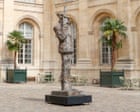
For forty years, France chose to hide its most uncomfortable mirror in the shadows. The twelve-foot bronze statue of Captain Alfred Dreyfus, sculpted in 1985 by Louis Mitelberg, was treated like a piece of embarrassing luggage. It was shunted from the Tuileries garden to a forgotten corner of the sixth arrondissement, hidden near the site of the prison where Dreyfus was first locked up. The message from the state was quiet but clear. Out of sight, out of mind.
That era of geographic exile is over. On July 12, 2026, the French government finally drops the act. President Emmanuel Macron and Paris Mayor Emmanuel Grégoire will unveil the 3.5-meter monument in its true, permanent home: Rue de Harlay on the Île de la Cité. It will stand directly in front of the Cour de Cassation, France’s highest civil court. This isn't just a change of address. It's a massive, overdue reckoning with a century-old institutional grudge.
The Long War Against a Bronze Officer
If you think a democracy can't hold a petty grudge for a century, you don't know French military history. When President François Mitterrand originally commissioned the statue in 1985, the plan was simple and logical. Put it in the courtyard of the École Militaire. That’s the exact cobblestone courtyard where, on January 5, 1895, Dreyfus was subjected to a humiliating public degradation. His insignia were ripped away, and his sword was broken over a soldier's knee while crowds shouted antisemitic slurs.
The military threw a fit. Officers vetoed the installation. They argued the courtyard was closed to the general public, but everyone knew the real reason. Even in the late twentieth century, the high command couldn't swallow the image of a Jewish officer, whom they had framed for treason, standing tall in their sanctuary. Mitterrand backed down.
Instead of facing the institution, politicians played musical chairs with the monument.
- It sat in the Tuileries for six years.
- It was kicked over to Place Pierre Lafue in 1994.
- It ended up by Boulevard Raspail, tucked away near the old Cherche-Midi prison.
Ariel Weil, the mayor of Paris Central and a descendant of the Dreyfus family, didn't hold back when describing those choices. He noted that the prevailing attitude was to place the statue in a corner of Paris where it wouldn't embarrass anyone and wouldn't be seen. Nobody wanted it there—not the family, not historians, and certainly not the artist.
The Courtroom Victory That Took 120 Years to Cement
The choice of Rue de Harlay is incredibly specific. On July 12, 1906, the Cour de Cassation officially wiped away the fraudulent conviction, completely exonerating Dreyfus. The ceremony to unveil the statue takes place on the exact 120th anniversary of that rehabilitation.
The base of the statue features a gut-wrenching line from a letter Dreyfus wrote to his wife, Lucie, while rotting in the penal colony of Devil’s Island: "If you want me to live, help me regain my honour."
Placing this monument outside the high court acknowledges that the fight for human rights and judicial truth requires a public stage, not a hidden alleyway. The Dreyfus Affair didn't just split families down the middle; it reshaped European politics. It was the raw violence of the antisemitic press during the trial that convinced a young journalist named Theodor Herzl that assimilation wouldn't protect European Jews, sparking the modern Zionist movement.
Go Beyond the Monument
If you're in Paris for the unveiling, don't just stare at the bronze figure on the Île de la Cité and call it a day. To understand the sheer scale of the institutional forgery that almost destroyed a man's life, you need to head to the Museum of Jewish Art and History (mahJ) in the Marais district at 71, rue du Temple.
The museum houses a massive archive donated directly by the Dreyfus family, including the terrifying, fabricated documents the French army used to seal his conviction. Seeing the physical evidence of a state conspiracy makes the newly relocated statue feel a lot heavier. The museum also displays an epoxy resin cast of the statue in its main courtyard, which has actually been more famous and accessible to the public than the wandering original.
Now that the genuine bronze statue occupies the literal center of Parisian civic power, the next step belongs to the public. Walk down to the Île de la Cité. Examine the broken sabre held in the statue's hands. Read the inscription. Use it as a stark reminder of what happens when nationalism and bigotry hijack the legal system. The monument is finally out of the shadows; don't let the history slip back into them.