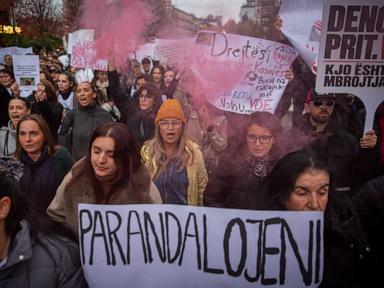
Thousands of people filled the streets of Pristina to demand immediate state accountability after eight women were killed in domestic violence incidents within a single year in Kosovo. The protests, organized largely by feminist collectives and civil rights groups, erupted following a string of high-profile murders where victims had previously reported their abusers to the police, sought protection orders, or interacted with the justice system prior to their deaths. Demonstrators marched past government buildings, police stations, and courthouses, chanting for the dismissal of negligent officials and the classification of femicide as a distinct, aggravated crime under the criminal code.
The demonstrations were not born in a vacuum. They represent the boiling point of a multi-year institutional failure across Kosovo's police, prosecution offices, and judiciary. On paper, Europe's youngest state possesses some of the most progressive legal frameworks in the Balkans regarding gender equality and domestic protection. In practice, those laws are routinely undermined by lenient sentencing, unmonitored restraining orders, and a deeply ingrained institutional culture that treats lethal domestic abuse as a private family dispute rather than a severe public safety threat.
The Anatomy of a Predictable Tragedy
When eight women die at the hands of current or former partners in a country of fewer than two million people, it ceases to be a statistical anomaly. It becomes an indictment of the state apparatus.
A pattern emerges when examining the case files of domestic homicide in Kosovo over the past several years. The murders rarely happen out of nowhere. In case after case, the victims did everything the state told them to do. They walked into police precincts. They filed formal complaints. They endured the social stigma of publicizing their abuse in tightly knit communities where family reputation is often prized above individual survival.
And then the system stalled.
Protection orders in Kosovo are frequently treated as administrative paperwork rather than urgent life-saving mandates. A judge signs a document forbidding a perpetrator from approaching a victim within a certain distance, and the court considers its immediate duty fulfilled. Yet there is virtually no active enforcement mechanism to ensure the abuser complies. Electronic monitoring bracelets, despite being legally provided for under Kosovo's legislation for years, remained largely unimplemented due to procurement delays, budgetary neglect, and bureaucratic finger-pointing between the Ministry of Justice and the police. Without physical tracking or immediate police intervention upon breach, a protection order is nothing more than a piece of paper stopping a bullet.
Why Progressive Laws Fail in Kosovo's Courts
Kosovo incorporated the Istanbul Convention directly into its constitution in 2020, giving international standards on preventing and combating violence against women direct legal applicability and priority over domestic laws. Legal scholars praised the move as a milestone for human rights in Southeast Europe. Yet constitutional amendments do not automatically rewire the minds of judges and prosecutors raised in a patriarchal legal tradition.
When domestic violence cases actually reach a courtroom, the outcomes are frequently characterized by suspended sentences, minor fines, or mandatory psychiatric treatment orders that lack clinical follow-up. Prosecutors often downgrade charges from severe bodily harm or attempted murder to lesser offenses like light bodily injury or general intimidation. This systemic minimization sends a clear message to perpetrators that the state will not impose meaningful consequences for escalating violence.
Consider the mechanics of how a typical case degrades inside the judicial pipeline:
- Initial Police Response: Officers arriving at a domestic disturbance frequently focus on de-escalation and reconciliation rather than evidence collection. Statements are taken poorly, and officers sometimes pressure victims to return home "for the sake of the children."
- Prosecutorial Delays: Case files sit on desks for months. During this window, victims face intense economic and familial pressure to withdraw their testimonies. Because prosecutors rely heavily on victim testimony rather than independent forensic or circumstantial evidence, a recantation effectively kills the case.
- Judicial Leniency: When convictions do occur, judges routinely cite mitigating circumstances—such as the perpetrator being a first-time offender, having dependents, or expressing remorse—to justify sentences below the statutory minimum.
- Failure of Inter-Institutional Coordination: Police, social workers, prosecutors, and shelter directors operate in silos. A prosecutor may not know that a suspect has violated a restraining order three times in the past month because the local precinct failed to log the breaches into a centralized database.
The Weaponization of Family Reconciliation
To understand why the justice system hesitates, one must look at the informal social structures that still govern daily life in both urban and rural Kosovo. Extended family networks often act as informal arbitration boards. When a woman reports abuse, her own relatives—and certainly her husband's family—frequently intervene to negotiate a quiet settlement.
State actors are not immune to this cultural gravity. Social work centers, which are chronically underfunded and understaffed, often lack the resources to offer a woman a viable path to independence. If a social worker cannot guarantee housing, financial support, or childcare, encouraging a woman to stay with an abusive husband begins to look, in the eyes of an overwhelmed bureaucrat, like the most practical option. It is a fatal miscalculation.
The Economic Trap Keeping Victims in Danger
Leaving an abuser requires capital. In Kosovo, where female labor force participation remains among the lowest in Europe—hovering around twenty percent—economic dependency is a primary driver of domestic entrapment.
A woman who decides to leave an abusive marriage often walks away with nothing. Despite inheritance laws that guarantee equal rights to women and men, customary practices routinely result in women renouncing their inheritance in favor of their brothers. Property is overwhelmingly registered in the names of men. Without assets, savings, or formal employment, a victim of domestic violence has nowhere to go.
State-funded shelters provide temporary refuge, typically capped at six months to a year. While the staff at these facilities often work under extreme pressure to protect residents, shelters are a bandage, not a cure. Once the allotted time expires, women are forced back into the community. Without subsidized housing programs, vocational training, or guaranteed employment quotas, many survivors are forced to return to the very homes where they were nearly killed simply to avoid homelessness and starvation for their children.
Street Protests vs Institutional Inertia
The thousands who marched in Pristina were not merely mourning the eight women killed that year. They were confronting a political class that offers condolences on social media after every murder while refusing to overhaul the institutions responsible for preventing them.
Following high-profile killings, government officials routinely hold emergency meetings, condemn the violence in strong terms, and promise systemic reform. Police commanders are occasionally suspended, and disciplinary reviews are initiated against negligent prosecutors. However, these measures rarely result in permanent removals or criminal prosecution for official negligence. Once public outrage subsides and media attention shifts to regional geopolitics or economic inflation, the promised reforms stall in parliamentary committees.
The protesters' demands have grown increasingly specific because civil society has learned that vague promises yield zero results. Activists are pushing for three concrete structural shifts:
- Criminalizing Femicide: Establishing the gender-motivated killing of women as a distinct criminal offense carrying mandatory life imprisonment without the possibility of sentence reduction for mitigating factors.
- Mandatory Accountability for Negligence: Automatic criminal investigation of police officers, prosecutors, and judges whenever a victim is killed after having previously reported her abuser to state authorities.
- Immediate Operationalization of Electronic Monitoring: Full funding and deployment of GPS tracking devices for high-risk perpetrators subject to restraining orders, transferring the burden of vigilance from the victim to the state.
The Regional Blind Spot in the Balkans
Kosovo's crisis mirrors a broader regional failure across the Western Balkans. Neighboring countries, including Albania, Serbia, North Macedonia, and Bosnia and Herzegovina, grapple with identical patterns of post-conflict militarization, illegal firearm proliferation, and weak judicial oversight.
The prevalence of unregistered weapons left over from the late-1990s conflicts plays a decisive role in turning domestic disputes into fatal shootings. When an abuser has easy access to a handgun or an assault rifle, the window between a verbal threat and a homicide shrinks to seconds. Police in Kosovo confiscate hundreds of illegal firearms every year, yet the sheer volume of unaccounted weapons means that domestic violence calls carry an acute lethality risk that police protocols fail to treat with adequate urgency.
Furthermore, international donors and European Union oversight missions have spent millions of euros over two decades training Kosovo's police and judiciary. While these programs have produced modern police academies and digitized courtrooms, they have largely failed to alter institutional incentives. Judges are still evaluated more on the speed with which they clear case backlogs than on the quality or protective efficacy of their rulings.
What Real Accountability Requires
Reforming a failing protection system does not require writing new laws. Kosovo's legal code already criminalizes domestic violence, stalking, harassment, and unlawful possession of weapons. What is missing is the political will to enforce the existing statutes against both the perpetrators of violence and the state employees who enable them through inaction.
If a police officer fails to confiscate a firearm after a domestic violence report, that officer should face immediate termination and criminal charges for dereliction of duty. If a prosecutor drops charges without conducting an independent investigation, the Prosecutorial Council must strip them of their license. If a judge issues a suspended sentence to a repeat offender who subsequently murders his partner, judicial immunity must not shield that judge from professional ruin.
Until the personal and professional cost of ignoring a woman's plea for help becomes higher for state officials than the effort required to protect her, the marches in Pristina will remain an annual ritual of grief rather than a catalyst for survival.