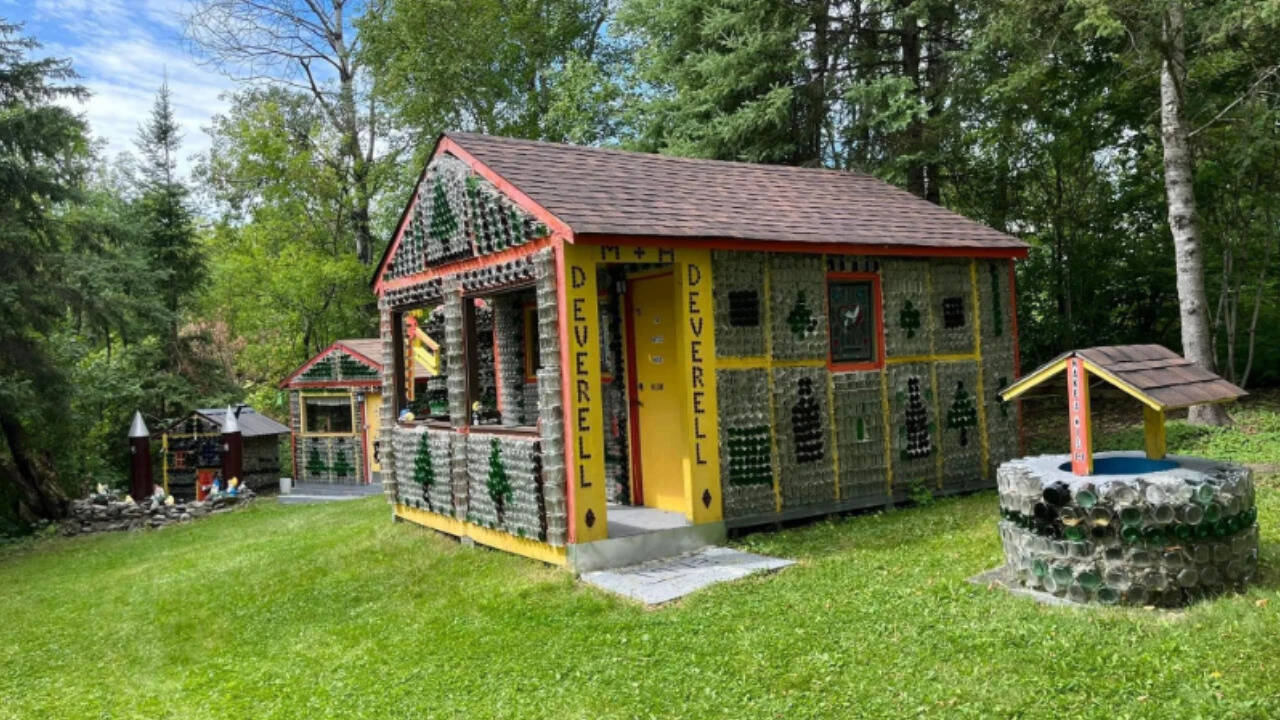
Alternative housing models frequently face a critical friction point between ideological ambition and financial reality. When a Melbourne couple commits $880,000 to construct an Earthship-style dwelling utilizing recycled bottles and tires in Tasmania, the project ceases to be a simple lifestyle shift. It transforms into an intensive capital allocation and thermal engineering case study. Analyzing this undertaking requires stripping away the novelty of bottle-and-tire masonry to examine the underlying cost functions, thermal performance mechanics, and regulatory hurdles governing radical sustainable architecture.
The Capital Allocation Breakdown
An $880,000 expenditure for an off-grid residential asset defies the conventional narrative that alternative construction offers an inexpensive escape from housing market pressures. Standard owner-builder projects driven by waste-material reuse are historically lauded for low material costs, but labor dynamics radically alter the balance sheet.
The primary cost drivers in unconventional construction diverge sharply from standard residential builds:
- Labor Intensity and Productivity Loss: Traditional materials like brick, timber framing, and drywall are standardized for rapid installation. Earthship construction relies heavily on hand-packed earth tires, bottle walls, and thermal mass stabilization. These techniques lack modular efficiency. Each tire requires meticulous back-filling and tamping to achieve structural integrity, multiplying labor hours exponentially. When professional contractors or specialized builders are brought in to meet building codes, labor costs soar, neutralizing the savings of free waste materials.
- Regulatory Compliance and Engineering Sign-Off: Municipal planning and building authorities operate on deterministic engineering standards. Non-standard load-bearing walls made of compressed rubber and glass require bespoke structural engineering assessments, specialized soil testing, and iterative architectural reviews. These ancillary professional fees add significant overhead before a single footing is poured.
- Off-Grid Infrastructure Capital Expenditure: Achieving true operational independence from municipal utilities requires heavy upfront capital investment. A robust photovoltaic array with battery storage, independent rainwater catchment and filtration systems, greywater recycling wetlands, and internal thermal mass heating systems require high-grade industrial components. These systems replace monthly utility bills with a massive upfront capital expenditure, skewing the long-term return on investment calculations.
Thermal Dynamics and Material Efficiency
The foundational premise of the Earthship design methodology is passive solar thermal performance. Understanding whether an $880,000 capital outlay yields operational efficiency requires evaluating the thermodynamic properties of the building envelope.
Earthships utilize rammed-earth tires as thermal batteries. Tires packed with dense earth absorb solar radiation during peak daylight hours through extensive north-facing glazing, storing thermal energy within the massive wall matrix. As ambient temperatures drop at night, this stored energy radiates back into the living space, stabilizing indoor temperature fluctuations without mechanical heating.
However, the efficacy of this mechanism depends heavily on local climatic variables. Tasmania's temperate maritime climate features distinct challenges:
- Solar Insolation Constraints: High cloud cover and shorter winter daylight hours reduce the total thermal energy available for capture. If the thermal mass fails to reach optimal charging temperatures during winter, the high conductivity of dense earth can actually work against the occupants, drawing internal heat outward.
- Moisture Management and Vapor Barriers: Earth and rubber composites are susceptible to subterranean moisture infiltration. Without meticulous damp-proofing and sub-surface drainage channels, moisture absorption degrades the thermal mass capacity of the walls and introduces structural degradation risks. The vapor permeability of bottle walls requires careful flashing and sealing to prevent condensation bridging.
The Scalability and Valuation Paradox
A major friction point in unconventional residential architecture is the divergence between sunk capital and market valuation. Real estate valuation models rely heavily on comparable sales data, standardized construction quality, and broad market liquidity.
When an individual injects $880,000 into a custom, highly specialized recycled-material dwelling, the asset suffers from severe liquidity constraints. The pool of prospective buyers who possess both the financial capacity to purchase an $880,000 home and the operational willingness to manage an active off-grid utility ecosystem is exceptionally narrow. Consequently, the asset often fails to command a commensurate resale value relative to its construction cost.
Furthermore, the operational maintenance burden of an Earthship differs fundamentally from a connected suburban home. Systems such as indoor greywater botanical treatment cells, solar inverter maintenance, battery cycling management, and cistern sanitization require active operational oversight. The homeowner transitions from a passive consumer to a facility manager.
Strategic Optimization for Alternative Housing
Attempting to replicate or scale an off-grid construction model requires a disciplined approach to risk mitigation and cost containment:
- Labor Arbitrage: To prevent labor costs from destroying project economics, the builder must commit to sweat equity for non-structural, repetitive tasks while outsourcing critical compliance elements like waterproofing, electrical systems, and structural framing to licensed professionals.
- Hybrid Material Selection: Pure adherence to waste materials can introduce structural inefficiencies. A hybrid framework that pairs high-performance engineered timber or insulated concrete forms for load-bearing zones with recycled bottle walls for non-structural interior partitions optimizes both thermal performance and regulatory approval timelines.
- Utility Integration Assessment: Before committing capital to total off-grid independence, run a net-present-value analysis comparing the cost of grid connection versus autonomous generation systems. In many semi-rural plots, a grid-tied solar setup with battery backup offers superior financial returns and lower operational friction than a fully isolated system.
The economic reality of high-end alternative housing is clear. Innovation in sustainable construction is valuable, but emotional attachment to waste-material aesthetics must not override structural economics. True resilience requires balancing environmental ideology with rigorous cost accounting and engineering pragmatism.