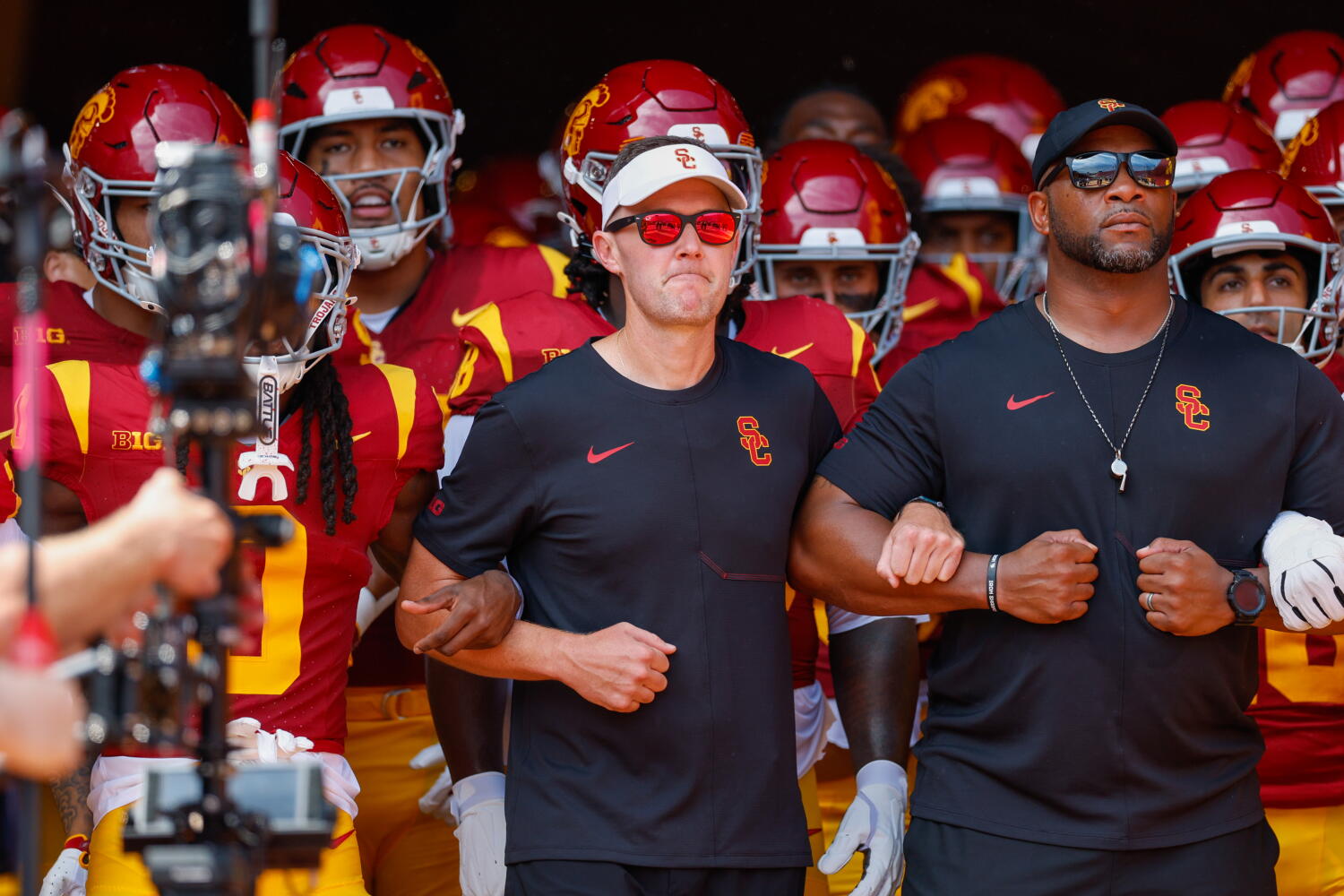
Broadcast networks do not buy sports rights for athletic aesthetics; they buy guaranteed live audience aggregation to offset linear television attrition. NBC’s willingness to anchor its Big Ten media rights investment around a Lincoln Riley-led resurgence at the University of Southern California is a calculated bet on market correction, West Coast inventory scarcity, and the elasticity of brand equity. When NBCUniversal committed hundreds of millions of dollars annually to secure the Big Ten’s primetime broadcast window, the network acquired a portfolio of Midwestern bluebloods—Ohio State, Michigan, Penn State—paired with an asymmetric growth asset in Los Angeles. For that asset to yield an acceptable return on invested capital, USC must transition from a volatile, defense-deficient program into a consistent College Football Playoff contender, and Riley is the operational lever NBC is counting on to execute that shift.
The Structural Arbitrage of the Los Angeles Media Market
To understand why a network executive in New York prioritizes a football coach in Southern California, one must examine the mechanics of television carriage and advertising yield. Los Angeles is the second-largest Designated Market Area (DMA) in the United States. Unlike Columbus, Ann Arbor, or State College—markets with near-total saturation where television ratings have a high floor but a capped ceiling—Los Angeles exhibits extreme viewership elasticity.
In a saturated college town, a 7-5 football team still commands the majority of local television households. In Los Angeles, a 7-5 football team competes against professional franchises, entertainment alternatives, and outdoor leisure, resulting in rapid audience abandonment. Conversely, when USC occupies the top ten of the national rankings, the Los Angeles DMA awakens, delivering massive incremental reach that traditional Big Ten markets cannot replicate.
NBC’s acquisition of Big Ten rights was explicitly engineered to capture this geographic expansion. By placing USC in the 7:30 PM Eastern (4:30 PM Pacific) primetime slot on Saturday nights, NBC unlocks three distinct commercial advantages:
- National Primetime Anchor: A competitive USC provides a coastal counterpoint to SEC dominance on ABC/ESPN, creating a true coast-to-coast broadcast footprint.
- Affiliate Value: NBC’s West Coast owned-and-operated stations (such as KNBC in Los Angeles) gain high-margin local advertising inventory during peak fall months.
- Peacock Subscriber Acquisition: Exclusive streaming windows featuring a revitalized USC brand serve as a direct conversion funnel for NBCUniversal’s direct-to-consumer streaming platform, reducing customer acquisition costs through live sports urgency.
This financial architecture relies entirely on competitive relevance. An unranked USC playing a mid-tier Big Ten opponent in November generates dead air for national advertisers. Therefore, NBC’s programming strategy is functionally tied to Lincoln Riley’s ability to solve USC’s on-field structural deficits.
Deconstructing the Lincoln Riley Operational Thesis
Network executives evaluate coaching hires not through the lens of scheme, but through historical conversion rates of talent to television ratings. Lincoln Riley’s track record presents a clear, quantifiable profile: elite offensive production paired with systemic defensive vulnerability.
From a broadcast perspective, Riley’s offensive methodology—rooted in Air Raid spacing, quarterback-centric efficiency, and high-tempo scoring—is an optimal television product. High-scoring games retain casual viewers through the fourth quarter, preventing the audience drop-off that plagues low-scoring, defensive struggles. Riley’s ability to develop Heisman-caliber quarterbacks (Baker Mayfield, Kyler Murray, Caleb Williams) creates individual star narratives. Modern sports broadcasting is heavily dependent on star-driven marketing; a recognizable quarterback allows NBC’s promotional department to sell a matchup to casual fans who have no affinity for institutional football history.
However, the transition from the Big 12 and Pac-12 to the Big Ten exposed a severe flaw in Riley’s operating model. During his initial tenure at USC, the program’s inability to recruit, develop, and scheme defensive line play created a hard ceiling on its championship viability. In the Big Ten, where line-of-scrimmage physicality dictates possession margins, an unbalanced roster results in late-season collapses—precisely when television ratings are most valuable.
NBC’s ongoing confidence in Riley is predicated on a specific organizational pivot: the willingness to overhaul defensive infrastructure. The hiring of defensive coordinator D'Anton Lynn from crosstown rival UCLA, alongside aggressive investments in defensive personnel through the transfer portal and Name, Image, and Likeness (NIL) collectives, signals a structural correction. If Riley’s offensive floor remains constant while the defensive unit moves from bottom-quartile nationally to top-thirty, the mathematical probability of a ten-win season increases exponentially.
The Cost Function of Program Volatility
Media rights contracts are fixed-cost obligations. NBC pays the Big Ten the same rights fee regardless of whether USC finishes 11-1 or 6-6. Consequently, program volatility acts as a direct tax on network profitability. We can map this dynamic through the lens of advertiser risk and programming efficiency.
When USC underperforms, NBC suffers a cascading series of operational inefficiencies:
- Make-Good Liabilities: Upfront advertising sales are priced against guaranteed audience delivery. If a hyped USC primetime broadcast underdelivers its projected rating due to the team falling out of contention, NBC must provide free commercial inventory ("make-goods") to advertisers in subsequent broadcasts, directly eroding profit margins.
- Promotional Sunk Costs: Networks allocate millions of dollars in cross-channel promotional inventory during the summer to establish narrative arcs for the upcoming season. When a marquee team suffers early-season losses, that promotional capital is rendered obsolete, forcing marketing teams to pivot mid-season to lower-profile matchups with weaker brand recognition.
- Sub-Optimal Flex Scheduling: The Big Ten’s television contract utilizes a draft-style selection process among NBC, CBS, and FOX. NBC frequently uses high draft picks to secure USC home games or marquee road matchups (such as USC at Michigan or Penn State at USC). If USC falters, NBC has wasted a top selection on a depreciating asset, leaving superior matchups to competitors.
Betting on a Lincoln Riley turnaround is therefore a bet on variance reduction. NBC does not necessarily need USC to win the National Championship every year; it needs USC to eliminate the four- and five-loss seasons that destroy late-season narrative equity. Consistent appearances in the expanded twelve-team College Football Playoff represent the exact threshold required to stabilize NBC’s return on investment.
The Big Ten Integration Friction and Schedule Asymmetry
A rigorous analysis must account for the structural headwinds Riley faces that did not exist during his tenure at Oklahoma or his first two years in the Pac-12. The mechanics of the Big Ten introduce three distinct friction points that threaten to delay or derail a turnaround.
The first friction point is geographic travel tax. USC’s transition into a conference anchored in the Midwest requires multiple cross-country flights per season across two or three time zones. Sports science demonstrates that circadian disruption degrades athletic recovery, cognitive reaction time, and injury resilience. A roster playing road games in State College, Columbus, or Piscataway faces cumulative physical fatigue that accumulates by November. Riley’s coaching staff must optimize sports science, hydration protocols, and travel logistics to prevent fourth-quarter physical deterioration against fresher Midwestern opponents.
The second limitation is recruiting geography realignment. Historically, USC’s competitive advantage rested on monopolizing elite high school talent within the Southern California basin. Over the past decade, national powers like Alabama, Georgia, and Ohio State successfully penetrated the California market, stripping USC of its regional moat. While Riley utilized the transfer portal to rapidly assemble top-end skill talent, sustainable Big Ten contention requires multi-year developmental depth along the offensive and defensive lines. High school linemen require two to three years of collegiate strength and conditioning before contributing at a championship level. The transfer portal rarely yields elite, plug-and-play defensive tackles, meaning Riley’s turnaround timeline is constrained by the biological reality of player development.
The third variable is NIL capital allocation. In the modern collegiate ecosystem, roster construction is an open-market auction. While Los Angeles offers immense commercial opportunities for individual player endorsements, USC’s collective infrastructure initially lagged behind entrenched boosters in the SEC and Big Ten. A sustainable turnaround requires the USC administration and donor base to maintain top-ten national liquidity in roster payroll. Without continuous capital injection to retain veteran players and acquire portal talent, Riley’s schematic advantages will be neutralized by superior aggregate talent on opposing sidelines.
Television Metrics vs. On-Field Reality
A common analytical error is conflating television viewership with competitive excellence. A brand as polarizing and historically significant as USC generates baseline curiosity regardless of record. During the 2023 season, despite USC’s late-season defensive collapse and four losses in five games, the program remained one of the highest-rated draws in college football, largely due to the presence of Caleb Williams and the spectacle of high-scoring losses.
However, relying on spectacle-driven ratings is a failing long-term strategy for a broadcast partner. Viewership driven by a team’s dramatic collapse has a short shelf life; once the narrative shifts from "championship contender" to "dysfunctional underachiever," casual viewers tune out permanently.
NBC’s analytical models distinguish between curiosity viewership and championship viewership. Curiosity viewership spikes early in the season—such as a high-profile Week 1 neutral-site matchup against an SEC opponent—and decays rapidly after a second loss. Championship viewership compounds over time, peaking in late November and December when playoff implications drive massive audience aggregation across neutral demographics.
Lincoln Riley’s mandate from a broadcast perspective is to convert USC’s reliable early-season curiosity ratings into late-season championship ratings. Achieving this requires winning ugly—securing victories in cold-weather environments when the passing game is compromised by wind or precipitation. Until Riley demonstrates that his teams can win a 17-14 game in November through defensive execution and a disciplined rushing attack, NBC’s investment remains exposed to seasonal decay.
The Strategic Play for Network and Program
The alignment between NBC and USC represents a symbiotic gamble where neither party can achieve its strategic objective independently. NBC lacks a secondary West Coast anchor of comparable scale—UCLA does not command the same national brand recognition or casual fanbase—while USC requires NBC’s national broadcast distribution to validate its Big Ten move and maximize its recruiting pitch to national prospects.
To insulate its investment and force the desired outcome, NBC must deploy its scheduling and promotional leverage aggressively while USC executes its defensive reconstruction. The network should prioritize placing USC in early-season showcase windows against historic Big Ten rivals (Michigan, Ohio State, Notre Dame) to establish immediate conference legitimacy, while protecting USC from late-season afternoon road slots in extreme weather environments whenever scheduling mechanics allow.
Simultaneously, USC’s leadership must treat defensive roster acquisition not as a supplementary adjustment, but as the primary capital expenditure of the athletic department. If Riley’s structural overhaul of the defensive staff yields a top-twenty-five unit by the second year of Big Ten play, USC will stabilize as a perennial ten-win program, validating NBC’s media rights valuation and securing the network's primetime anchor for the duration of the contract. If the defensive metrics stagnate, NBC will be forced to reallocate its prime promotional capital toward Midwestern certainty, relegating its flagship Los Angeles asset to regional irrelevance.