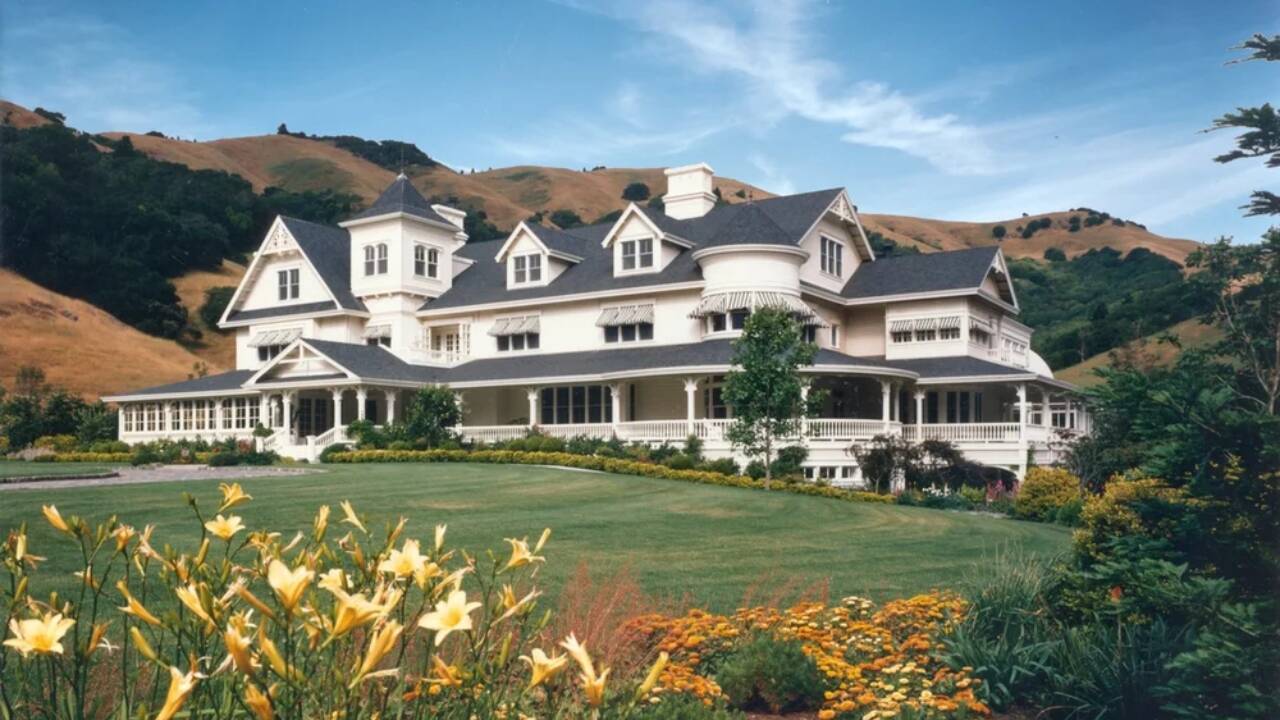
Capital allocation in the entertainment industry typically prioritizes agglomeration economies. Studios cluster within dense urban cores like Burbank or Century City to minimize transaction costs, accelerate talent mobility, and facilitate rapid information exchange. George Lucas inverted this paradigm. Beginning in 1978 through strategic parcel acquisition along Lucas Valley Road in Marin County, California, the development of Skywalker Ranch represents a deliberate capital expenditure strategy designed to internalize production externalities, insulate creative output from corporate interference, and maximize long-term asset value.
Deconstructing the facility requires evaluating its operational architecture through three distinct lenses: spatial economics, structural functionalism, and asset monetization. If you liked this article, you should check out: this related article.
The Spatial Arbitrage of Isolation
The primary economic variable governing studio operations is spatial friction. Urban production facilities trade high real estate density for proximity to talent pools, yet this proximity introduces continuous operational interruptions. Skywalker Ranch was engineered to solve an inverse problem: how to eliminate cognitive friction at the expense of geographic convenience.
Spanning over 4,700 acres, the compound exhibits an extreme land utilization ratio. Fewer than 15 acres have been structurally developed. This low-density footprint is not merely an aesthetic choice; it functions as a spatial moat. By acquiring surrounding acreage over decades—pushing cumulative land investment past the estimated 100 million dollar threshold—Lucasfilm established absolute control over the acoustic and visual envelope of the workspace. For another perspective on this event, refer to the recent coverage from Variety.
The financial mechanics of this footprint rely on long-term capital preservation rather than immediate operational yield. Traditional commercial real estate demands high turnover and maximized square footage utilization. Skywalker Ranch operates on the opposite principle: under-building the property preserves asset optionality and protects the creative workforce from external market volatility.
The Functional Cost Function of Post-Production
While frequently mischaracterized in popular media as a private residential estate for George Lucas—who maintains his primary office there but does not reside on-site—the property functions primarily as an integrated post-production ecosystem. The core economic engine of the ranch is housed within the Technical Building, home to Skywalker Sound.
The facility internalizes the entire audio post-production pipeline, housing feature mix stages, sound design suites, and editing rooms within a single secure perimeter. This integration alters the cost function of major motion picture production:
- Transaction Cost Reduction: By housing editorial, mixing, and Foley work on a unified campus, the facility eliminates the friction associated with moving assets across disparate vendor networks.
- Acoustic Isolation: The geographic isolation of Marin County provides a controlled ambient noise floor that urban studios cannot replicate without expensive structural dampening.
- Asset Longevity: The inclusion of the 300-seat Stag Theater equipped with advanced acoustic calibration ensures a standardized review environment that bypasses the quality degradation common in multi-site handoffs.
The economic model of Skywalker Sound relies on renting these specialized capabilities to third-party studios and independent filmmakers, transforming an internal cost center into a revenue-generating asset that services hundreds of external feature films and television series.
Ancillary Monetization and Vertical Integration
A high-fixed-cost asset requires secondary and tertiary revenue streams to offset ongoing maintenance liabilities. Skywalker Ranch manages this through a disciplined approach to vertical integration and agricultural yield.
The property operates as a functioning agricultural enterprise. Through Skywalker Vineyards, established in the early 1990s, the estate cultivates acreage for wine production, alongside olive groves and specialized livestock operations like Wagyu beef production. These operations convert idle pastoral land into high-margin, luxury consumer goods distributed through controlled channels, such as the General Store located at the Letterman Digital Arts Center in San Francisco.
Furthermore, the conversion of peripheral infrastructure, such as the adaptation of Big Rock Ranch into the Summit Skywalker Ranch resort facility, demonstrates a methodical shift toward high-yield corporate retreat hosting. By packaging the estate's exclusivity into an ultra-private corporate hospitality product, ownership captures economic rent from executive teams willing to pay a substantial premium for isolation and security.
The Limits of Decentralized Studio Design
Despite its structural efficiency, the operational model of Skywalker Ranch exposes distinct strategic limitations. The primary vulnerability of isolated production campuses is scaling friction.
When Lucasfilm operated its primary digital animation and corporate divisions out of Marin County, the physical separation from urban media hubs created logistical bottlenecks in talent acquisition and cross-company collaboration. This operational reality forced the strategic relocation of core business units, marketing, and the animation division to the Letterman Digital Arts Center in San Francisco's Presidio by 2005.
The lesson is stark: while specialized post-production and creative incubation thrive in sequestered, low-density environments, large-scale administrative and digital pipeline operations require the network effects of urban agglomeration. Skywalker Ranch survives not as a blueprint for mass-market studio operations, but as a specialized high-end enclave—a monument to capital deployment optimized for deep creative focus rather than corporate scale.
Strategic Forecast
As media production shifts increasingly toward distributed digital workflows and cloud-based asset management, the value proposition of physical post-production real estate undergoes structural pressure. However, ultra-prime physical facilities like Skywalker Ranch insulate themselves against commoditization by anchoring their operations around irreplaceable human capital, bespoke acoustic architecture, and absolute security. The future valuation of such assets will depend less on square footage and more on their capacity to function as secure, high-trust enclaves for elite creative collaboration that cannot be replicated in a virtual environment.