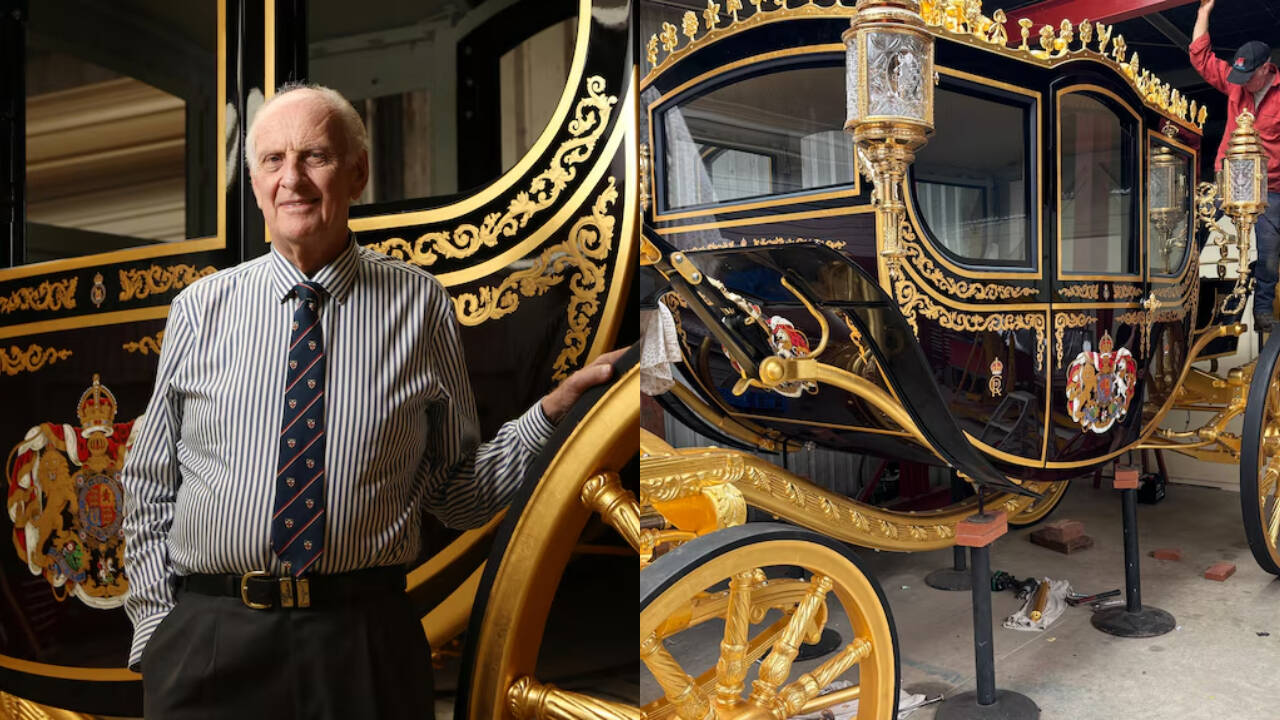
When Jim Frecklington passed away at seventy-six, he took with him an institutional memory that cannot be downloaded, digitized, or replicated by a computer-controlled milling machine. His workshop was a quiet sanctuary where time moved differently. Right now, tucked away near completion at ninety-eight percent, sits a royal carriage destined for King Charles. That final two percent is not merely a matter of applying a final coat of varnish or tightening a few stray bolts. It represents decades of accumulated tacit knowledge, a chasm that no living artisan can easily cross without confronting the ghost of a master.
The death of the world's last prominent royal coachmaker forces a brutal reckoning about how modern society treats heritage crafts. We mourn the loss of human life, but we also mourn the silent extinction of entire disciplines. When a monarch orders a state coach, the public sees gold leaf, velvet upholstery, and gleaming mahogany rolling down the Mall. They rarely see the bruised knuckles, the decades spent tracking down seasoned ash wood, or the agonizing geometry required to balance a vehicle weighing multiple tons so that it glides with the smoothness of a phantom. Frecklington was the last practitioner of a trade that bridges medieval woodworking and Victorian industrial prowess. Now, the chain is broken.
The Weight of Ninety Eight Percent
Finishing a project at ninety-eight percent sounds like a trivial hurdle to the uninitiated. Two percent remaining implies minor touch-ups, a quick polish, a final inspection. In the rarefied air of bespoke royal coachbuilding, the final two percent is where the soul of the machine lives.
Consider the tolerances required for a vehicle that must carry a sovereign over cobblestones while remaining structurally impervious to stress. Frecklington worked by eye and touch as much as by measurement. He understood how timber breathes through changing seasons, how iron forged in specific temperatures reacts to damp British air, and how suspension systems built on leather straps must be tuned like concert cellos.
When an artisan reaches ninety-eight percent completion, they possess an internal blueprint. They know why a specific joint was pegged rather than glued. They know where the hidden stress points lie. When that artisan dies with the work unfinished, the remaining two percent becomes an archaeological excavation. The workshop team left behind is forced to reverse-engineer the master's intuition. They stare at a carriage door hinge and ask themselves what Frecklington would have done when the metal resisted his file. Every remaining stroke of the brush carries the terrifying responsibility of finishing someone else's symphony without the sheet music.
The Mechanics of an Extinct Vocation
To understand why Frecklington's death leaves such a profound void, one must examine the anatomy of coachbuilding as an industry. It is not manufacturing. It is an intricate web of sub-specialties that have vanished from the modern economic register.
Coach-painting alone is an art form lost to modern automotive spray booths. A traditional royal coach requires dozens of hand-applied layers of paint and clear varnish, each cured for days and rubbed down with pumice by hand until the surface achieves a deep, liquid mirror finish. There are no shortcuts. If you rush the drying time, the finish micro-cracks under sunlight. If you use synthetic modern clears instead of traditional oil-based varnishes, the rich amber depth that gives royal carriages their historic gravitas disappears, replaced by the sterile gloss of a modern luxury sedan.
Then there is the wheelwright's craft. Wheels on a state coach are not rubber-wrapped steel rims. They are complex assemblies of seasoned English oak and ash, tensioned by red-hot iron tires shrunk onto the wood through thermal contraction. The blacksmith must calculate the exact expansion of the iron ring, hoist it glowing from the forge, and drop it onto the wooden skeleton with split-second precision. Too hot, and the wood scorches and weakens. Too cold, and the tire seizes halfway, ruining weeks of woodwork.
Frecklington was one of the very few people alive who had mastered these archaic disciplines. He did not learn them in a university lecture hall. He learned them through decades of apprenticeship, trial, failure, and obsessive dedication at the Royal Mews before striking out on his own to build masterpieces like the Australian State Coach and the Diamond Jubilee State Coach.
Patronage in an Age of Austerity
The narrative surrounding royal commissions often gets bogged down in debates over public expense and modern relevance. Critics view state coaches as costly relics of an imperial past. That perspective misses the economic and cultural engine humming beneath the pageantry.
When a master coachmaker receives a commission, money does not simply vanish into a golden carriage. It flows directly into specialized micro-economies. It keeps tanners working with traditional vegetable-tanned leathers alive. It sustains foresters hunting for ancient, twisted burls of timber that possess natural grain patterns capable of resisting splitting. It pays gilders who spend weeks hammering gold leaf thinner than a red blood cell.
Frecklington operated largely outside the safety net of corporate funding or massive institutional subsidies. His work was sustained by a rare combination of personal grit, private patronage, and a stubborn refusal to compromise on quality. When public budgets tighten and monarchies face intense scrutiny over optics, the first budget lines to feel the squeeze are ceremonial arts. Yet, once those skills die out, they cannot simply be turned back on by voting for a budget increase. You cannot buy a master coachbuilder off the shelf. You have to grow them over forty years, and the conditions that nourished Frecklington's career—generous patrons, institutional patience, and a cultural reverence for historical continuity—no longer exist in the modern marketplace.
The Inheritors of an Empty Workshop
King Charles now faces a quiet crisis of heritage. The unfinished carriage sits in the workshop as both a tribute and a challenge. Who will sign off on the final bolts? Who will take responsibility if the finish does not match the exacting standards set by the man who spent his life studying surviving royal transport in the damp vaults of London?
The apprentices and journeymen who worked alongside Frecklington are fiercely talented, but they have lost their anchor. In master-apprentice relationships, the master holds the unwritten history. He is the library. When the library burns down, the survivors are left translating fragments.
The modern world prizes speed, scalability, and digital efficiency. We build things to be updated, replaced, or discarded within a decade. A royal coach is an intentional rejection of that disposable ethos. It is built to last centuries, to outlive dynasties, to stand as a physical monument to human patience. Frecklington understood that deeply. He spent his final years wrestling with timber and gold leaf not for social media applause or quarterly earnings reports, but because he believed that objects of profound beauty anchor a society to its own history.
The carriage sits at ninety-eight percent. It will likely be finished. Someone will mix the final varnish, someone will tighten the last bolt on the leather suspension, and the vehicle will eventually roll out into the daylight for some future coronation or state procession. But the air inside that workshop will be colder. The invisible hand of the master builder will be missing from the final touches. And when that carriage finally passes cheering crowds, the gold leaf will shine under a sun that has just set on the last true master of his craft.


