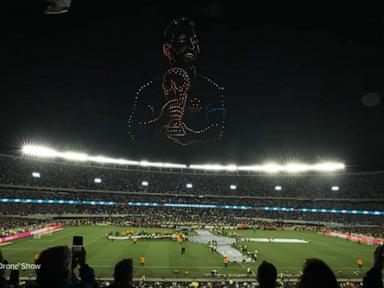
Every time a major sports victory happens now, municipal governments and corporate sponsors rush to replicate the same sterile playbook. They spend a small fortune programming hundreds of glowing plastic quadcopters to form a giant floating jersey, a crude replica of a trophy, or a pixelated face in the night sky. The media calls it a breathtaking tribute. The public eats it up on social media feeds.
It is actually a lazy, sanitized substitute for genuine cultural expression.
When Buenos Aires celebrated Lionel Messi and the national football squad with synchronized drone displays, it was heralded as the pinnacle of modern civic pride. Cities across the globe are dropping millions on these luminous light installations, believing they represent the future of public commemoration. They do not. They represent the complete outsourcing of authentic collective emotion to automated algorithms and Chinese-manufactured hardware.
We have traded the raw, chaotic, sweat-soaked energy of public squares for a glorified screen saver hovering over the obelisk.
The Illusion of Scale and the Death of Spontaneity
Look at the mechanics of a modern drone show. You have a fleet of synchronized unmanned aerial vehicles flying pre-programmed GPS coordinates, tethered to a laptop running proprietary animation software. There is no risk. There is no danger of the crowd spilling over barricades or lighting unauthorized flares. There is only a polite, corporate-approved light show that lasts precisely twelve minutes before the batteries run low and the swarm returns to its landing pads.
Real worship and true celebration require friction. They require human bodies packed shoulder-to-shoulder in the streets, blocking traffic, singing out of tune, and risking the minor chaos that comes with actual community participation. When you replace millions of screaming fans with a silent array of blinking LEDs, you remove the human element from the celebration. You turn a national deity like Messi into a corporate brand logo projected onto the night air.
Cities choose drones because they are safe, controllable, and easy to monetize. They keep crowds orderly. They prevent property damage. They give brands a clean backdrop for promotional photography. But safety is the enemy of awe. A truly memorable cultural moment cannot be pre-packaged by an events agency three weeks in advance and executed with military precision.
The Economics of Artificial Awe
Municipalities are burning taxpayer funds on these aerial light displays under the guise of economic development and tourism. Let us look at the actual balance sheet. A single high-end enterprise drone deployment for a major civic event can easily cost upwards of six figures once you factor in regulatory permits, airspace clearance, certified pilots, and equipment licensing.
For that same budget, a city could fund grassroots youth sports leagues for a decade, revitalize decaying neighborhood pitches where actual future champions learn to play, or invest in public infrastructure that benefits communities long after the batteries are dead. Instead, administrators prefer the ephemeral dopamine hit of a viral TikTok video.
It is the municipal equivalent of buying followers. It looks impressive for five seconds on a smartphone screen, but it leaves behind zero lasting cultural value. Once the lights turn off, the sky is empty, the streets are clean, and nothing has actually improved for the people living there.
What We Are Losing in the Dark
The defenders of drone entertainment argue that it is eco-friendly compared to traditional fireworks. No smoke, no loud concussions that scare pets, no cardboard debris littering the streets. This is technically true, but it misses the entire point of what made pyrotechnics culturally potent in the first place.
Fireworks are violent, loud, and unpredictable. They demand your attention because they shake the ground beneath your feet. They carry an inherent element of danger that elevates the stakes of the gathering. Drones offer none of this visceral impact. They are silent, polite, and deeply boring. They ask you to look up at the sky and admire the engineering prowess of a tech vendor rather than feel a deep, visceral connection to your neighbors.
When Buenos Aires turned its gaze upward to watch a fleet of drones draw a glowing likeness of the World Cup trophy, it felt less like a nation honoring its greatest living icon and more like a tech convention product launch. Messi didn't win the tournament by writing clean code or following a pre-rendered flight path. He won through grit, tactical improvisation, and suffering on the pitch.
Honoring that kind of greatness with a corporate tech demo is an insult to the art form.
How to Fix Public Commemoration
If cities genuinely want to honor athletic or cultural milestones, they need to stop hiring Silicon Valley-style event planners and start listening to the streets.
First, redirect the drone budgets into community-level endowments. If you want to celebrate a historic sports victory, build permanent community assets that foster the next generation. Second, embrace the chaos of organic celebration instead of trying to sanitize it out of existence. Real culture is messy, loud, and impossible to control with a remote control.
Until city councils realize that human beings are meant to connect with other human beings—not with blinking quadcopters—our public celebrations will remain cold, hollow, and utterly forgettable.
Put down the controller. Let people spill into the streets.